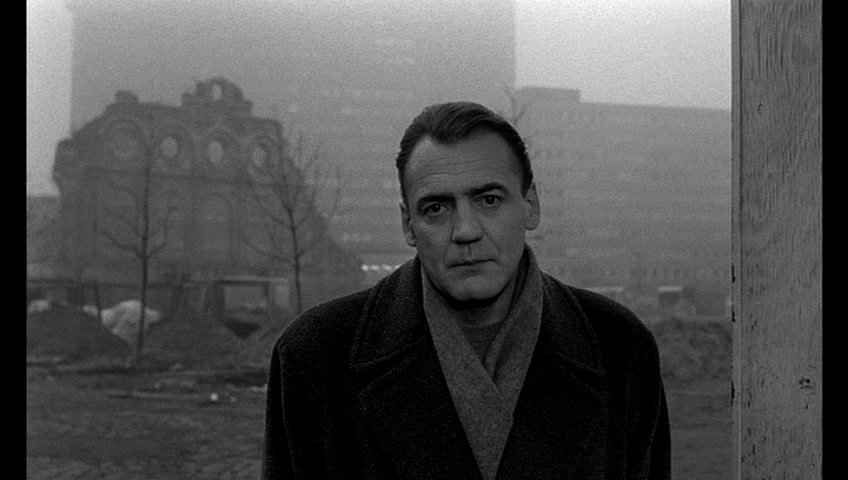
The Story:Wim Wenders' original title for Wings of Desire (his preferred English title) translates to "The Sky Over Berlin." Far be it from me to second-guess Wenders, but the original belies the Nature of the film. The skies over Berlin are an unbroken line, literally, an open air expanse through which the angels of the tale glide. But the film is one of transitions; everything is bisected and we cross over from one side to the other, breaking barriers as we move along, as easily as the angels walk through walls. We move from the angels' point-of-view to that of the street, while at the same time changing from black-and-white (angel perspective) to color (our reality). Even the city is in a state of flux, divided between West and East Berlin—it was filmed before the Berlin Wall fell—the architectures of the buildings changing, green-space being planted, slums falling, new buildings rising. Everything is changing, and the only way to survive the transition unscathed is to have the grace to fly above it all. Which is why this story of an angel who chooses this moment to make his own transition, from the spiritual to the tangible, is so special and fascinating.
Along the way, "there are so many good things," moments of poetry, both visual and aural, and everybody has their favorites: the library sequence—the angels hovering over the readers absorbing new thoughts, like it was an exquisite dish; the encounters with poor souls making the path of crossing-over; the dreams; the circus.
And then, there's Peter Falk. If there is a pivot-point for reality and fantasy, it is his performance in this film. Playing Peter Falk (he's called that on-set of the movie he's making, and he's recognized by citizens as "Lt. Columbo"), he is a real actor, playing a movie actor—himself—who also has a special connection to the angels of the film (as do children, who can see them, while the actor cannot). When Wenders offered this part—him—to Falk, I can imagine the actor hesitating for only a second, grasping it. Then, since he was pals and collaborator with John Cassavetes, well-known for on-set improvisation, Falk probably just said, "Yah, what da hell..." and did it.
It's my favorite scene in the film* (so far—I'm still studying this multi-layered gem), when we transition from an empty bus-compartment moving forward (semi-occupied by the angel Cassiel), to a scene of a humble food-stand, as the angel Damiel follows the perspective-lines of the bus on his path to tangible reality. There he encounters Falk, in town performing in a movie, taking a smoke break, getting a warm-up. Falk senses the unseen angel's presence, and engages him in conversation about the joys of life (much to the alarmed curiosity of the cook, who probably thinks this guy talking to himself, is crazy). It is this encounter that will convince Damiel to "take the plunge" in the very next scene and pursue his desires, that have wings, angels' or no.
Just another in a series of angels, spiritual beings of miracles, who choose, instead to hope, to hope, to hope.
The Set-Up: The angel Damiel (Bruno Ganz) on his rounds in Berlin, checks on some of his favorite haunts, the flying trapeze artist (Solveig Dommartin) and the actor, Peter Falk (Peter Falk). Just when he thinks Life can hold no more surprises, he discovers one more, which sets him on a solid path. Action!
Peter Falk walks through war ruins, which is intercut with Cassiel in an empty bus.
Falk stops at hot dog stand, Damiel walks by. He - and the hot dog stand-owner - stare in amazement as Falk begins to speak:
FALK: I can't see you, but I know you're here!
FALK: I feel it.
FALK: You been hangin' around since I got here.
FALK: I wish I could see your face...
FALK: ...just look into your eyes and tell you how good it is to be.
FALK: Just to touch something!
FALK: See, that's cold. That feels good!
FALK: Or, here, to smoke, have coffee. And if you do it together it's fantastic.
FALK: Or to draw:
FALK: ...ya know, you take a pencil and you make a dark line, then you make a light line...
FALK: ...and together it's a good line. Or when your hands are cold...
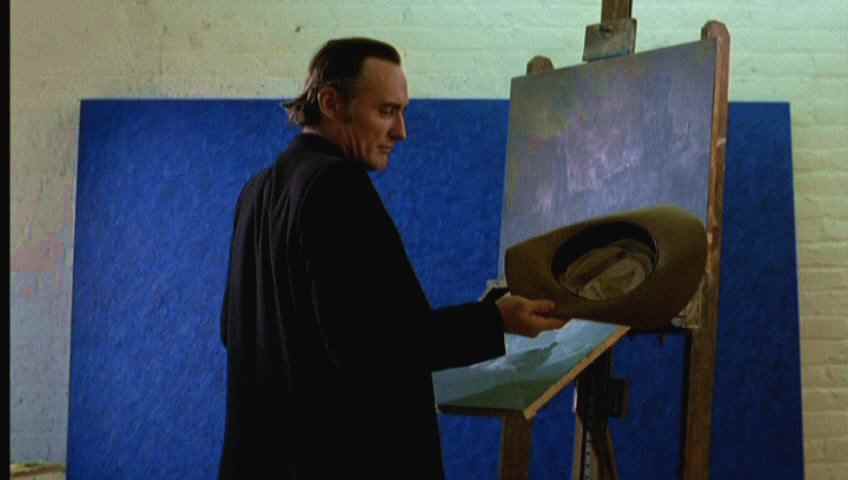
The American Friend(Wim Wenders, 1977) Of all the "Talented Mr. Ripley's" that emerged from the poison-pen of Patricia Highsmith, there was never one so unusual as this adaptation. Wim Wenders had been looking for a Highsmith property to adapt, and came up trumps—all the writings of the author of "Strangers on a Train" had been secured for adaptation. And when the elderly Highsmith met with Wenders, she was suitably impressed to present him with a prize she'd been saving, the galley of the unpublished "Ripley's Game," her third novel in the exploits of Tom Ripley, American A-type (amoral, asexual) sociopath, who's managed through murder, masquerade and machiavellian tactics to make himself a very rich, cultured man in the selling of forged paintings.
This was Hopper's first movie after the strung-out (in all meanings of the term) work he'd done as the fried photojournalist in Apocalypse Now, and the contrast couldn't be more striking. Hopper's Ripley is quiet, almost shy, highly observational—check out the once over he gives Bruno Ganz in the gallery—and highly self-reflexive.
His Ripley seems to believe that a movie is being made about him, and he's constantly recording himself, and taking self-polaroids. But, in action, his Ripley is fast, savage, uncompromising, and truly scary.
He's matched, step by clumsy step, by Bruno Ganz as the hapless picture framer, Jonathan Zimmermann, who becomes entangled in Ripley's scheme to provide for his family as he's dying.
Wenders has fun with the film, casting many directors in prominent roles, most notable to American audiences, two experts of the crime film, Nicholas Ray (he portrays Ripley's one-eyed genius of a forger) and Sam Fuller, who plays the snakish gangster at the center of the plot.
Also of note is the incredible work of director of photography Robby Müller, who manages to make every location suffuse with an unnatural glow of evil.
Ultimately, though, it is a love story. Whatever Ripley's motivations, his squiring of Zimmermann through a series of plots, murders and misadventures, secures the man a fortunate death. In the Malkovich Ripley's Game, the character celebrates his accomplishments by luxuriating in a sumptuous concert performance, but The American Friend is much more heart-breaking. Ripley observes the final act of Zimmermann on a beach, embracing a pier support, a sad, satisfied smile on his face, alone with his triumph. Simple, poignant, and a glimpse into a monster's heart, it is the one I prefer.
 The Story: Wim Wenders' original title for Wings of Desire (his preferred English title) translates to "The Sky Over Berlin." Far be it from me to second-guess Wenders, but the original belies the Nature of the film. The skies over Berlin are an unbroken line, literally, an open air expanse through which the angels of the tale glide. But the film is one of transitions; everything is bisected and we cross over from one side to the other, breaking barriers as we move along, as easily as the angels walk through walls. We move from the angels' point-of-view to that of the street, while at the same time changing from black-and-white (angel perspective) to color (our reality). Even the city is in a state of flux, divided between West and East Berlin—it was filmed before the Berlin Wall fell—the architectures of the buildings changing, green-space being planted, slums falling, new buildings rising. Everything is changing, and the only way to survive the transition unscathed is to have the grace to fly above it all.