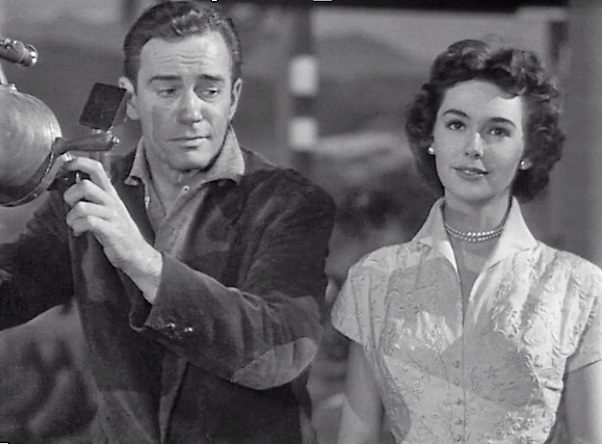
It Came From Outer Space(Jack Arnold, 1953) Before there was E.T., there was an un-abbreviated "IT." Writer and amateur astronomer John Putnam (Richard Carlson) is spending a quiet night in his desert home making lovey-dovey talk with his squeeze, teacher Ellen Fields (Barbara Rush)—frankly, she has the most earning power in this relationship—when he decides to take a look at the night sky. Well, he doesn't need a telescope to see what's coming our way. A big old flaming something-or-other comes streaking over the desert hills and crashes at the base of the desert foot-hills. Because he is so in love with his girlfriend, he decides to charter a helicopter from buddy Pete Davis (Dave Willock) to rush over to see what crashed. Hey, nothing to worry about! Little does he know that the thing is an alien space-craft, and one of its bug-eyed occupants (we'll call it "IT" for now) has exited the craft and started exploring the landing area, leaving a shimmering trail of...criminy, is that glitter? Do the "IT's" shop at Joann Fabrics?
You knows he's a 1950's writer because of the patches on his elbows. You know she's a 1950's teacher because she wears pearls.
No matter. John, Ellen, and Pete land by the crash-site at the old Excelsior mine (owned by Stan Lee, maybe?) and, interested as he is, he abandons his girl-friend and scrambles into the crater. There he finds a huge glowing orb that pulses with whatever energy or heat-waves are emanating from it. He sees what would appear to be a door at the front of it, figuring that, at that point, it's not a meteorite, but some sort of craft or device and, peering into it, he sees equipment. But, he doesn't see that he's being observed. As the door moves, it creates a small avalanche, and Putnam, no dummy, beats it out of there.
"Hmmph! Compensating for something?"
Putnam tells Ellen and Pete what he saw down there and they're a little skeptical—he should probably get used to that feeling, because over the course of the movie, nobody is going to believe what he says and they're going to think he's a kook. Doubling down on that begins almost immediately with the two most skeptical people anyone could find in a town—the sheriff (Charles Drake) and the local newspaper publisher (Alan Dexter). Putnam, still agog over what he saw, thinks nothing of telling them exactly what he saw, never once thinking "These guys could either lock me up or make me look like a loon in the paper." For a writer, he doesn't have much imagination. But, neither do police or newspapermen.
"Our town needs a soccer team..."
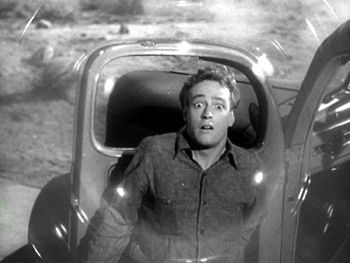
Of course, the sheriff is predisposed to think Putnam is a flake—he's had designs on Ellen for years (not that he'd let that get in the way of his job! *cough*) and things get a little uncomfortable between them...in front of the newspaper-guy, and so Putnam is persuaded to leave before things get worse and more people find out. But, on the way home, teacher Ellen gets a real education about maybe believing in what John saw down in the mine. But, now there's an IT blocking the road and they just avoid hitting it and trashing the car. When they get out to take a look—they get out and take a LOOK??!—the IT roadblock is gone, leaving only a trail of glitter like a "My Little Pony."
1950's prototype highway cameras...
After such a weird occurrence, Putnam and Ellen return to the Excelsior mine, where they find a circus of reporters, TV crews, police and scientists who are swarming all over the site. This might have been helped by that responsible newspaper publisher "fake-newsing" a front page headline that reads "Star Gazer Sees Martians." Way to vet, "Hearst." Putnam has microphones shoved in his face, but he and Ellen escape from the Press, but only after he is informed by one of the scientists that the craft is not radioactive. Good thing they're not in the Nevada desert in the '50's. They take a jaunt along the highway and scan the countryside with binoculars to see if they can see anything.
"I'm going to do a show called WHAT in the 60's?"
Along the way, they run into a couple of telephone linemen, Frank (Joe Sawyer) and George (Russell Johnson), who are working along the highway. Putnam stops and asks Frank if he's seen anything...ya know..."unusual." No, says Frank, but he's picking up weird signals over the wires. The two love-birds continue their searching while the two phone jockeys move down the line and have a close encounter—too close. George gets out of the close and while we get the IT's perspective through a "Jell-O" filter, he's enveloped by a noxious fog and collapses. Poor "Professor."
"John, why are all those people wearing red and blue glasses?" "I don't know, honey, but I'm glad I brought my pistol!"
Not finding anything up the road, Putnam and Ellen start worrying about the linemen they've left behind. They back-track and find the men's truck, abandoned, with some blood on the door. Putnam grabs his pistol (naturally) and the two start searching through the scrub, following the glitter to either find the ITs or Elton John. They don't get too far before they find George. But, George is, frankly, acting weird or—given that Russell Johnson is a pretty good thesp—acting badly. Speaking in a halting monotone, he has none of the personality of George and all of the personality of Al Gore. He is vague and unhelpful when asked about where Frank might be, but Putnam sees beyond a boulder an outstretched hand. Is it Frank? He doesn't intend to ask George or he'll probably get a lecture on carbon footprints, so they smile and act "normal" and get the Hell out of there.
Let me tell you about an Inconvenient Truth
Where do they go? The Sheriff's office. And why not? Just because he thinks you're a kook and has the hots for your girlfriend. What can go wrong? Putnam and Ellen convince Sheriff Matt to go with them because (gosh-darn it!) they have proof this time. And when they get there...the proof is gone. Even though it won't be invented for 15 years, someone has taken a Dust-Buster to the glitter. "But, we saw it, we tell you!" they argue, but the Sheriff just wants to get back to the office.
Too bad they weren't around 30 minutes earlier, when Frank woke up and saw two George's. The creature has taken on George's form, but reassures the two men that his kind would not take over their souls, their minds or their bodies. From now on in this post, we will refer to the ITs as "Xeroxians™." He tells them not to be afraid. It will only be necessary for a short time. We cut away before there are any questions about double Union wages for playing two parts.
Putnam and Ellen drive the Sheriff back to town, but they see Frank and George—or given their robotic walk and looks, their doubles. Putnam takes off after them and corners them, telling the Xeroxians that he wants to help, but asks where his friends are. He is reassured that they are alright, but to give the aliens time. "Give us time or terrible things will happen. Things you can only dream about." These guys sound like great Presidential candidates. Human beings must be like potato chips because the Xeroxians can't absorb just one. Pretty soon, they have a bunch of the township under wraps and unlike other alien probes, they're only violating their copyrights. Because he's a writer and amateur astronomer, Putnam decides to take the job of getting to the bottom of things rather than letting any professionals do it.
"Does this Jell-o filter make me look...?"
By any stretch of the imagination, It Came from Outer Space is not a great science fiction movie, although it does peg the ol' kitsch meter. So, it may come as a surprise that the story is an original treatment by Ray Bradbury, one the greatest lights in the night-sky of sci-fi. The screenplay is credited to Harry Essex, and the dialogue is sledgehammer subtle. But, the details are all Bradbury, most especially the concept that the Xeroxians are not invaders, but merely had to make an emergency landing on Earth, and are doing their best not to cause a distraction or garner attention to themselves. After all, they must think they've landed on the Planet of the Monkey-People and they're worried about being contaminated by our damn, dirty paws.
"Mischief Matters!"
Still, the psychology of the Xeroxians is a little contrived and very lucky for Earthlings. I mean, humans gets kidnapped and held hostage, sure, and their identities appropriated, but they're not exactly using their credit cards or something else heinous. However, on the Xeroxian side of the ledger, two of them get shot and immolated or dissolved, and they have no sense of regret or vengeance in any way displayed. Lucky Earthlings. Why, the Xeroxians don't even have a form a space small-pox that can cause lungs to explode to even the score.
"Who were those creatures?" "I don't know, but I wanted to thank them."
But, the Arizona Earthlings end up looking like doofi. There's not much tolerance displayed and a propensity to wave guns around, shoot first and investigate later. There's no sense of wonder but a prevailing sense of panic. And the Xeroxians? The worst you can say is they're dangerously middle-of-the-road—as in standing in it—and they have a lousy fashion sense. A black cocktail dress in the middle of the Arizona desert? Really? Still, that concept of non-hostile aliens is something of an anomaly in the science fiction firmament (although The Day the Earth Stood Still did it two years earlier), especially for a xenophobic time as the 1950's. Next week, same space, same time—another sci-fi movie with an equally reductive term for "the other."
Camera-saving VFX from the 1950's: evidently (you can tell from the left) that it was shot using a mirror.
Rancho Notorious(Fritz Lang, 1952) The old-old story of Hate! Murder! and Revenge! After hearing about this one for oh-so-many years, I finally got a chance to sit down and luxuriate a while with Rancho Notorious, a film that offers so many surprises—subtleties and Big Statements—that work-outs were had by both my jaw (dropping) and the remote, which afforded me the essential ability to go back and "look at that again." Rancho Notorious offers opportunities a-plenty for both. You don't see very many movies where people are actively snarling at each other, but then there aren't many movies like this wildly expressionistic main-stream Western directed by the master of German Expressionism Fritz Lang. Preceding High Noon by a matter of months, it also has a song-based score, but an odd one, not so "on the nose" as "Do Not Forsake Me...", but one's that's haunting and echoes through your head like a warning (as it did mine) for days. The song is "The Ballad of Chuck-a-Luck," (that was supposed to be the movie's title and there's a story for ya*) written by Ken Darby and plays over the titles and interstitially during the murder investigation that lasts the entire movie, each stanza ending with those words "Hate. Murder. And revenge." So, what's the story, pilgrim? Vern Haskell (Arthur Kennedy) is a ranch-hand in a small town in Wyoming and he only has eyes for Beth Forbes (Gloria Henry**),the girl who runs the counter at the dry-goods store. But, right after he comes a-courtin' two strangers come into town, with an eye to robbing the store, and when the one sees Beth, things go too far. She's raped and murdered by the outlaw when she screams and the two cowards escape.
Vern Haskell (Arthur Kennedy) doesn't like you
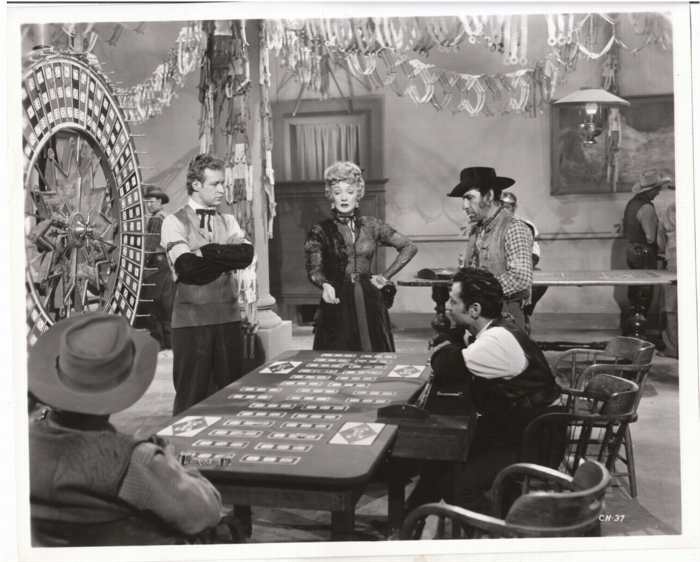
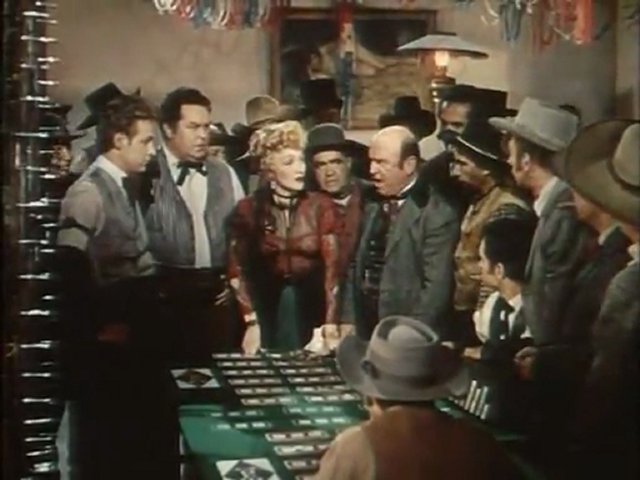
All Haskell wants is revenge, so he quits the ranch and, with a posse, heads in the direction the bastards left town. After hours of riding, the posse gives up, but Haskell refuses to stop, and soon comes across one of the men, Whitey, shot in the back by the other desperado, who only says the words "Chuck-a-Luck" to Haskell with his dying breath. Haskell travels on, gathering clues about the mysterious word that refers to a spinning "wheel of fortune" in gambling houses and a former dance hall girl named Altar Keane (Marlene Dietrich), who made a fortune on her departing spin of the wheel, and left town on the arm of the outlaw "Frenchy" Fairmont (Mel Ferrer), never to be heard of again. But, "Frenchy's" in jail, so Haskell gets himself arrested, and once behind bars, ingratiates himself with Fairmont, and gets sprung on his coat-tails. The two make their way to the Flying C Ranch, also known...as "Chuck-a-Luck," a working ranch legitimate to the world, but in secret is actually a hideout-for-hire for any outlaw willing to offer up a 10% share of their loot to Altar Keane. Quite the little operation the lady has there, and at the moment, she's full up. But she makes room for Haskell, whom she describes as "a man who stands in doorways." All the better to survey the room, looking for clues. Is it the guy who's fast with the ladies (George Reeves) with those tell-tale scars on his face? Is it the guy who keeps looking at him funny (Lloyd Gough, not credited due to The Black List), or the guy who's just funny-looking (wall-eyed Jack Elam in an early role, looking lean and mean). He decides to hang out at Chuck-a-Luck, picking up clues, laying low, making himself handy while not necessarily doing anything...illegal, until he can determine who's the right (by saying the wrong) man. It's a little bit like Poirot in spurs with a nasty disposition. Of course, today, Haskell would be expected to lay waste to the room and let God deal with the details. Here, revenge is tempered by justice and not hormones.
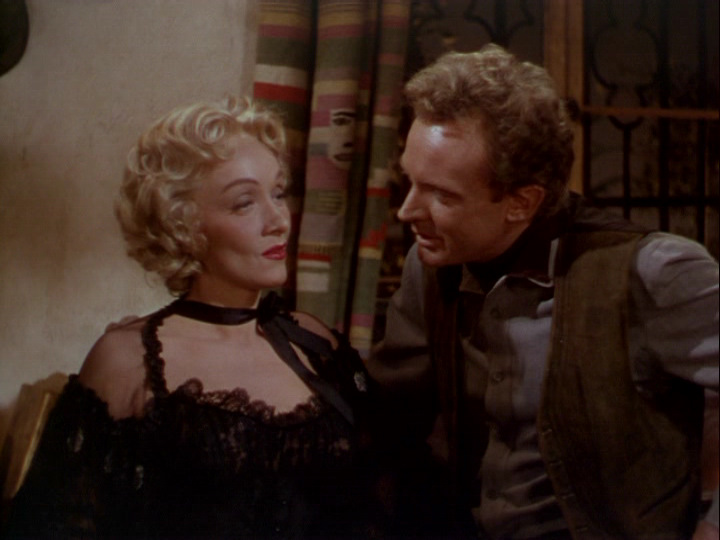
Russell Johnson and Marlene Dietrich in Rancho Notorious
Before we get onto the subject of Marlene Dietrich, we should probably discuss the wealth of character actors on the verge of hitting their defining roles: William Frawley, right before "I Love Lucy," George Reeves before "The Adventures of Superman," Mel Ferrer, only his fifth film and right before Scaramouche, Russell Johnson (Happy Birthday, sir), only his second movie, Jack Elam, Dan Seymour, John Doucette, the movie is top-heavy with great veteran character actors with recognizable faces. Then there's Dietrich. For those of a certain age (anyone born post-Blazing Saddles), one may not recognize what a force she was and continued to be throughout her career. She was the preternatural "other" woman, capable of seducing men and (pre-Code) women, one is always hesitant to call her the first feminist, but she might have been in movies, and she certainly was before it became "cool," (and she always was in the role). Put it this way, you'd never see Dietrich in a western riding side-saddle. Rancho Notorious is her slightly softened (although barely—when was the last time you saw a dance-hall girl riding the town sheriff like a horse?), in partnership with a man, and acting out of love or loyalty (always hard to say which with her), but it's her ranch and her operation, and that's something you rarely see in even the most hard-core of Westerns. And it's weird, but, in Westerns, Dietrich (sorry but it's a spoiler) always seems to take a bullet, as if the genre won't accept her (or any woman) as ruling the ranch. That would change, as film-makers got more bold.** Rancho Notorious is one of those odd Westerns of the Mainstream that took a decided bend in the river to do something else with the form. There's no pretense at naturalism (Lang wouldn't toy with that until Clash By Night), but used the familiarity of westerns to work out some interesting conflicts about gender roles (Others on that list are Nicholas Ray's Johnny Guitar, Samuel Fuller's Forty Guns, and, to a lesser extent, Hawks' Red River). It's not your usual oater. It's something different and it's recognizable from the first watch.
* The story goes that Howard Hughes wanted to change the title from "Chuck-a-Luck" and Lang wanted to know why. "Nobody'll understand it" was the reply, even though it was a familiar gambling game in the Southwest. "Okay, so what's your alternative?" Lang asked. "Rancho Notorious." came the reply. "Rancho Notorious?! Nothing's called 'Rancho Notorious' in this movie! You think anybody'll understand THAT?!" ** There was a shock for me: I remember Gloria Henry as the mother of "Dennis the Menace" on TV. Her presence was only the first of a long line of TV stalwarts who were paraded throughout Rancho Notorious—"Hey! there's...fill in the blank..." *** Ford's frontier women usually ran the ranch, but let the men think they did.