Showing posts with label Murray Hamilton. Show all posts

Tuesday, September 26, 2023

Anatomy of a Murder

Anatomy of a Murder
(
Otto Preminger, 1959) The novel of "Anatomy of a Murder" (by judge John D. Voelker and based on a 1952 murder case where he was the defense attorney) was a number one best-seller in 1958—and on the New York Times Best-Seller List for 62 weeks!—so it was fast-tracked to the movies with a tight script and un-fussy but frame-filling direction by Otto Preminger. The German producer-director shot it in one mere month and had it edited and scored ready for previewing 21 days after that. That could be the reason why the film is a whopping 161 minutes long, or it could just be that the film is so full of good stuff there wasn't anything to cut out.
 
But, "that stuff" was enough to make it controversial—and even banned in a couple places—in the U.S. of the 1950's. Preminger always enjoyed thumbing his nose at the Hays Code, and Anatomy of a Murder's constant harping on rape, torn panties, spermatogenesis, penetration, contraception and the terms "climax," "bitch" and "slut" were enough to draw people away from their televisions—where married couples couldn't sleep in the same bed—and into theaters (although star  James Stewart's own father considered it "a dirty picture").
Stewart plays, well, basically author-judge Voelker, loving the law and fishing. Retired D.A. Paul Biegler (Stewart) is enjoying a happy retirement—forced on him by being voted out of his district attorney position—of fishing and free jazz when he's approached by Laura Manion (
Lee Remick) to defend her Army Lieutenant husband, Fred (Ben Gazzara), who has been arrested for murder in nearby Thunder Bay, Michigan. The victim was a local innkeeper named Barney Quill. Meeting Mannion in prison, Biegler finds him admitting to the murder, but defends it saying that Quill raped his wife. He also claims that he has no memory of killing Quill, just the sort of detail Biegler can hook his defense on.
With his secretary sardonic Maida Rutledge (
Eve Arden) and alcoholic colleague Parnell McCarthy (Arthur O'Connell), the small consortium start doing research in the law stacks and strategizing their defense of Manion, which will entail a little manipulation of the facts...or at least some creative presentation. For instance, Manion's lack of recall lends itself to a defense precedent for temporary insanity based on "irresistible impulse"—that'll mean expert witnesses whose theories might lead to debunking by cross-examination.
Then, there's the matter of  Laura Manion, who is (shall we say?) a little "loose"—not only in her manner, but also with the facts— andcould be smeared at trial for "provoking" her attacker—the usual "tarnish the victim" strategy. So, she is coached, given a make-over, and presented in such a way at trial to be as unprovocative as possible. But, the facts of the case and Quill's attack can't be denied, try as the prosecuting team—local D.A. Mitch Lodwick (Brooks West) and stringer, big-city prosecutor April Dancer (George C. Scott, in one of his early highly acidic roles)—might, so they go after the tenuous "irresistible impulse" defense and the Manion's volatile married life. This creates a highly charged trial with Dancer's vicious cobra-like questioning and Biegler's "courtroom theatrics" thundering back and forth. One would swear 50% of the dialog consists of "Objection!" Pity the poor judge (played by Joseph N. Welch, he was made famous by the Army-McCarthy hearings—and had no shame to exploit it!).
Anatomy of a Murder is different than most of the trial depictions that 1959 audiences were used to. Saturated with previous courtroom dramas and the weekly trials of "Perry Mason" on television, viewers were seeing these things as mystery stories, with the investigating going on in real time only to have the solution revealed at the end. This one, however, already has the "whodunnit" sorted out before the first swing of the gavel. The emphasis is on debate, advocacy, counter-arguments, presentation, theatrics, and, frankly, scoring points with the jury. It's more like a real trial process is, but with better lines and better actors.
And...it's a hell of lot less boring. But, then, the law SHOULD be boring. Theatrics only muddy the head-waters to the truth. And to justice.
Scott goes in for the kill: "Barney Quill was WHAT, Miss Pilant?!"
But, it's also a movie on the cusp of change, especially with the actors, a mix of old Hollywood, young Turks, and The Method, the clashing styles all giving off friction-sparks in the proceedings. It is a genuine thrill to watch aging pro Stewart at full volume going after the intensely malevolent Scott and more than holding his own, or watch him back off and scrutinize the inscrutable performance of Gazzara. Stewart always makes it look easy, but he was a student of the acting form with a vast array of tricks in his kit-bag. He navigates the styles and generations of actors like a well-tuned sports car, constantly and smoothly shifting.
It's always a pleasure to sit back and judge Anatomy of a Murder. It sure beats jury-duty.

Tuesday, June 6, 2023

The Graduate (Post-Graduate Studies)

Ever re-visit a film from your youth and realize that it was saying something you hadn't realized at the time? The movie hadn't changed (unless it was directed by George Lucas), but you had. You'd gotten older, maybe wiser, but certainly had learned a few things as you gained time and experiences in the intervening years. The Graduate was one of those films for me. I wrote this a few years ago—but neglected to bring it over from the old blog-site—and things keep changing, but the movie—and it's message—still remains. It just wasn't the vision that was planted in my brain when I first saw it as a self-obsessed romantic youth.


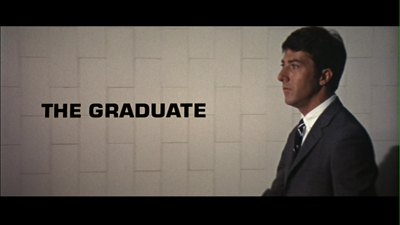
The Graduate (Mike Nichols, 1967) During the summer of 2009, the small rom/com (500) Days of Summer contained a line that hit home on many fronts. The romantic hero (says the police blotter-like narrator) formed his romantic ideas at an impressionable age due to "a mis-reading of The Graduate."

An easy thing to do.

Lots of young romantic kids—I was one of them—grooving on the surface-tension of the movie, missed Mike Nichols' (and scenarists Calder Willingham and Buck Henry's) wise, dispassionate warning of a life led for instant gratification, something that went right over the heads of a clan preparing for "The Summer of Love." When we first find Benjamin Braddock (Dustin Hoffman) he's going nowhere mighty fast: first, stuck in a plane seat, then on an airport's "moving sidewalk"—life going by, him standing still. He'll spend his first summer out of college in much the same way. His first night home, he'll be hiding in his room (to avoid his parents' celebratory welcome home party) "worried about (his) future."
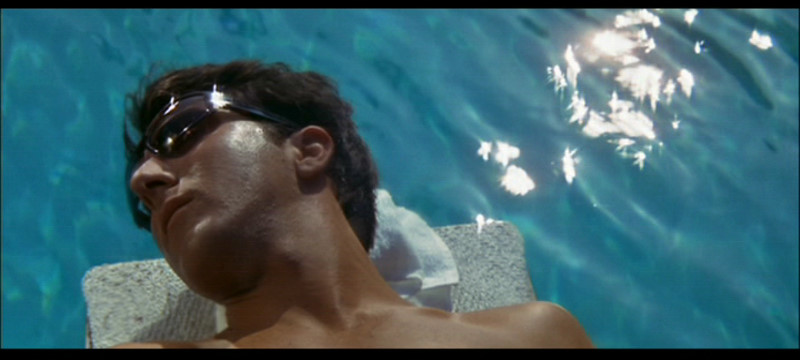
But the world will have none of it. Along with the free advice ("plastics...") and the pinched cheeks that will continue through his adulthood, Ben is coerced into driving the wife of Ben's father's partner home from the party. Once there, "things get a little weird." Dressed in her leopard-print coat,* Mrs. Robinson (Anne Bancroft) reveals herself to be quite the predator, as well as revealing that she's neurotic, alcoholic and...oh, by the way, Mr. Robinson (Murray Hamilton) won't be home for hours. Yes, as a matter of fact, she is trying to seduce him,** and Ben barely makes it home uncompromised by Mrs. and Mr. Robinson, who gets home sooner than expected.
But Ben is feeling pressure at home. Dad wants him to think about graduate school and is trying to hook him up the Robinson's daughter, Elaine (Katharine Ross). To an extent he does a little bit of both by spending time in post-graduate studies with Mrs. Robinson, who becomes fiercely adamant against Ben dating her daughter. He also finds out that the Robinsons have a marriage of convenience as she became pregnant with Elaine and that was the thing to do.
It's pretty apparent that after four years of schooling, Benjamin doesn't listen very well. Forced into a date with Elaine, he's determined to screw it up, succeeds all too well, then, having reduced her to tears, decides that he can't be that much of a heel and makes it good to her. A romance begins to take shape, but is quashed when Ben reveals to Elaine that he has had an affair with her mother.
Against all odds (or reason) Benjamin begins seriously pursuing Elaine, making it his goal, and, despite her initial reservations, culminating in a rescue at the church of her wedding, where they famously escape on a bus, having defied convention, their parents, and get things their way.
Orson Welles has said any story can have a happy ending...depending where you end it. If Nichols had ended with Ben and Elaine flush with revolution bussing away to their future, it would have been a happy ending.
But he doesn't. He stays on his shot of the two rebels as their expressions change from elation to confusion to...what? Ben has been so focused on the prize and Elaine, confused and pressured into marriage, that they don't have a plan...they don't even know where the bus is going. The story will go on, and Nichols doesn't cut away until the last moment—he lets us see their expressions change, her looking at Ben unsure, Ben just looking forward still in an adrenaline daze of what he's done.
And what he's done is risk something the whole movie has been warning against—becoming like his parents. Mrs. Robinson has aspirations and dreams that were exploded when she became pregnant with Elaine and she became dependent on a man for her well-being. Elaine, with no degree, is now dependent on
the adrift Ben and the only thing on his mind is domestic bliss, although how he'll get there, he probably doesn't have a clue. Their impulsive act of rebellion is a trap to becoming their parents. A lot of people missed that message in the 60's, but it's always been there for anybody not blinded by the comedy and the attraction of its stars.
It occurred to me (after loving the movie for 30 years) when someone professed to not liking it much because the character of Elaine is so ill-defined and confused. It is not a strong woman's part, despite its screen-time and seems more a fantasy—a screenwriter's convenience, her change of attitude towards Ben being a mystery and ultimately she trades one controlling force—her family—for another—Ben. And Ben is simply a mess—single-minded, shallow, without much motive other than selfish ones. He's very much his parents' son.
So, when (500) Days of Summer came out, with its shallow male pursuing a female through friendship and assuming forever is part of the bargain, and its female character who enjoys the friendship but doesn't see it "safe" enough to be permanent,*** the connection to The Graduate clicked, all too finally. It is a comedy (in the classical sense), as its protagonists don't even know that by pursuing their course of what they see as rebellion, they've condemned themselves to living the quietly desperate lives of their parents.
On the occasion of its 30th Anniversary, a lot of critics who could do so, re-evaluated The Graduate, and down-graded it accordingly. Given the new "reading between the frames," I'd actually up-graded as being far more subtle and wise than the comedy aspects of the film would suggest. Perhaps it's time to pay a visit to Sam Mendes' Revolutionary Road, as well.
What did "The Bard" say? "You say you want a revolution, well, you know/we'd all love to see the plan..."
"Everybody puts Benjy in the corner:" Dustin Hoffman and Anne Bancroft "Graduating"

* This was the 1960's—the term "cougar" would show up forty years later. Bancroft was only six years older than Hoffman at the time.

** We dissected this scene in "
Don't Make a Scene: The Graduate."

*** (500) Days of Summer has a telling scene, he takes her to see The Graduate and she ends up sobbing; what he sees as romantic, she sees as frightening, terrifying...and her situation.

Saturday, July 11, 2020

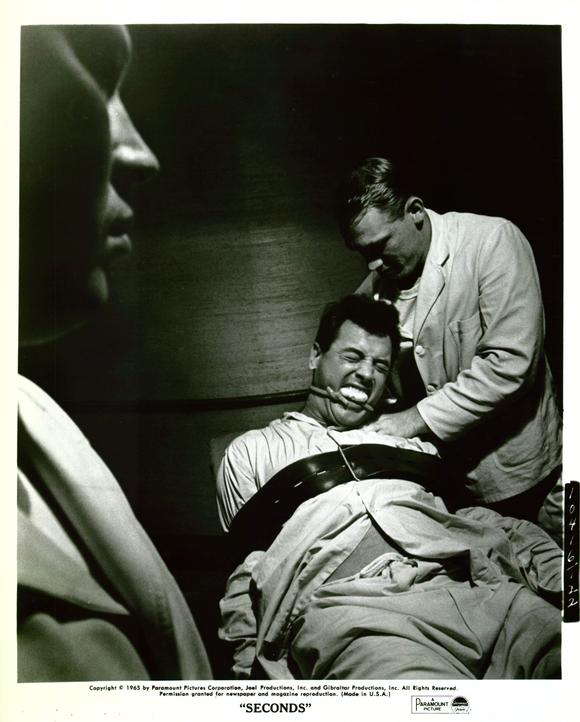
Seconds

Seconds (John Frankenheimer, 1966) Post "Star Wars," science fiction films have been pretty cookie-cutter—fleet-ships, a Hero with a Thousand Names, odd plasticized bi-ped creatures in supporting roles and quests that somehow or other usually get around to revenge. Even the "new" can become old hat.

Science Fiction used to be about concepts, and technology was just an aspect of futurism. For all the newly-conceptualized metal and plastic and wires and blinking lights, it is the organic that has to contend with the changes and evolution just can't keep up with the advancement of tools (especially when they're eventually turned into weapons). Who or what is being served? How does one adjust...if one adjusts? That's why to see Seconds is still a thrilling experience, as it calls to mind a feature-length, subtler "Twilight Zone" episode, that takes an idea and turns it around in its hand, exploring the angles...and the consequences.*
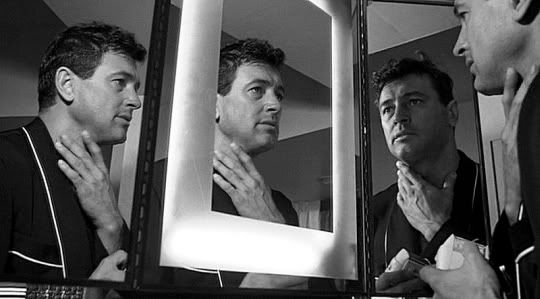
Bank executive Arthur Hamilton (John Randolph) is receiving mysterious phone-calls from someone who claims to be an old friend but doesn't sound like him. A note is slipped into his hand as he enters the subway, and upon further exploration (and prompting) learns that he is being offered a second chance in life. The anonymous corporation will transform him with plastic surgery (even replacing his finger-prints) and an exercise regimen, while setting up a planned "accident" with an unrecognizable "similar body-type" to explain his absence. To the world, he will die, but he'll be resurrected as a new man, with a new life, in a new community—everything re-arranged neatly and clinically. From the ashes of Arthur Hamilton will emerge Hamilton 2.0, Antiochus Wilson (Rock Hudson), bohemian painter. "Wilson" makes a go of his second chance, but he's still the man he used to be inside, and he struggles internally with his new choices...and the ones he left behind. Changing his mind becomes the greatest challenge.
Filmed in black and white—this film would have been over-powering and kinda ugly in color—by the master cinematographer James Wong Howe (with assistance by John A. Alonzo), Seconds is filmed in disorienting tight close-ups, and with unnerving wide-angle lenses that contort, bend and mold the right-angles of life into constricting prisons. The helter-skelter editing of David Newhouse and Ferris Webster keeps the viewer from becoming complacent, and Jerry Goldsmith's bizarre discomfiting score only adds to the unease. This is Hudson's best role—if you're like me and aren't into rom-com's—and his best movie. But it's contradictorily a one-sided performance—there's not an awful lot of joy (I think that may be the point), and he's unsure, disoriented or drunk throughout most of it. And, as Frankenheimer says in his commentary, he really worked hard in this role...especially towards the end.
One should also be aware that in one scene in the corporation's stark "briefing room," the cast is comprised of Randolph, Will Geer (he's especially creepy in this role, while being his most benevolent) and Jeff Corey—all "brethren" in the secret society of blacklisted actors.
This version of Seconds is not the one released in the States in 1966. A disorienting wine-making festival sequence with pre-hippie free-thinkers orgiastically stomping grapes in the buff was deemed too risque for its release (and Hudson wasn't comfortable with the sequence, as is evident in his performance), but it has been restored for the DVD release.

It's still an affecting film, even now, over 40 years later, a cautionary time-capsule of that era when the concerns of the speculative writer was society and not space-ships. Sometimes, fantasies have a nasty habit of becoming nightmares.

Saul Bass' disorienting Title Sequence gets you in the mood.
* Director Frankenheimer worked in the Golden Age of Live Television and worked with Rod Serling, pre-TZ, and post-TZ—Serling wrote the script for Frankenheimer's Seven Days in May.

Wednesday, September 10, 2014

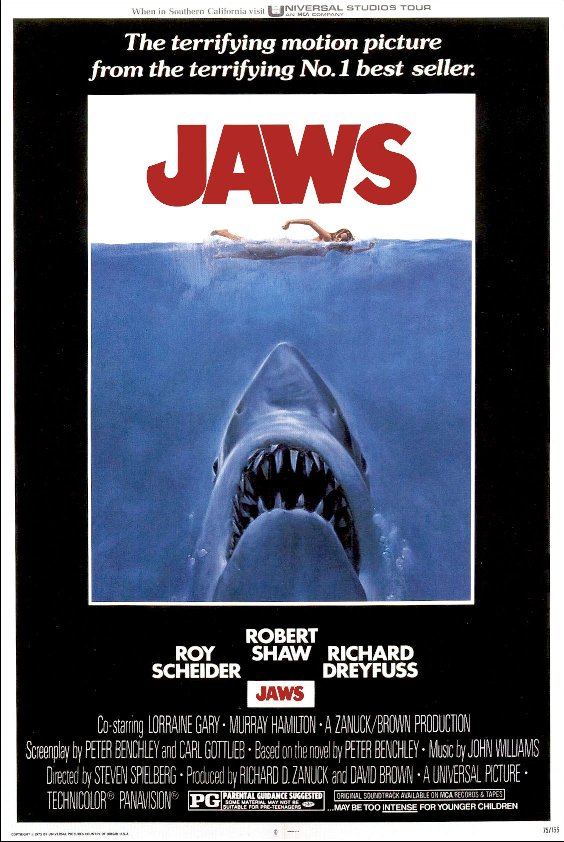
Olde Review: Jaws

I was looking at an old work-book from a UW course I took on Film (Cinema 201-Section AB) way back in 1975. The assignment was to keep a journal of films you saw/film-related things you were doing. And I found this entry for October 5 (with errors intact):

"After putting it off all Summer I went to see the summer's most lucrative film, "Jaws." Despite the fact that it was a matinee showing with what seemed like Western Washington's entire pre-teen population running up and down the aisles, and despite a projectionist whose religion must have prohibited properly framing a film, one was able to glom some sort of satisfaction out of the efforts of Steven Spielberg. I haven't seen much of Spielberg's work on television or theater (I didn't see "Sugarland Express" or many of his "Columbo" episodes) but those I have seen shows him to be a concentrator on montages, and a manipulator of audience reactions through erratic editing.

First of all, I have to say that the movie is a darn sight better than the novel it is based on. Spielberg and his screenwriters Gottlieb and Benchley have taken out the unnecessary sub-plots and gotten down to brass tacks by concentrating on the shark and its influence on the denizens of Amity. 

The first half of the film deals with the suspicions and final confirmation that there is a chomping monster out there in the water. The second half deals with the attempts of Brody, Quint and Hooper to subdue the beast. The fact that the movie is so clearly divided into two sections leaves them open to be compared with each other. As such, I prefer the first half. In this section, Spielberg moves logically from one incident to the next, playing on the suspense of the viewer. Also in this section is Spielberg's best sequence in the picture. As people mill and swim along the beach, Scheider sits on the beach watching for any shark activity in the water. Using passers-by as a blind to soften the jolt and heighten disorientation, Spielberg cuts closer and closer to Scheider as his (and our) tension mounts. Spielberg cuts back and forth between the various people of interest and Scheider, teasing the viewer with a gliding swimming cap (an example of perverse humor running throughout the film, something totally left out of the book, and an improvement) and some underwater shots of splashing limbs (a previous visual signal that the shark was ready to attack), a piece of wood floating in the water that a now-deceased dog had been retrieving. Spielberg builds until when the shark attacks, Brody's horror is shown in a "Rear Window" type of space ripping that brings Brody closer and the surrounding area farther away, separating him from his surroundings. This final scene might have been done faster for my taste, but that Spielberg thought of using it at all, is to be admired. The whole sequence is well-coordinated, tightly edited, and completely effective. As such, it is representative of the first half as a whole: logically scripted, meticulously photographed and planned, tightly edited. Of course, in the first half Spielberg concentrates on proof of the shark's existence. We never fully see it and Spielberg plays on our suspense in anticipating another attack.
With the second part, the suspense leaves. Spielberg, in the scenes in (sic) the Orca, Quint's boat, must rely on grotesque shots of the shark's maw, and sheer savagery, such as Quint being chewed alive. Subtlety leaves the picture. So does the execution that was so effective in the first part. Sequences are slip-shod, the editing, ragged and choppy (this for those action sequences in Part 2 to replace the suspense of Part 1). And Spielberg throws crisis upon crisis ("Let's see, is the boat on fire this time or is it taking on water?") Sure, the second part is tense like the first part, but it is also nerve-wracking. I reacted much more differently to Part 2 than to Part 1. The Orca sequences consisted of horrifying images and situations. I reacted with a horror that I also had from watching the various human torches in "Towering Inferno," a very inferior film, that relied solely on such horrors, for its shocks. Part 1 had much fewer than these, and instead of giving us a jolt from an unexpected violent action draws it out by making it expected and making us wait for it. Hitchcock can draw out such a scene expertly. Spielberg shows signs in Part 1 that he can also. But for now, he also must depend on sudden violence for a shock; a common weakness in films today."

Teacher's Remark: "Best treatment of the film I've yet read anywhere."


Well, as generous as that comment is, I still sound like a little snot, reading this. It's interesting to note this was at the beginning of Spielberg's career...long before he became "Dreamworks SKG"...and was still looked on as a novice film-maker, even by one such as me. And I agree with just about everything I said here. But then, Spielberg shot the film this way because he didn't have a working "mechanical shark" that he could use for the majority of the film's shooting, forcing him to use substitutes...like floating barrels, and to shoot an awful lot of peripheral stuff...and when he did use "Bruce," as the "shark" came to be known, well, it just didn't look very convincing. Hence the look and erratic nature of "Part 2"--the Orca scenes. Recall Orson Welles' line: "The enemy of art is the absence of limitations."