Showing posts with label Miriam Hopkins. Show all posts

Tuesday, April 9, 2019

Design for Living

Design for Living (Ernst Lubitsch, 1933) High class production about the bohemian class. Noel Coward's play (which had nothing to do with the bohemian class) about a menage a trois (and, by association, a menage a quatre) is given a rinse of the more suggestive parts by Ben Hecht (it's Pre-Code, so they don't go through too many cycles on this one, just to keep both the prudes and the lascivious in a lather) and an added dash of charm by director Lubitsch and cast with a collection of players that folks wouldn't have bat an eye at before, but in retrospect (given subsequent histories), is a bit unexpected.

En route to Paris, graphics artist Gilda Hopkins (Miriam Hopkins) shares a train compartment with two American down-on-their-heels artistic wanna-be's, painter George Curtis (Gary Cooper) and playwright Thomas Chambers (Fredric March), both of whom become enchanted with Gilda, and she with them (“A thing happened to me that usually happens to men. You see, a man can meet two, three, or even four women and fall in love with all of them, and then by a process of interesting elimination, he is able to decide which he prefers. But a woman must decide purely on instinct—guesswork—if she wants to be considered nice. Oh, it’s quite all right for her to try on a hundred hats before she picks one out.”) but agree with her to keep things merely friendly and professional, as she starts to act as confidante and muse for both their lives and their art. That she is also sought-after by her much-too-old boss, Max Plunkett (Edward Everett Horton) only complicates matters.
George, Thomas and Gilda decide to share a loft and make a pact of no hanky, no panky and no combination of the two, as the off-beat living arrangements create a certain amount of tension between the three. Meanwhile, Gilda uses her connections to jump-start the two men's careers. Thomas' latest play is put in the hands of a London producer, and soon, he's flying off to help with re-writes and overseeing production.

"No sex. A gentleman's agreement..."
In his absence, Gilda and George begin an affair while, in London, Tom's absence makes his heart grow fonder and he decides then and there to marry Gilda once the play opens. But running into Plunkett at the theater, he discovers that George and Gilda are now a couple, and rushes back to Paris only to find that the lovers have moved out of the loft. George, however, is in Nice working on a commissioned portrait, and so Tom seizes the opportunity to make a stand. 
"Unfortunately, I'm no gentleman."
Gilda reluctantly agrees to see Tom, and—wouldn't you know it?—she decides she's really in love with Tom and they begin an affair while George is out of town. Except, George comes back and finds the two lovers in his own penthouse love-nest and things turn ugly. It seems that three's company and two's are not to be trusted. What's a girl to do?
She complicates things, of course. Gilda decides to marry her boss, Plunkett, but the marriage cannot be consummated when George and Tom send over potted plants as gifts ("It would have been much more tactful for them to forget!") which so upsets Gilda that she hides in her room, crying. Then, at a large soiree the couple is throwing for Plunkett's clients, Tom and George crash it, making mischief wherever they go, including Gilda's bedroom, which infuriates Plunkett. The marriage is over and the three decide to move back in together.
Now, this is in the Pre-Code era before content restrictions were self-imposed on studio's, so although it may seem raunchy, everything is merely suggested. In fact, Hecht's adaptation (although Coward bitched it was hardly that) makes the trio far more relatable to the movie-going public by taking it out of the rarefied air of British manners and class, and making the two artist-types Americans. You couldn't mistake March, a deft farceur, or Cooper—still in his glamour days before he aged into more rural authenticity—for upper-crust, even if you dress them in tails. And Horton maintains his professional befuddlement. 

Hopkins, of course, has the toughest role, making her designer charming despite an inability to make up her mind and a tendency towards—dare we say it?—capriciousness (we didn't dare say it). But, it's perfectly true that she's merely playing a man's game in the sexually sampling context and the men play by the same rules. This was 1933 and it seems like (now) the only women in movies who take the same attitude are labelled promiscuous or villainous. This is progress?

The film stays light, funny, extraordinarily quotable—without any Coward—and froths with "The Lubitsch Touch." At the same time, in that time or ours, it's also a little revolutionary. Vive le révolution.


Thursday, October 6, 2016

Dr. Jekyll and Mr. Hyde (Twinned)

Private Joker: I think I was trying to suggest something about the duality of man, sir. 
Pogue Colonel: The what? 
Private Joker: The duality of man. The Jungian thing, sir. 
Pogue Colonel: ...Whose side are you on, son? 
Full Metal Jacket

"(Cocaine) enhances your personality!"  "Well, what if you're an asshole!?"
Bill Cosby from Bill Cosby, Himself

Better living through chemistry? And whose side, indeed? This Hallowe'en season we haven't been looking at monsters, and creatures and other outside forces that threaten us and make us come face to face with horror (as we have in the past). We've been looking at those that attack us from within. Not at the monsters that peer at us from outside our bedroom window, but the ones that look at us indoors in our very own mirrors. What special horror it is, when we come face to face with our enemy, and it's our own. No better example of that came from the pen of Robert Louis Stevenson in the year 1861.

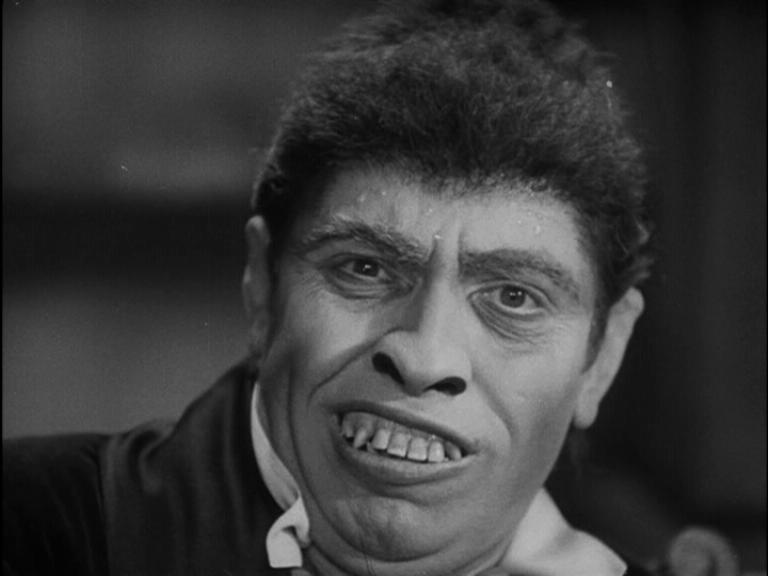
 Dr. Jekyll and Mr. Hyde (Rouben Mamoulian, 1931) A new version of Stevenson's "Strange Case of Dr. Jekyll and Mr. Hyde" seems to crop up every few years. There've been versions with John Barrymore, Basil Rathbone, Christopher Lee, Spencer Tracy (see below), and TV versions with Jack Palance and even one with Lionel Bart musical numbers that featured Kirk Douglas. But, this is the one people remember, for many reasons—first being Frederic March's portrayal (which won him an Oscar for Best Actor...in a Horror film, mind you), the effects, the outright sexiness of it (as the film was "Pre-Code,") and for director Mamoulian's stylish treatment—full of straight-on shots of the actors facing the audience, mirrored shots, and all the transformations, each one staged differently (and in a couple of instances using a combination of make-up that only becomes apparent in monochrome when struck by lights colored by different gels—with "Hyde" finally appearing as an ape-like creature in need of radical orthodentia.  March turns in an incredible performance (and he won an Oscar for it, the first actor to do so for a lead in a horror film—the second being Anthony Hopkins in The Silence of the Lambs), his Jekyll (pronounced Jee-kull as the Scottish Stevenson would have it) clearly conflicted but held in check and completely invisible in the form of the obstreperous Hyde, leaping over parapets and loudly enunciating (through those big false teeth) his intentions in a husked gravel.  When first confronting his new image in the mirror he cries "Free!  Free! At last!"


Now, in Dr. Jekyll and Mr. Hyde (Victor Fleming, 1941) the Dr. Jekyll (pronounced Jeh-kull) played by Spencer Tracy, is far more considering: "So, this is evil, then" he observes staring at his new countenance in the mirror.

Yes. Yes, it is. Tracy's Jekyll is a thinking, decent man with dark undertones, far less egocentric than the stentorian performance of March; his Hyde is shaggy dark eyebrows and hair, with a curled upper lip like a scar and a direct gaze and uncouthness, despite his pretensions of refinement. March's Hyde is a proto-human; Tracy's is just a sadistic sociopath. Jekyll's frustrations with his straight-laced potential father-in-law (Halliwell Hobbs in the first, Donald Crisp in the latter) are buried deep and Hyde releases that pent-up rage.  In the Tracy version, the intelligence is still there (as opposed to March's gleeful monkey-man) but used malevolently—the words are erudite and evenly spoken, but his actions are quick-silver and savage.  

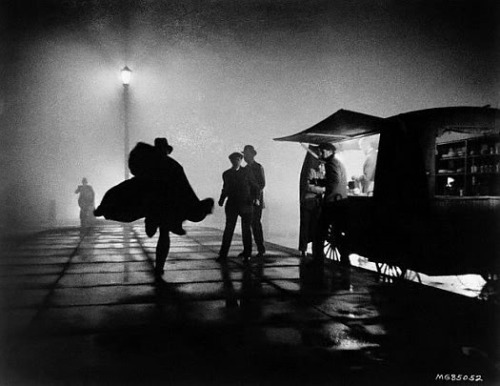
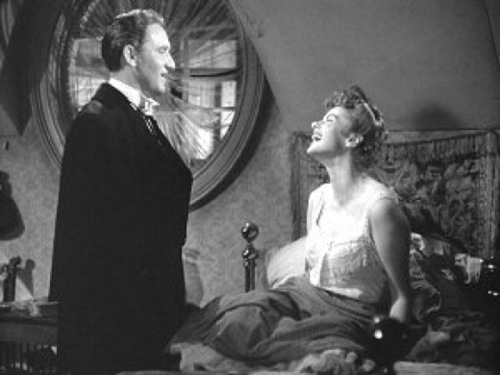
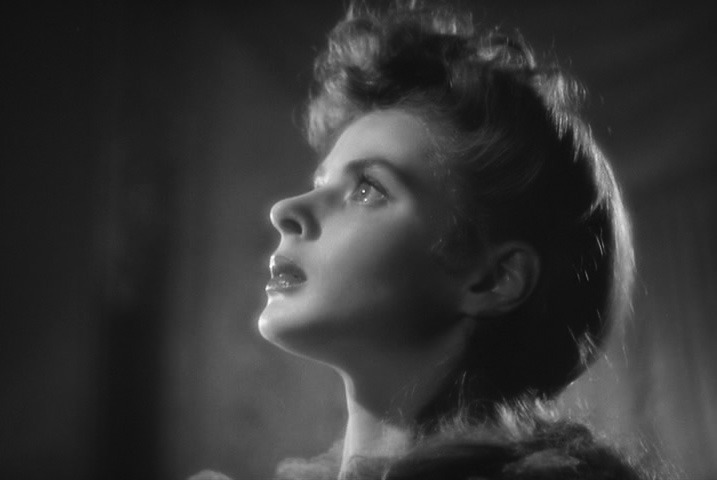
The Tracy version of the character depends less on make-up than the actor's own inventiveness (not that March was any slouch, far from it). Directed by Victor Fleming, with more emphasis on thick fog effects (where Hyde seems to be allowed to be swallowed in the thick mists, until he disappears like so much water vapor) and the psychology of evil, it is sumptuously produced and veers into the surreal during the transformation sequences. These are weirdly disturbing, shifting from surfacing lily-pads to Jekyll whipping a team of horses...which then turn into the two women in his life: his faithful fiance (played by a never-lovelier Lana Turner) and a bar-maid (a very early role for Ingrid Bergman, this one preceded Casablanca). One can only imagine the direction that the director gave his actresses for this sequence and the others ("Okay, Ingrid, you're a wine-cork, but a happy wine-cork!"). Whereas March's Hyde is all simian actions and attitudes, Tracy's is psychologically, adroitly cool, a genuinely mean bastard gleefully tripping up theater managers with his walking stick, and setting up Bergman's Ivy Petersen as a kept woman, scarring her physically and mentally. Both films stray from Stevenson's narrative, which only implies Hyde's actions, which seem to stay only in the realm of violence, but both Mamoulian's and Fleming's films features the story of the two women who suffer at the man's hands and split personalities. Bergman's performance is raw and heartbreaking, subtly letting emotions percolate under the surface of her skin, a luminous smile capable of dropping precipitously and tremulously, then escalating into hysteria. Turner's performance is pitch-perfect, but merely an ingénue role and she's not required to do too much of the tortured complexity she would display later in her career.

Mamoulian's film is fancy; Fleming's is fanciful, each taking different approaches to what is essentially the same screen-story, deviating just as far off the cobblestone streets of the novella, and each one coming to the same conclusion—different from the story's where Jekyll's fate is left in the air, seemingly condemned to live out his life as the evil Hyde—to satisfy the moralists in the audience, pre-Code or not. Interesting to see them back-to-back (to-back-to-back) and explore the similarities and differences—a bit like Jekyll and Hyde themselves.

Interestingly, these two Jekyll's, Tracy and March, squared off against each other in the courtroom drama Inherit the Wind.*

* And another parallel: March received his first Oscar nomination for playing the part of actor Tony Cavendish in The Royal Family of Broadway.  The role of Cavendish was based on John Barrymore who had a big success...playing Dr. Jekyll/Mr. Hyde in the 1920 film version.


"...Room for one more, honey?"

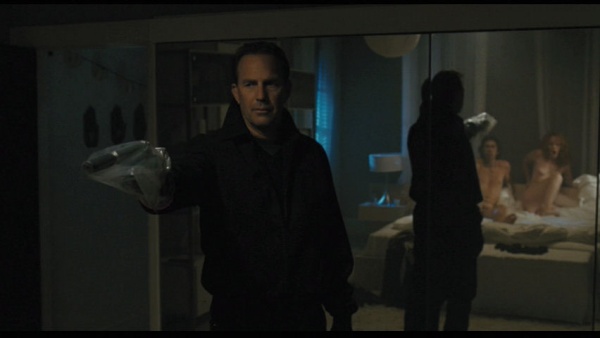
Mr. Brooks (Bruce A. Evans, 2007) A more modern take on the Jekyll/Hyde-in-plain-sight story (we won't talk about the various "Hulk" movies—the superhero version of it) is this creepy psychological thriller about another upstanding citizen and pillar of the community, Earl Brooks (Kevin Costner), CEO of a thriving box-making business. Brooks has a seemingly normal nuclear family: a loving, doting gorgeous wife (Marg Helgenberger) and a slightly spinning-out-of-orbit daughter (Danielle Panabaker), but the fourth member of the clan is the one with the most fission—the other voice in Brooks' head, Marshall, played by an on-screen William Hurt. The performances of the two men couldn't be more different: Hurt has the easier one—the all-leering, cackling, lip-smacking Id, while Costner (being in the "real" world) is restrained, cerebral, and calculating on the inside. Costner really is a fine actor, and his Brooks, in control of most situations unless Marshall convinces him otherwise, every so often goes on a killing binge that satisfies a weird craving. One entertaining aspect is that Brooks is self-aware enough of his situation to go to AA meetings. He's an addict and he knows it. But there aren't enough steps in any program to cure his issues. He's made enough of a blood-splash to attract the attention of local detectives (Demi Moore leading the investigation) and one fan-boy (Dane Cook) who wants in on the action. Earl and Marshall are caught in the middle (and with two personalities it gets very crowded in there), yinging and yanging between their two points of view and calculations. But the creepiest moments—the genuinely chilling ones—are when they combine, joining each other in a sick, twisted laugh for a shared joke, between the two personalities in the one man. For all the gruesome murders and gouts of blood on display, that's when Mr. Brooks gets really scary.