Showing posts with label Mark Damon. Show all posts

Friday, October 18, 2024

House of Usher (1960)

House of Usher
(aka The Fall of the House of Usher) (Roger Corman, 1960) Roger Corman was getting tired of the usual grind at American International Pictures—get enough budget-money to make two black-and-white movies that they could get into drive-in's or the bottom of double-bills and use that money to make one good color film (in Cinemascope...or something like it) that might attract some talent...and box office.

To his horror, he got what he wanted. And something else besides—he got an expanded shooting schedule of 15 days, "a luxury" for AIP. As other studios were making films based on the works of Edgar Allen Poe (which was in the public domain), they chose a good "bottle-story" "The Fall of the House of Usher" and secured the talents of fantasy/horror novelist Richard Matheson to come up with a screen-story based on elements of Poe. Script in hand, Corman then spent 1/3 of the film's $300,000 budget on its star Vincent Price, who lost weight for the role, dyed his hair an almost white-blonde and even shaved off his signature mustache for the part. Then to create the proper atmosphere, Corman sent a crew into the Hollywood Hills to photograph what was left of a recent wild-fire and, hearing of a local fire department burning a derelict barn, sent out a couple cameramen to get dramatic shots. That location footage would all save time and money in the special effects department. And, thriftily, be reused in later Corman films.
Phillip Winthrop (
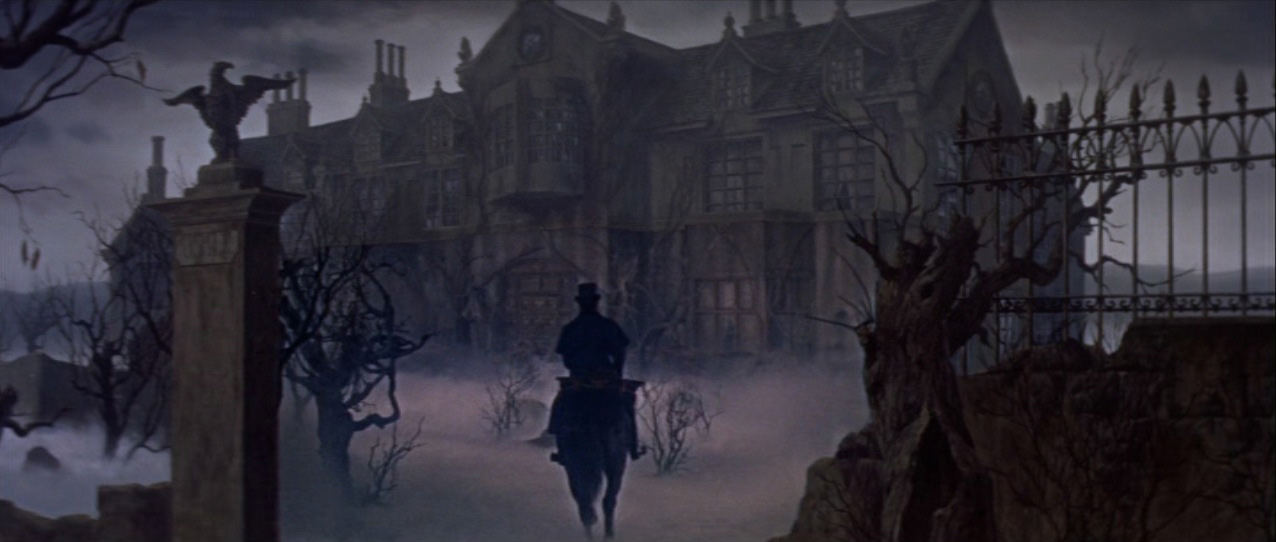
Mark Damon) rides on horseback trough the misty New England deadlands where sits the House of Usher to see his fiancee Madeline (Myrna Fahey), who parted from him at the request of her brother and only relative, Roderick (Price). Like many of the Corman Poe heroes, his audience is instantly refused, but he persists, and gaining interest, an odd request is made by the butler Bristol (Harry Ellerbe)...to remove his boots.
There's a reason, beyond preserving the carpeting. When meeting the reluctant Roderick, Winthrop's raised voice sends him into a paroxysm of agony. Roderick, you see, (and he implies Madeline) is suffering from "a morbid acuteness of the senses," due to their family history. "Mine," he explains "is the worst for having existed the longer, but both of us are afflicted with it. Any sort of food more exotic then the most pallid mash is unendurable to my taste buds. Any sort of garment other then the softest, is agony to my flesh. My eyes are tormented by all but the faintest illumination. Odors assail me constantly, and as I've said, sounds of any degree whatsoever inspire me with terror." Brother and sister, he says are like "two pale drops of fire guttering in a vast consuming darkness."
But, it goes beyond that. Roderick believes the Usher line is thoroughly cursed, so much so that the very house is crumbling as if by the weight of a generational evil—the front tower itself has a large crack in it, the land around it dead. "
This house. The pall of evil which fills it is no illusion. For hundreds of years, foul thoughts and foul deeds have been committed within its walls. The house itself is evil now." To Winthrop, these are the ravings (although quiet) of a madman, and he informs Roderick that he intends to take Madeline away and marry her—which, if the house is cursed and is going to crumble, would it be a good thing, no?
But, Roderick will have none of it. "You cannot take my sister out of this house. If she were to bear children, the Usher evil would spread - malignant, cancerous." He warns Winthrop to leave the house forever, forget Madeline, and spare himself a terrible fate. Which, of course, Winthrop has no intention of doing. He entreats Madeline to leave with him, but, in the night, she dies and Roderick has her buried in the family crypt, her coffin chained.
Roderick can't be reasoned with, but Winthrop learns from the butler Bristol, that Madeline has, in the past, suffered from cataleptic fits, leading Winthrop to fear the worst—to persuade him to leave, Roderick has taken advantage of her seizure to pretend that she is dead and has prematurely entombed her. And, at that point, there's a lot of running around and a lot of activity that, if we were staying true to Roderick's infirmities, would have paralyzed him.
Considering AIP's previous output, House of Usher looks positively sumptuous. And if most of the players are a little stiff—stiffer than Madeline becomes—Price more than compensates for it with a theatrical performance that stops short of chewing the "pallid mash" of the scenery, but luxuriates in Matheson's funereally purple prose. He's the center of the story, anyway, so his hefty chunk of the film's budget is money well-spent—if you're putting it all up there on the screen. And Corman's compositions take full advantage of the widescreen format, filling the screen with detail, despite the limitations of the budget. Those extra five days of filming he got were well worth it.
And the Poe preoccupation with premature burial (which would obsess the Corman-Poe adaptations, as well) lends just enough horror to the story that it doesn't resort to "monster-fare" as one of the producers who grudgingly approved the budget complained. The movie made over a million dollars in its initial run, more than justifying the risks taken and launching a string of nicely written, morbid dramas for many years to come.

Saturday, October 29, 2016

Black Sabbath (1963)

Black Sabbath (aka I Tre Volti Della Paura—The Three Faces of Fear) (Mario Bava, 1963) One of those Italian horror film omnibi that contracted for distribution with American International Pictures for the drive-in crowd, and one of those that eked out more than passing interest. AIP was under some condition to bowdlerize the thing to make it their own—of course, they dubbed it into English and their lab, Pathecolor, put a different tinge on things (the screencaps of the original are much more vibrant and beautiful), and Boris Karloff served as "host" (just as he'd been doing for the TV series "Thriller"), as well as appearing in one of the three segments. They also changed the order of the three stories, starting with "A Drop of Water" and ending with Karloff's turn in "The Werduluk" and made significant changes to one of them that somewhat confused the issue.

The origins of the three stories are a bit controversial, supposedly in the public domain, but not definitively. They resemble what producers would do with the later "Night Gallery" series, having the same "vibe" and conciseness to keep the shooting costs low.

The three stories were a mixed body-bag of settings and plot (although AIP did some judicious editing to try to give one of them—"The Telephone," which was a psychological thriller piece—more of a supernatural slant like the others. The one thing that unifies them is Bava's beautiful color cinematography and an elaborate production design that, at times, takes one's breath away.
"The Drop of Water"—London, 1910: Jacqueline Pierreaux plays a nurse who is called to the mansion of a medium who has died that night to prepare the body for burial. Noticing a large sapphire ring on her finger, she pockets it and notices strange things begin to happen. The medium's corpse eyes open and freaks the nurse out—the weird woman is dead but her eyes seem to be accusing her. The sound of dripping water (she has knocked a glass of water over in fright) becomes a steady rhythm and she is constantly being pestered by a fly. She goes home. The drips start again. A pestering fly appears. The lights go out. The medium's corpse appears in the bed. SHRIIIEK!
"The Drop of Water" leads the American AIP version, but it was the last of the trio in the original Italian version because it has the creepiest concept and has a steadily increasing amount of tension that finishes with a nicely open-ended coda.
"The Telephone"—Modern day, France: A high-class call-girl (Michele Mercier) —she's not acknowledged as such in the American version—returns to her apartment and gets ready for bed. The phone rings. No one's there, not even heavy breathing. She hangs up hesitantly. The phone rings again. There's someone on the other line. She hangs up. 

The phone rings again. This time the caller identifies himself as "Frank" (and at this point, the two versions diverge—in the Italian version, Frank is her former pimp who she testified against, landing him in prison, and in the American version, he's a former lover who's dead). He calls her, threatening her, and she worriedly calls her friend Mary (Lydia Alfonsi) to come over and help. Mary does so, but what Rosy (the call-girl) does not realize is that it is Mary who has been making the phone-calls, disguising her voice.
At this point, things get very confusing—the Italian version has Rosy and Mary as former lesbian-lovers, which isn't mentioned in the AIP version, and the American version has some chicanery with a letter that appears and manifests some ghostly writing. The ending remains the same, but slightly confused given the departures from the original. But, one gets the impression the main reason to have the story is to allow a lot of shots of Mercier in a negligee.
"The Werduluk" 18th Century Russia: Vladimir Durfe (Mark Damon) is on a long journey and comes across a body, with a large knife in its chest and missing its head. He secures the knife and continues on his travels.
He stops for the night at a rural inn, which is in chaos. Giorgio (Glauco Donorato) explains that the family is upset because his father Gorca (Karloff) has been missing for five days, having set off to kill a "wurdalak," a living corpse who feasts on the blood of the living. Durfe notices that the kitchen knife set is missing one piece, the very one that he recovered from the body on his travels. Giorgio offers Durfe a room for the night and begins to ask questions about what he knows, but before they become answered when Gorca enters the room, with the head of the wurduluk, which he then leaves hanging on a post in front of the cottage to warn others.
Well, that's great for outside, but what about inside? Gorca's manner is different than what his family members expect and they begin to fear that before he killed the vampire-creature, he might have been set-upon himself. Gorca's return may be the ultimate good new/bad news scenario.
Karloff displays more energy than he'd had in years and doesn't depend on his reputation to play the old vampire-hunter. In the meantime, Bava's cinematography is at its most flamboyant, letting go of realistic touches to bathe the story in experimental lighting and exotic color schemes.
The music scores differ, also: the Italian version has a more moody score, and the AIP score (by Les Baxter) "mickey-mouses" a bit, over-accentuating the shocks and surprises. If one has seen the original, the music might reduce one to giggles.

And, oh yes, speaking of music, it's where "the band" got its name.