What to post on July 4th? I've done versions of Yankee Doodle Dandy almost to death. There isn't a Capra film that feels appropriate. But a Western...I've got a couple that I want to spend a bit more time on—both dealing with the "Native Question" (not sure why there was ever a question to begin with). But, looking at some "ready-to-go" things I'd done in previous years, this one jumped out at me. A Western at a critical juncture in the Nation's History (and there's never really been a time that wasn't) when we were in danger of blowing up the results of "The Democratic Experiment" due to the same issues that destroyed past dynasties, autocracies, kingdoms, and dictatorships...even home-owner associations—the power of greed and the greed of power. You can say all people will be equal, but inevitably somebody's going to be more equal than others. And character plays a big part in how that works itself out (if you're paying attention).
Also it's a complicated story, in the way that American history—outside of the beginners' text-books—can be complicated, that tests preconceptions and prejudices. As a democracy should.
So, here is that most American of genres, the Western, directed by Taiwanese director Ang Lee, which actually seems apropos, telling the story of a nation of immigrants. It's a great movie that nobody went to see. As I said, it was "wrongfully overlooked" but also, I think, vastly underappreciated.
"On the Western frontier of Missouri, the American Civil War was fought not by armies, but by neighbors. Informal gangs of local Southern bushwhackers fought a bloody and desperate guerrilla war against the occupying Union army and pro-Union Jayhawkers. Allegiance to either side was dangerous. But it was more dangerous still to find oneself caught in the middle ..."
The story of Quantrille's Raiders and the Missouri Irregulars were a sorry part of the Civil War story, but its tales of guerilla raids between two groups, the "bushwhackers" and the "jayhawkers," criss-crossing the Kansas-Missouri border, it's history with Quantrille, Bloody Bill Anderson and Jesse James and the murderous raid on Lawrence, Kansas in 1863 have been explored, somewhat tangentially, as the first battles in the Outlaw West.Director Ang Lee may seem an odd choice for a Western of this nature, but such was the case when he directed Sense and Sensibility. Versatile, facile, and able to make universally accepted films across genres, there seems little Lee cannot succed at whether period romance (Sense and Sensibility), spy-noir (Lust/Caution), martial arts flick (Crouching Tiger, Hidden Dragon), even cross-blending sci-fi/horror and superhero movies (Hulk).
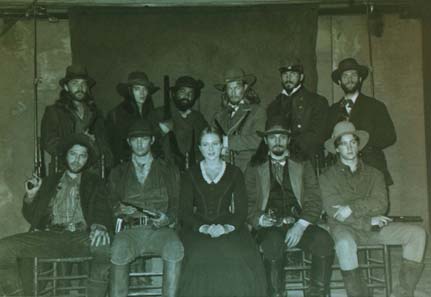
Ride with the Devil, with a screenplay by James Schamus (now head of Focus Features) was not a box-office success when it opened, perhaps as it was an unconventional western with controversial elements: four young people, Jake Roedel (Tobey Maguire), Jack Bull Chiles (Skeet Ulrich), George Clyde (Simon Baker), and Daniel Holt (Jeffrey Wright) all find themselves fighting as Confederate guerillas during the Civil War as "bushwhackers," not so much as they believe in the Southern cause—Holt is a freed slave—but because of issues with loyalty, friendship and attacks on their families. Soon, they're conducting murderous assaults on established Union positions with deadly accuracy, which Lee stages with a brutal efficiency: quick cuts, fast pace and attention to the damage a round bullet can inflict. Housed for the winter in a make-shift shelter, they are looked after by Southern sympathizers, with particular interest paid by a war-widow named Sue Lee (Jewel), who begins an affair with Chiles and offers support and food during the harsh winter. It's a nicely paced gritty portrayal of life led as an outlier, and the elements are mixed as to keep one guessing about what will happen next.The revelation here is Tobey McGuire, heretofore usually playing callow youths (which is why he was picked to play Peter "Spiderman" Parker), here he's got a versatile range of situations, starting out as a disillusioned follower, then his own man of a kind, backed by a steely gaze that turns durn creepy at times, and an "on-the-edge-of-cracking" voice that lolls over dialogue. Nice work, and Lee makes the most of him, using the boyish qualities of McGuire for moments of humor, terror and combinations of both.
Wrongfully overlooked.
 Match Point (Woody Allen, 2005) The box office was good for Match Point, Allen's first hit in years, and one wonders why. The film is accomplished and assured, simple in execution but morally complex, one of those little Woody Allen morality puzzles that update the classics (in this case, "Crime and Punishment", as well as any number of "bad-boy makes good" novels, where all you need is a compromised conscience to make it in the world). The BBC put in money, so the locations are in Great Britain (it's good to get out of New York once in awhile). The actors are young and skew to a lower movie-going demographic (although except for Scarlett Johansson, the actors are not box-office draws)--but there are no "tunes" on the soundtrack, merely ironically chosen opera extracts sung by Caruso (complete with vinyl surface noise).