or
"Heil Hitler. Etc."
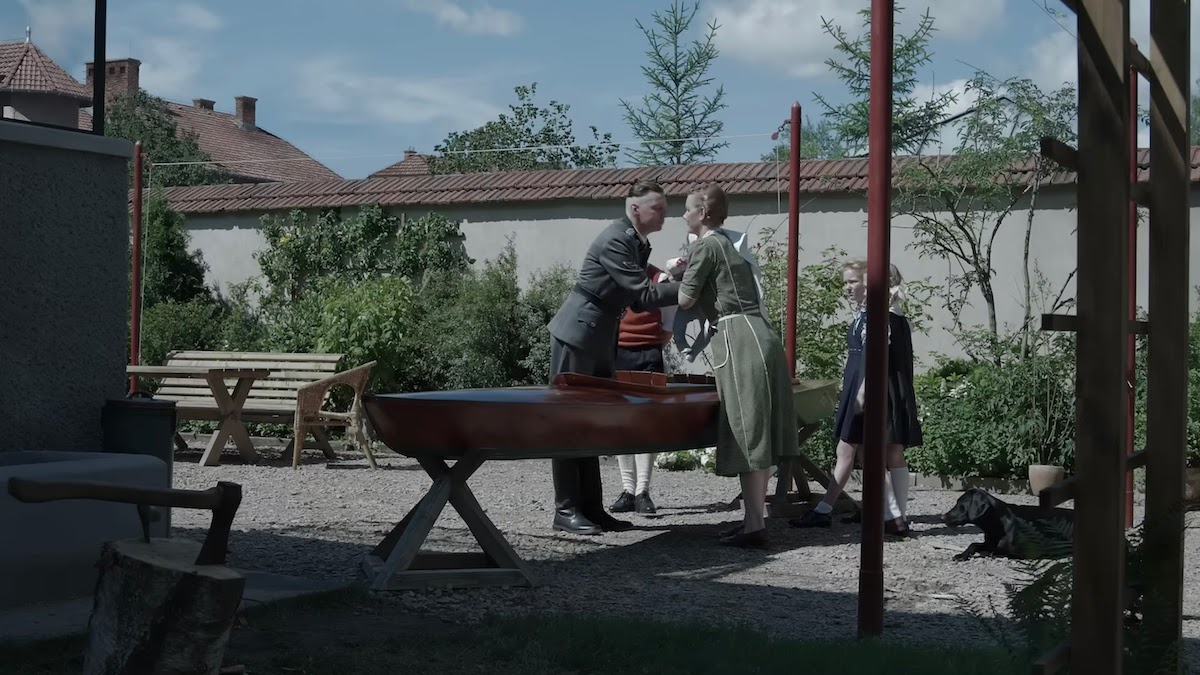
The Höss family are a typical middle class German family making their way through the second World War in 1943. They're living the good life and father Rudolf (Christian Friedel) and mother Hedwig (Sandra Hüller) are raising their five kids a stone's throw from his work. Mom tends the garden and sees to the children while keeping a close eye on the servants, all Jewish, all frail. Dad gets on his horse every day and rides to his work as commandant of Auschwitz-Birkenau.
Martin Amis—who died last year—wrote the book of The Zone of Interest, and Jonathan Glazer, who made Birth and Under the Skin, bought the rights before publication. Then, he threw out Amis' story, with its marital complications, and took the book down to its essentials, scrapping the fictional characters and replacing them with the real-life husband and wife living next to the camp that he supervised. Reality is often stranger than fiction and more horrifying, and when one looks at the situation as it was, to add anything else to it would be to reduce the significance of the basic horror of it all—to live a normal, even prosperous life, close to—and because of—a self-evident crime against humanity. To that end, he did an awful amount of research, interviewing servant-prisoners and making available all the resources he could find including at the Auschwitz museum. Life for the Höss family is pretty banal, but the true devil is in the details. Their lovely courtyard with garden and pool has a high privacy wall...but it's topped by barbed wire. The armed security tower peeks up over it, as does the smoke-stacks. The day to day maintenance of the garden is done by Jewish prisoners, and the servants are, as well, doing the cooking, cleaning, laundry, and the cleaning of blood from work-boots. There are daily deliveries of supplies, clothes, articles are picked over for what is useful—Mrs. Höss is seen trying on an elaborate fur coat, and finding a lipstick in the pocket, tries that, as well...applying it to her hand before applying it to her lips (its source, not used directly for being considered toxic). Her son, at bed-time, examines his collection of gold-laden dental-bridges.
 As segregated as the family is from the horrors from which they prosper, the atrocities, though out of sight, can never be out of mind (Höss locks the doors every night, despite so many guards). The Zone of Interest has an intricate sound-scape—starting with an overture of sorts—over a black screen a chorus of voices, echoing strings...and whispers...emanate for minutes, sensitizing us to what will be an ever-presence of aural clues to the horrors that can't be entirely drowned out. Amidst bird-sounds and conversation, are rumbles of trains, furnaces roaring, dogs aggressively barking, shouted commands, gun-shots...and in one instance screaming. It becomes part of the fabric of life, omnipresent, noticeable when a new sound escapes.
 So, what's the plot? What's it about? Not much. And a lot. Day-to-day living and day-to-day dying. Hedwig's Mother comes by for a visit and marvels at the house and the garden ("Of course, I like it. How could I not? You really have landed on your feet, girl"), but the glow emanating from the smokestacks and the noises disturb her sleep and she cuts her visit short.
  Rudolf, who is supervising the construction of a newer more efficient crematorium, is doing such a good job with his "numbers" that he is being sent to a better position in Oranienburg—"structural changes" he's told; Hedwig is extremely upset and refuses to move with him from the paradise they've made for themselves ("They'd have to drag me out of here! Everything we want at our doorstep!"). He goes and is put in charge of all the concentration camps—they have to step things up as transports are now coming from Hungary.
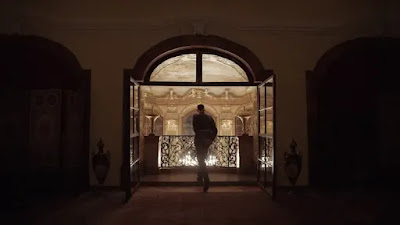 A celebration is made with dancing and music, but on a phone-call back home, Hoss admits that viewing the party from a balcony "I was just trying to figure out how much gas it would take to kill everyone because of the high ceilings."


Some of the most extraordinary sequences are photographed using thermal imaging. Under the cover of darkness, a local girl hides fruit and other comestibles in the construction sites of the camp for the prisoners to find...at one point, she finds a piece of music hidden in a tin-can, takes it home and plays it on her piano. These scenes are eerie, like watching undeveloped negatives, their acts of charity in stark contrast to the scenes of indifference to suffering that are shown in full-color.

It's almost like there are two movies going on: the one Glazer made and the one that goes through your head as you're watching it, filling in the information that the movie leaves out—the awareness of the extermination on an industrial scale, the conditions all well documented and preserved for our education and as a reminder to never again walk that path to Hell (Glazer shows us the museum in the present day and even that sequence fills one with a sickening irony that makes one realize that even good intentions can have unforeseen consequences). The audience is left to fill in the blanks, a co-conspirator to the filmmakers' intentions to show just how commonplace true evil can become when it is ignored, or, worse, to somebody's benefit.
 One walks out of the movie a little numbed—isn't that the point? It is ironic from beginning to end, with no limit to its repercussions as far as a person's responsibility to the plights of others. You may be reading this on a cell-phone made in a factory that is basically a sweat-shop, where the workers are making nowhere near a living wage and no thought given to the safety of those workers. The computer I'm typing this on might have been, as well.

We are all complicit in some way, if we go about our daily lives without consideration of others going about theirs. You cannot look at a scene in which human ash is used as fertilizer in a garden and not be horrified. And beyond that, to thinking that the human race, for all its accomplishments and marvels, can still surprise and shock with its capacity to undermine itself as just another animal, using its intellectual prowess to ignore, look the other way, and not think at all. The potential for greatness is staggering and offset by its potential to lay it all to waste by seeing human lives merely as commodities.


Höss family portrait