Showing posts with label James Gleason. Show all posts

Friday, October 29, 2021

The Night of the Hunter

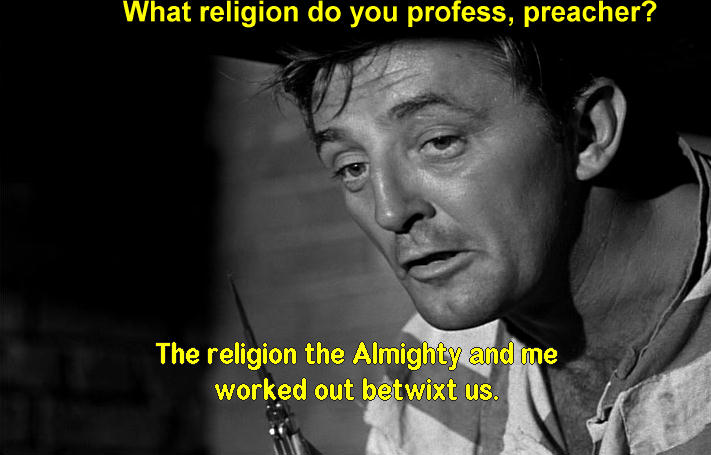
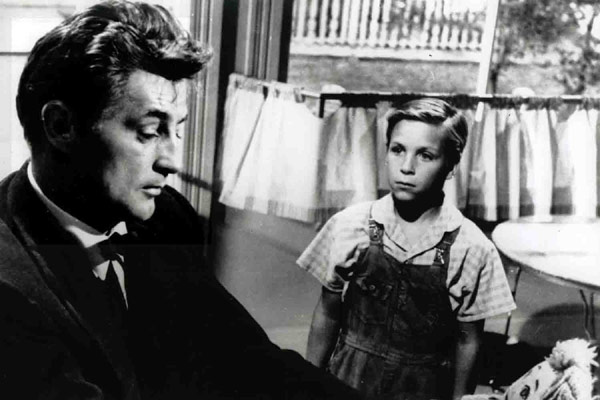
Ah, little lad, you're staring at my fingers. Would you like me to tell you the little story of right-hand/left-hand? The story of good and evil? H-A-T-E! It was with this left hand that old brother Cain struck the blow that laid his brother low. L-O-V-E! You see these fingers, dear hearts? These fingers has veins that run straight to the soul of man. The right hand, friends, the hand of love. Now watch, and I'll show you the story of life. Those fingers, dear hearts, is always a-warring and a-tugging, one agin t'other. Now watch 'em! Old brother left hand, left hand he's a fighting, and it looks like love's a goner. But wait a minute! Hot dog, love's a winning! Yessirree! It's love that's won, and old left hand hate is down for the count!

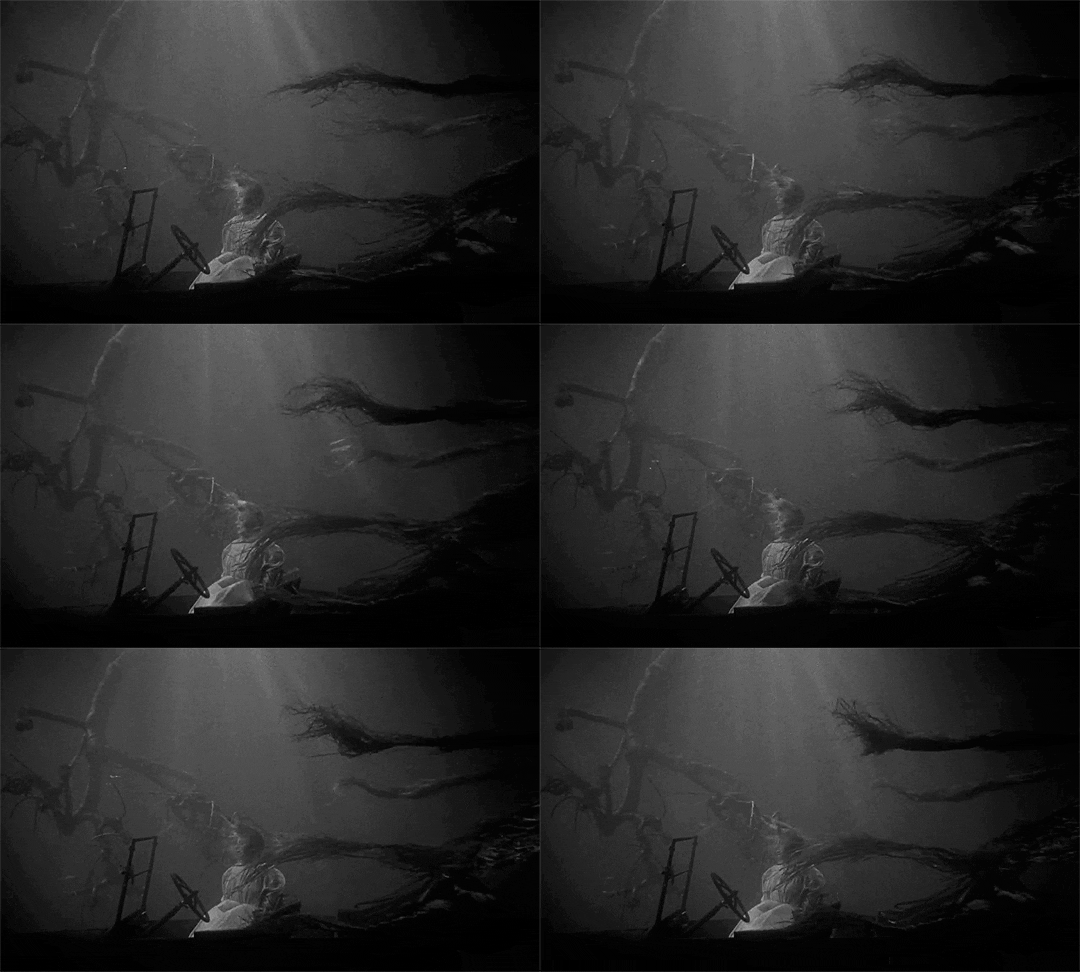
The above quote is a distillation of the conflicts in The Night of the Hunter—a failure at the time of the film's release in 1955, but has become a cult classic among fans of the Gothic, the film-noir, the atmospheric, the poetic, and amongst film-makers—Spike Lee famously recalled it in Do the Right Thing—as what one is capable of when "making pictures". The movie veers from day-blasted scenes in the sunlight, to an artificially encroaching studio-night of terrors and claustrophobic angles.

One of the most stylized, creepiest movies ever made--the only one ever directed by actor Charles Laughton--The Night of the Hunter tells the story of an almost-elementally corrupt minister who comes to town seeking fortune by seducing and murdering the wife and terrifying the children of his old cell-mate, and tells it in the manner of a magical fairy tale. As two of the targets of the Rev.'s obsessions are the impressionable children of Willa Harper (Shelley Winters), the film becomes a battle between Good and Evil as seen through their eyes.
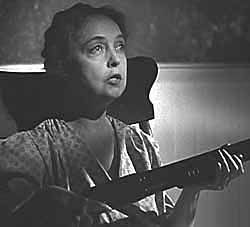
The Good is represented by the Grandmother
, played forthrightly by silent film star Lillian Gish. The Evil is the right Rev. Harry Powell, who strides into town with the conflicts in his soul tattooed on his fists. It's a bravura performance by Robert Mitchum, who wasn't known for bravura performances, usually satisfied maintaining a laconic air to get by. Here he brays and exhorts like a bull and it's an amazing thing to see so theatrical a performance come out of him--in fact, it's the role he's best remembered for. The film itself is a creepy blend of reality and fantasy, of realism and theatricality and the clashes of those sensibilities jar one's attention, while burrowing into the soft places of one's skull. Despite poor box-office and critical pans when it opened in 1955, The Night of the Hunter abides. 
 
It abides and it endures.


Wednesday, January 10, 2018

A Guy Named Joe

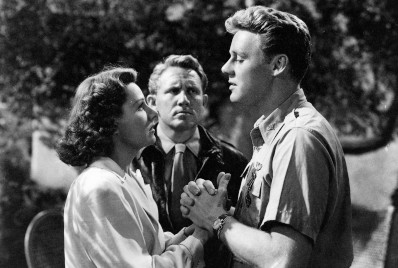
A Guy Named Joe (Victor Fleming, 1943) A Guy Named Joe is a wartime fantasy film—it was made in 1943 during the second world war—that was such a favorite of Steven Spielberg's (when he was watching movies on television while he was growing up) that he remade it as his own film, titled Always, in 1989. One can see why, despite the latter film's torturous transition changing the milieu from World War II bombers to forest fire-fighting in modern times. It has a lot of diverse plot elements and crosses many genres: love story, war story, fantasy, action. Yet it's also a personal story with a character arc close to Spielberg's heart: a man-child has to learn to grow up. But, instead of committing to something, here the key to maturity is letting go...making the sacrifice. Of course, that story is only one dangerous mission away from being told in any war film. In a story about fire-fighting, not so much.
But, back to Spielbergian motivations—the best reason to remake this movie? The love story in the first one doesn't work. Whatever passes between Spencer Tracy and Irene Dunne in this movie feels more like mere tolerance than a quickening flame. One hesitates to bring Hollywood gossip into discussing the results on film; what is on-screen should be taken at face value, and the situations and logistics on-set should, if all goes well, be invisible to the casual movie-goer (and Fleming, a yeoman director who skirted the complexities of Gone with the Wind and The Wizard of Oz is better than most at surmounting them). But, the chemistry between Tracy and Dunne, that is so important to making the rest of the film work is not there.  The two did not get along during filming, and Tracy's entire performance comes off as aloof and "above-it-all," not heartfelt as it should be. In his update, Spielberg overcompensated by going the other way, with Richard Dreyfuss' work being a little too smiley and treacly and trying too hard to be "winning," thereby making his character seem petty and destructively selfish during Always' darker passages.

But, the story is a compelling one: Pete Sandidge (Tracy) is a chances-taking bomber pilot in the European theater of WWII. He's best buddies with Al Yackey (Ward Bond) and sweet on Durinda (Dunne), a pilot in her own right. During one mission, however, Pete is killed and, finding himself in the after-life, is tasked by "The General" (Lionel Barrymore) with helping to train a young pilot, Ted Randall (Van Johnson in his first major screen role) in the Japanese theater. Durinda comes back into the picture, still shattered by Pete's death, but at the urging of Yackey, she ends up nearby, and, though reluctant, finds herself falling for Ted.
For Pete, this is agony, watching their budding romance, and leaves him conflicted about his "mission" and his feelings, and only an extremely melodramatic act of sacrifice forces him to "see the light," as it were.  

The screenplay is by Dalton Trumbo, and he works hard—maybe a bit too hard—to balance the conflicting emotions in Pete, and as good as Tracy is, he can't seem to find the right balance to give Pete the depth of character integration to keep the different aspects of his personality together. The motivations are there in the script, but Tracy, fine in individual scenes, can't seem to make Pete a whole human being, giving a slightly disinterested air to the character. Some scenes were re-shot later in the studio to find a better balance (which, ironically, might have led to the problem), but the results on-screen don't pay off. Maybe it's the integration of fantasy elements with a war film that causes the conflict, and although the film comes to a resolution satisfyingly, it leaves one feeling a little melancholy, as if something more could be done. Partially, that's the film and how its elements might have more fully gelled. But, it's also the resolution of the film, too. Realistically (and bear in mind we're talking about a fantasy film here) the proper resolution is to face facts and accept and let go, for spirits on both sides of the astral plane...to accept grief and move on, parting. A bitter pill, even if for a greater good (which is always suspect). In the end, it comes down to making the best out of loss, and given the time of strife in which the film was made, that's a heartening statement to make, if superfluous, given the very real individual losses the world was producing during that war.
Interesting if not completely successful. However, three years later, Michael Powell and Emeric Pressburger would take similar themes and turn it into the far superior, and more fantastical, A Matter of Life and Death (or as it was known in the States, Stairway to Heaven).