Showing posts with label James Coburn. Show all posts

Friday, April 17, 2020

The Magnificent Seven (1960)

So, I was talking to a co-worker about movies. Our tastes are different. "What'd you watch last night?" I asked. 
"Oh! Great movie! The Magnificent Seven!" 
"You've never seen The Magnificent Seven?"
 "No-oo." 
"Well, finally, we can agree on something...The Magnificent Seven is a classic!" 
"Yeah. And I lo-ove Chris Pratt!"

(Long Silence)

"What?" I spluttered. "Wha...Chris Pratt?" 
"Yeah, he's so great..." 
"You mean you're talking about that Denzel Washington mess?" 
"Yeah, he's great, too."
"No, no, no, no, no!" (I explained). "You HAVE to see the Yul Brynner version!" 
"Who?" 
"Yu...okay, Steve McQueen's in it!" 
"Who?" 

At this point, I started pulling what's left of my hair out—not to try and explain Yul Brynner, of course (Good thing I didn't lead with Horst Bucholz or Brad Dexter) and explained in the most condescending way possible that if she didn't see Charles Bronson in it, it just isn't The Magnificent Seven. 

I wonder if she ever did.

The Magnificent Seven (John Sturges, 1960) Sturges' remake of Akira Kurosawa's Seven Samurai as a Western (more accurately South-western) with cowboys (more accurately gun-slingers) is a rousing crowd-pleaser (while still maintaining the original's final resigned tone). This is not only due to Kurosawa's indestructible original tale of warriors from a by-gone age quixotically trying to save the residents of an agrarian town from bandits, but also for the charismatic cluster of stars vying for screen-time with "The King" himself, Yul Brynner.* Steve McQueen, coming off the "Wanted: Dead or Alive" series was particularly shameless about trying to grab the spotlight from Brynner. 

"It doesn't bother me," the older actor would tell Sturges. "All I have to do to upstage them is take off my hat."
In this version, it's a Mexican village being robbed by bandito's led by Eli Wallach's Calvera that cause a trio of farmers to go searching for "gun-fighters"  (they are told that gun-fighters are cheaper than guns) to take on the thieving gang. One by one, the odd troop are assembled including up-and-coming stars McQueen, Charles Bronson, Robert Vaughn, James Coburn, Brad Dexter and Horst Bucholz,** all pistolero's down on their luck and taking on the job—for their various reasons, be it bravado, assumed reward, paternalism, loyalty—until something better comes along. It's a dangerous temporary job, so the stakes have to be personal, beyond the measly compensation for the task. They are all aware that the risk to themselves is high, but not as much as the risk to the farmers.
Each of the seven have their reasons, but each of them have their own style of combat, making the final assault on the town (after a couple of skirmishes and a temporary change of fortune) that much more dramatic as each gun-fighter has to fight their own battles in their own individual style. And it doesn't matter what style they use...they always seem to do it cool.
When one compares the Kurosawa original with Sturges' adaptation, one notices a big difference—Nature. Sturges' stage is a big blue-skied sand-blasted valley-scape that doesn't much change and makes no impact on the outcome, whereas Kurosawa staged the original's dynamic set-pieces in a violent rain-storm, increasing the odds and making them more mythic, with the Heavens themselves having a stake in the conflict. Kurosawa wasn't complaining, though. He reportedly liked the American version so much he presented John Sturges a ceremonial sword.
Momentum is kept up by some sharp writing (by blacklister Walter Bernstein and Walter Newman, both credits replaced after much bickering about changes made on set by William Roberts) but also by a rousing Copland-esque score by Elmer Bernstein*** that manages to goose the action up several notches from how it's paced on screen. This might be sacrilege to say (as the score is so iconic and tied to the movie as much as a pack of Marlboro's), but it's almost like Bernstein is trying too hard in places, as when the theme thumps along when Chris (Brynner) and Vin (McQueen) are riding a buckboard to a confrontation.

Curiously the pacing is a bit slower when the words stop and the action begins, but one hardly notices when Bernstein is controlling the tempo.
The transition (and translation) from Japan to Mexico is a bit seamless, despite the lack of atmospherics, and just as the Samurai have their distinct characteristics, so, too, do the gunfighters--only Horst Bucholz, given an outlandish billing in retrospect, fails to rise to the potential of the others. The genius of the film is Kurosawa's, but this Americanized version still has its own unique charms, enough to make The Magnificent Seven a huge success in its own right. A couple years later, the same tack was used to create a westernized version of Kurosawa's Yojimbo,**** and launched the "Spaghetti Western" and the career of its chief architect, Sergio Leone.


The Magnificent Seven was voted into the the National Film Registry in 2013.


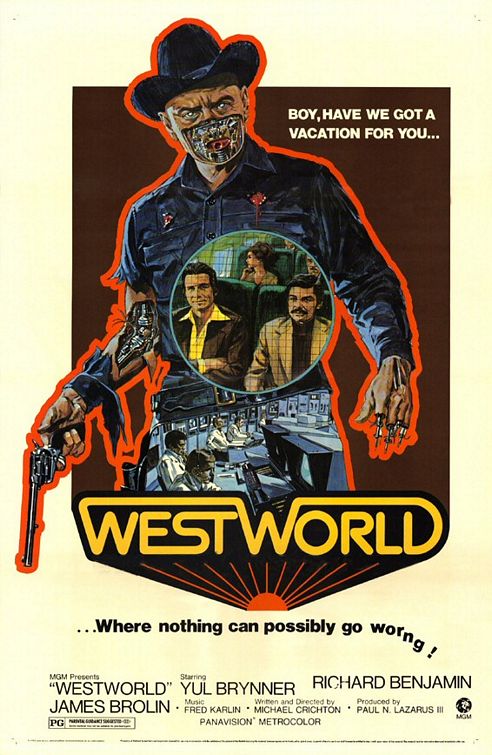
* Brynner cut such a fine figure as a gunslinger (despite his Russian heritage—his character's ethnicity was explained away as "Cajun") that he came back for the first sequel The Return of the Seven, and was the emblematic robot shootist in Westworld and its sequel Futureworld.
** The closest I could come to finding a movie that had so many future stars (and Brad Dexter) in it is Francis Coppola's The Outsiders.
*** Bernstein's theme became known as "The Marlboro Theme" because it was used as the background music for that brand's (now extinct) cigarette commercials. The prolific Bernstein (no relation to Leonard) only won one Oscar for his music--for the musical score to Thoroughly Modern Millie.

**** That would be A Fistful of Dollars, starring Clint Eastwood.


***** The film's story would be used...again...as A Bug's Life. And, anyone remembering Roger Corman's Battle Beyond the Stars will see more than a resemblance to The Magnificent Seven (beyond just the casting of Robert Vaughn).


Wednesday, June 5, 2019

The Americanization of Emily

The Americanization of Emily (Arthur Hiller, 1964) Talk about making a silk purse out of a sow's ear.

On this day before the anniversary of D-Day, let's take a look at one of the movies that featured that turning-point in the second World War. But, where most movies or books treat that fateful attack with respect and even reverence, this movie is satirical...and smart....while still being a member of that branch of cinema known as "the service comedy."


The original novel of "The Americanization of Emily" was written by William Bradford Huie (he also wrote "The Execution of Private Slovik", "Mud on the Stars"—which was adapted by Elia Kazan as Wild River—and "The Revolt of Mamie Stover") and although there are some similarities in characters and incidents, characterizations are slightly different as refracted through the typewriter of Paddy Chayevsky. 
The other difference is in attitude. In the novel, "Americanization" is a synonym for prostitution, as British women are assumed to be more loose sexually in the face of having access to wartime contraband normally rationed during the conflict. Chayevsky tones it down a bit by implying that "Americanization" is merely being influenced by American bootlegging. "Influence" might be a polite term.
It's the anticipatory days of the D-Day Invasion of Normandy and Britain is flush with military of every ally and stripe. None are more prevalent than the Americans. Cutting a considerable swath through the vulnerable island-country is Lt. Commander Charles "Charlie" Madison (James Garner), assistant to Navy Admiral William Jessup (Melvyn Douglas), who has assigned him a cushy job—in the parlance, he's a "dog robber," a fixer, although the less colloquial term might be procurer. It is Charlie's heady task to bring comfort to the allies—the entitled officers and the higher-up the better. For the buying of favors and political influence is its own kind of war, strategic and cut-throat. Charlie's had enough of the other kind. Having survived at Guadalcanal, Charlie had a change of heart about his role in the effort; having seen so many brave men die, he has figured out that the best way to survive it is to be a coward. He became as he says "a self-preservationist." Hence, his job change.
It is Charlie's heady task to make the lives of the higher rank-and-file officers more comfortable and, thus, more malleable in their negotiations by providing them whatever they want—women (mostly "although individual tastes may vary")—local girls who can be persuaded by giving them dresses, fine food, things they're not used to in their severely rationed country to be escorts and discretely silent—as well as liquor—top-shelf—cigars, fine foods, and the services and linens to display them on, clothes for the women (because the men are in their uniform finery), perfumes...and the ever-present Hershey's chocolate bars. The women are seen as a commodity, like the others, bargaining chips merely. They are supplies as surely as the guns, the ammunition, they shoot and the transports that ferry them to and fro...even to Normandy.
This may be upsetting in the era of "MeToo" but one can also make a case that the soldiers are mere commodities, as well, counting more as strength in numbers, than as individuals. One can fall as long as there are replacements who can take their position and, hopefully, last a foot farther in the advance.
Into this capitalist quagmire steers Emily Barham (Julie Andrews) of the motor-pool and self-described prig, whose job is to chauffeur the uniforms around—men-drivers being in short supply at the moment—and doing their part to help "the war effort" in any capacity they can. She is, at first, repulsed by Charlie and his proffered hedonism in a time of sacrifice, but he's a charming rogue—"a rascal" as she calls him—but, his cynicism and forthrightness about it makes him stand out, as does his philosophy of staying out of the action, which is attractive to a recent war-widow, whose family has its share of empty chairs at the dinner table and pictures on a shrine of a wall. Charlie, given his stance, may be around a bit longer for anyone sentimental enough to be thinking about the future, especially a future without loss.
If it wasn't for the bloody war. World wars have a way of getting in everybody's business. And this one conspires to separate Emily from Charlie and Charlie from his life. The Admiral, suffering from grief over the death of his wife, and seeing the Navy's role in the invasion as merely support, wakes up from a drunken stupor with an overarching idea that just may improve the position of the Navy—"The first dead man on Omaha Beach must be a sailor!" ("Was there a contest?" Emily will ask, aghast, later). And so Charlie is volunteered to storm Omaha Beach while his until-recently roguish friend-turned PR enthusiast "Bus" (James Coburn) commands a film crew documenting his efforts and probable death.
It is Charlie's worst nightmare. Not only is he back in a fire-zone, but he's doing it for the reason he knows and understands best—exploitation. But, if a man has to die for something, shouldn't it be as something more than a mere symbol and a ploy to get attention for a better share of budget appropriations? Sure, a man can get killed for doing the right thing and for being noble—as per Charlie's earlier arguments regarding his belief in cowardice*—but, not as a bargaining chip. Maybe there are distinctions and higher purposes. Maybe Charlie has to be fed some of his own medicine to concede such things exist and are worth the fight.
A lot of people don't get past that first caustic hour of Madison monologing his new religion, and it's too bad because the second half turns it on its ear through the blackest of comedy and the absurdity of herd-instinct, military protocol and "Mad Men" thinking. Chayevsky does not temper his language and uses it with scalpel-like precision. You'll find that in this screenplay, he does some deft "three-peating" to get laughs and make points, and it's not enough for one character to see the error of his ways (as would be a typical, safe goal for a movie resolution), but it's much more tougher for two lovers to switch roles as they grow together and are separated by crossing both intellectual and emotional paths coming through the wry. It's a twist that would challenge O. Henry, while keeping its satiric edge while providing a nice, neat (and slightly provocative) comfort zone.
Both stars, Julie Andrews (this was only her second film) and James Garner, have said that, of all of the films they made, The Americanization of Emily was their favorite.

They would appear together again in Victor, Victoria (directed by Blake Edwards) in 1982.

Sunday, February 3, 2019

Major Dundee

Major Dundee (Sam Peckinpah, 1965) Semi-restored version of Major Dundee that's a bit closer to the idea Sam Peckinpah had in mind when producer Jerry Bresler took the film over, edited it with a meat cleaver and threw on a wildly inappropriate score (a ranch massacre with bodies littering the desert and the main house on fire until it collapses is set to a bouncy Mitch Miller tune?* Say, what? Peckinpah has been accused of bad taste in his movies, but he'd never have pulled something as egregious as that!).

Peckinpah's first A-budget movie has a great story. A hard-nosed Union Major, Amos Dundee (Charlton Heston)** side-tracks a bit from the Civil War to capture or kill the marauding Apache chief who torched that outpost. To do so, he must cross the border to Mexico in a mission that doesn't officially exist. His requisitioned army of nobodies employs cut-throats and horse-thiefs, Confederate Rebels and Buffalo Soldiers. No one asks: Can't we all get along? It's just assumed that they can't, but a sense of order and hierarchy is maintained within the groups, while the groups test and prod each other en route.

The cast includes Richard Harris as leader of the Confederates (who has a past with Dundee), a small band made up of Peckinpah irreg'lars Ben Johnson, Warren Oates, L.Q. Jones and John Davis Chandler. Brock Peters is in charge of the Buffalo Soldiers. Slim Pickens and Dub Taylor are two of the criminals, R.G. Armstrong as a vengeful preacher and in Dundee's command are Michael Anderson Jr. (who narrates), Mario Adorf, Jim Hutton (whose character arc is almost as interesting as Harris' character's) and crusty scout James Coburn.
That's a great cast. 
And the film is full of detail (you want to see it on a big screen). There are some extraordinary screen-caps from the film below that show Peckinpah's innate ability to fuse landscape and character, not unlike John Ford, whom Peckinpah seems to emulate while presenting either a celebrational rabble or a ceremonial piety but infused with a more cynical rough-hewn presentation. I don't think John Ford would have had a soldier swatting flies away from a war wound, but I could be wrong.
Heston is a bit of an odd man out in the film, his acting rhythms are slower than Peckinpah is able to deal with in his cutting style (in fact, there's a couple places where Peckinpah cuts in the middle of Heston's reaction shots just to speed the man up a bit) and the clashes show. In an interview, R.G. Armstrong calls Heston "a poser," (which is certainly true, but also calls him "the nicest guy in Hollywood"—Heston gave up his salary to keep an embattled Peckinpah as director***), but Heston loosens up quite a bit in this film than he had in any previous one, setting a tone for his subsequent work as less heroic, more recognizably human presences.
But the movie falls apart somewhat, when the troop liberates a starving town from the French; everyone looks impoverished (even the dogs outside town are skin and bones), the exception being the widow Santiago (Senta Berger)**** whose nursing duties among the starving citizens hasn't reduced the glow in her cheeks or made her any less voluptuous. Her presence and the subsequent romance with Dundee just doesn't sit well with the grit of the rest of the movie, and so Peckinpah wounds Dundee and sets him on a rehabilitating toot that manages to negate a lot of the nobleness of the character, and undermines a couple other parts as well. 
A broken arch does not connect (and thus dooms any romance)
between Major Dundee and Teresa Santiago (Senta Berger)
Production began before a suitable third act was constructed, and Peckinpah was convinced that once filming had begun, the script would be hammered out. But production delays and disputes between the director, the studio and the producer ate up a lot of that valuable work-time. And Peckinpah began to drink, most days towards the end, showing up drunk on the set.
Peckinpah gives shape to Richard Harris' Captain Tyreen caught between
his sense of honor and loyalty to the Confederacy.

Still, up until the romance, it's a gritty, atypical Western story with integrity and a nice mature brusque edge to it. Studio interference would hamper this film and dog Peckinpah for the rest of his career.

The remains of Dundee's command escape the French across the Rio Grande.
A shot with such depth it approaches 3-D.

* The opening credits run over the shot of the house burning, and the structure collapses when the director's credit comes up. Peckinpah liked to do things like that.

** To give you a flavor of the writing by Peckinpah and Harry Julian Fink (Dirty Harry), Dundee is characterized as a "$70 red-wool, pure-quill military genius or the biggest damn fool in Northern Mexico."

*** When asked by a reporter if that would set a precedent among Hollywood actors, Heston said, "It's not even going to set a precedent with ME!" A great line.

**** Peckinpah was dissatisfied with the romance story-line imposed on the script but not the actress: Senta Berger would work with Peckinpah again (and James Coburn) in the director's fine Nazi war film Cross of Iron.