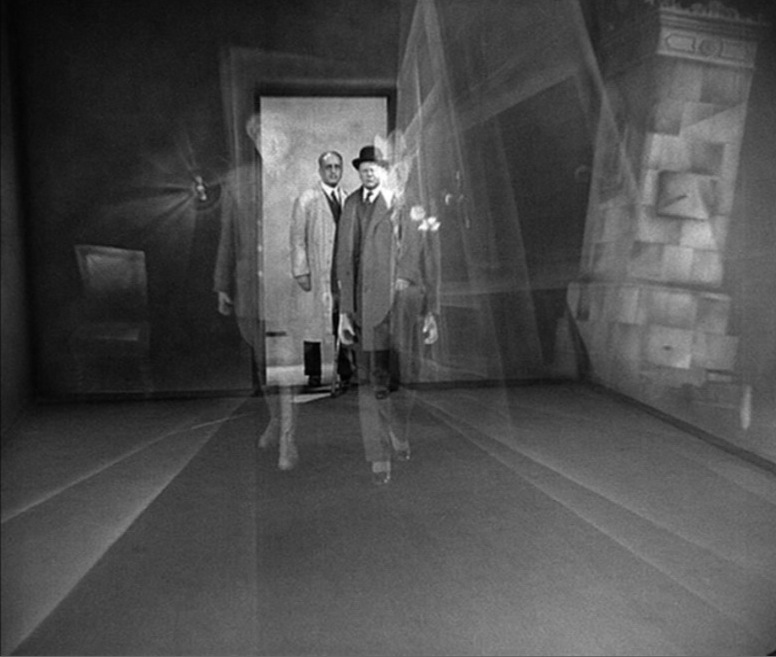
The Testament of Dr. Mabuse (Fritz Lang, 1933) A man hides in a warehouse that is shaking with the vibrations of heavy machinery in an industrial area of town. Two men come in and open a storage container behind which the man is hiding. The dust and dirt from the lid fall over the hiding man and he involuntarily flinches, exposing his foot behind the container. The two men see it, and while one takes out a black-jack to kosh the fellow, the other urges discretion and they leave the way they came. The hiding man, gun in hand, comes out from his hiding place and listens at the door. The other men are on the other side listening. The man steels his courage, pops a couple pills, takes a swig from a flask, and charges through the door.
No one is there. He looks around. The coast is clear. He exits the building. Just in time, he throws himself against the building as a slab of concrete falls right where he'd been standing. Alarmed, he runs down the street, only to see three thugs at the end of the block waiting for him. He turns and runs the other direction down an alley. At the end of the alley, two men wait with oil drums. they push one off the truck and it rolls down the street towards our man. He dodges out of the way, just as the drum explodes in a violent explosion that rains fire throughout the alley.
And that's just the film's first six minutes.
Welcome to the paranoid world of Fritz Lang. It's a world just like ours—but with actual conspiracy theories coming true—and dialed up to "11." Conceived in Germany in its early death-throws between World Wars I and II, when the first war's defeat inspired a dangerously enervating arrogance, Lang used movies to show the best and the worst of societies only too eager to lie to themselves out of some misbegotten quest for power, and it could come from government, from industry, even the motley interests of a lynch mob.
Those were inspired by what was happening in Germany. But, Lang's fantasy instigator was a master racketeer, capable of single-mindedly disrupting the delicate balance of life—Dr. Mabuse. Created in 1921 by the author Norbert Jacques, the Bad Doctor first appeared in a massive two part film project in 1922, then Lang brought him back in a sequel The Testament of Dr, Mabuse, (partially based on an unfinished Jacques novel) even though the previous film had seen the evil manipulator turned mad by the perceived souls of his victims. But, even that cannot stop Mabuse.
All the masterminds of crime you could name—Professor Moriarty, Fu Manchu, Ernst Stavro Blofeld, Hugo Strange, Hannibal Lecter—they don't hold a suddenly-snuffed-out-candle to Mabuse, Fritz Lang's "man behind the curtain," so powerful he can control his vast drug, counterfeiting, terrorism, assassination and extortion rings from his near catatonic state inside a Berlin mental institution, his minions receiving their instructions from a mysterious source, who might be Mabuse himself. Lang made three movies about Mabuse--one in 1922 Mabuse, Der Spieler, and in 1960, The Thousand Eyes of Dr. Mabuse, his last directed film. This one, the middle of the trilogy (or actually tetrology if you count "Inferno" as the second chapter of Der Spieler), was made under the unapproving gaze of the Nazis, and subsequently banned by Goebbels, prompting Lang, one of the stellar visionaries of German cinema (M, Metropolis) to flee the country for Hollywood. And what a vision it is, reflecting the paranoia of National Socialist Germany. Men are sniped while trapped in traffic jams, or nearly blown to bits with barrels of gasoline thrown down narrow alleyways. Among the plots that Mabuse inflicts are plans for jewelry heists and a long-running counterfeit scheme. But, along the way will be death-traps with no exits and only the inexorable ticking of a hidden bomb, and the sabotage of Mabuse's lab, designed to provide a distraction for the mad man's escape, while the city of Berlin is threatened with a resulting cloud of poison gas.
Lang even uses the limitations of the film-frame itself to keep you on edge, as lethal chunks of concrete fall from out of frame to threaten those trapped inside it. No one is safe, and little is what it seems in the web that Mabuse spins, even unconsciously. Lang expertly uses double exposures—some almost miraculous ones—to lend a disconcerting bizarreness to the look of the film. Two men try to stop the mad-man's plot: the personally beleaguered police Commissar Lohmann (Otto Wernicke), who is brought into the madness by the psychological cracking of a former detective, and one of Mabuse's gang, Thomas Kent (Gustav Diessl) who lost his penchant for killing after a stretch in prison and the love of a good woman (Monique Rolland). The men, the authority working outside and the man on the inside, must resolve their own distrust of each other when confronted by an over-arching nemesis, whose power extends even beyond the grave. One sees in this, the inspirations for Hitchcock and 007 (the film ends with an impressive series of chain-explosions), that not only evolved the thriller genre, but the action film as well. But leave it to Lang to take Mabuse's evil and take it to the next level, a supernatural one, influencing people's minds like a Jedi Master, such is the criminal hypnotist's power. No one's safe, in reality or beyond.
Now, that is genuine creepiness.

 It's just one of a string of unsolved crimes that have occurred, and they have only one thing in common—the victims have all previously stayed at the Hotel Luxor in Berlin, and the authorities are starting to concentrate their investigative efforts there. That's a lucky thing as the Luxor has another crisis going on that day. Marion Menil (Dawn Addams) is standing on a high ledge of the Hotel, threatening to jump. The police can't reach her, but the American millionaire Henry Travers (Peter Van Eyck) is staying at the Luxor—he's just negotiated buying a British rocket company—and his window is a life-saving arm's length away from the distraught woman. His soothing words and offers to help convince her to come in off the ledge.