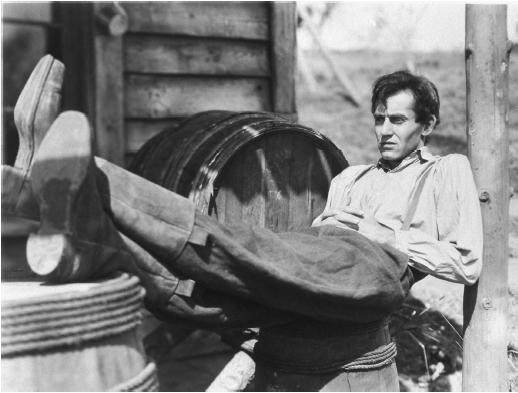
When Orson Welles was asked what movies he studied before embarking on directing Citizen Kane he replied, "I studied the Old Masters, by which I mean John Ford, John Ford, and John Ford."
Running parallel with our series about Akira Kurosawa ("Walking Kurosawa's Road"), we're running a series of pieces about the closest thing America has to Kurosawa in artistry—director John Ford. Ford rarely made films set in the present day, but (usually) made them about the past...and about America's past, specifically (when he wasn't fulfilling a passion for his Irish roots).
In "The History of John Ford" we'll be gazing fondly at the work of this American Master, who started in the Silent Era, learning his craft, refining his director's eye, and continuing to work deep into the 1960's (and his 70's) to produce the greatest body of work of any American "picture-maker," America's storied film-maker, the irascible, painterly, domineering, sentimental puzzle that was John Ford, John Ford, and John Ford.
 Stagecoach (John Ford, 1939) This classic western was hailed as the first "adult western" when it premiered and changed many folks' minds about the viability of the dusty genre to tell stories beyond those of bank-robbers and Indians and greedy rustlers and romancing school-ma'rms. Oh, and singing cowboys. It went beyond childhood fantasies and explored something beyond the white hat/black hat simplicity of early "oaters" to look at things like hypocrisy and duplicity.
Ford tells the story (based on a script by Dudley Nichols from a story, "Stage to Lordsburgh" by Ernest Haycox ) of a motley group of passengers thrust together on an event-filled stagecoach ride to Lordsburgh. That's the bones of it. But, it's not so much the location work, the horses, or the gun-play as it is the interaction between a coach of people on the outskirts of civilization—or what passes for "civilization" out there on the prairie.
The stagecoach is being driven by Buck (Andy Devine) with Marshall Curley Wilcox (George Bancroft) riding shotgun; the Marshall is taking that position because there's news that "The Ringo Kid" has broken out of prison, vowing revenge on the Plummer brothers for the murder of his father and brother. The Plummers are in Lordsburgh, so chances are "Ringo" is headed there, as well, giving the Marshall a chance to catch him before any one else is killed.

But, there's another reason: Geronimo is on the warpath, and a stagecoach is just the sort of thing he and his Apache band will be looking for. Not that the passengers loading in the town of Tonto in the Arizona Territory are all that valuable: there's Lucy Mallory (Louise Platt), a young Army wife with a secret on the last leg of a journey to re-unite with her husband; the gambler Hatfield (John Carradine), who takes pity on the woman for her long journey and chooses to accompany her; there's Sam Peacock (Donald Meek), a liquor salesman. The city's "Law and Order League" are kicking out two of the passengers: Doc Boone (Thomas Mitchell), the town doctor and town drunk, and "a lady of pleasure," Dallas (Claire Trevor). A last minute addition is the town banker, Henry Gatewood (Berton Churchill), who blusters and bullies his way onto the stage, making for crowded conditions.

They don't make much head-way until they run into another orphan—"Ringo" (John Wayne), yep, just as the Marshall thought, on his way to Lordsburgh with death on his mind, but a horse that's gone lame, and so he hails down the stage with a rifle-cock, dust-blown and sweating in one of the grandest introductions that Ford ever allowed one of his actors.* "Ringo" does intend to confront the Plummers, but he's glad to see the Marshall and Buck, anyway, as they're old friends. And, heck, sure, he did a jail-break, but there's no reason to get ornery about it, as the Marshall's just doing his job and he sure could use that coach-ride.

It might've been healthier to catch the next one. It's crowded on that stagecoach and Ringo is relegated to the floor, caught in the middle between bickering, loathing, and often drunken passengers. Ringo stays friendly and guileless. So much so that he treats Dallas with the same respect that he does Mrs. Mallory—at the first stop at Dry Fork, when everyone else sits for a lunch-break, he offers her a chair (next to him, in fact), the haughtier passengers move away from their company. At Dry Fork, their cavalry escort moves on to Apache Wells—there's been an incident and Mallory's husband has gone off with them—but, the coach passengers vote to move on despite the lack of troops watching over them.

They make it to Apache Wells, but their stay there will be unexpectedly long: first, Mrs. Mallory is informed that her husband has been injured in a skirmish with Apaches nearby, which leads to a medical emergency that forces them to stay the night, forces Doc Boone to sober up, and allows some folks' opinion of Dallas to change.
But not Ringo. Her actions only cements his opinion of her, and before the next day dawns, he proposes to her, which just puts her in a state of confusion. She thinks he's naive and doesn't know about her, but he doesn't care. Then, there's the little matter of his heading for Lordburgh—he's not going to let go of his blood-feud, and for Dallas, that's a prospect that can only lead to a very short marriage and widow's weeds.
Dallas and Ringo concoct a desperate plan for his escape—she grabs a rifle, he grabs a horse and he's off before Wilcox can notice he's gone. But, once he does, it doesn't take him long to find him. He's stopped, looking off at the horizon. The Apaches are sending war-signals, and no matter what delicate condition the passengers are in, they're heading for Lordsburgh, pronto.

There begins a sequence for which Ford became famous—a desperate chase across the desert with no cover in sight, with everyone riding at top-gallop, break-neck. This one is augmented and devised by the work of legendary stuntman/arranger Yakima Canutt (who was recommended for the job by Wayne). To this day, it's an amazing show of guts and bravery. The most amazing of which are two shots that are unbroken—where Canutt plays an Apache warrior who leaps from his horse to the lead-horse of the stagecoach, is then "shot" by Ringo and falls back between the horses and between the wheels of the wagon. The other he doubles for Ringo, as he leaps from horse-back to horse-back trying to retrieve the reigns of the lead horses dropped by Buck when he's shot during the fire-fight.
Canutt's work was so respected by Ford that the stunt-man was put on the payroll of every subsequent Ford film (unless he was working on another picture), whether his services were needed or not.
Stagecoach was made in that Golden Year of 1939, probably the apex of Hollywood output as far as high-end quality. It has aged very well, balancing out things that seem merely quaint today (but were radical in its era) with things that still boggles the mind and eye. One of those things is the cinematography of Bert Glennon, a workmanlike photographer who Ford would rely during his RKO days before setting up stables at 20th Century Fox. Ford would call on him again for his glorious Wagonmaster.
It's been remade (twice, both wildly inferior to the original), made John Wayne a star, won Thomas Mitchell his Oscar, and changed the Western genre from kiddie fare to acceptable adult material. It also earned Ford another of his innumerable "Best Director" nominations at the Academy Awards.
And Orson Welles watched it forty times before making Citizen Kane.
 |
| John Wayne walking in 1939, the way he'd walk the rest of his Western career. |


* It's a "truck-in" shot, a difficult maneuver as you have to maintain focus for the entire distance. They didn't, as one can see in Stagecoach, even though it has a great effect. But, they would when Ford did the same trick on Wayne in The Searchers. Why he did it for Wayne here is one of those John Ford mysteries. Wayne had worked in the background of a lot of Ford films, and the director was definitely grooming him to become an actor—even a star. But, director Raoul Walsh got him first, changing Marion Morrison's name to "John Wayne" and starring him in his film The Big Trail, a massive wide-screen (65 mm and stereo sound) wagon-train epic, which is a great movie, but it failed to make back its substantial costs at the box-office. Wayne was left to languish, making B and C-grade Westerns at Monogram and Mascot Studios, until Ford wore off his "snit" about Wayne's seeming "betrayal" and cast him in Stagecoach. This elaborate intro shot may have been Ford's penance.

 It tells the story of a night in the life of "Gypo" Nolan (Victor McLaglen—who won a Best Actor Oscar for his performance), an Irish mug with nothing going for him. Out of work and kicked out of the IRA for not killing a targeted constabulary, he's more than a wee bit desperate and his mood is made any better when his streetwalker-girlfriend (Margot Grahame) trying to pick up a customer. He man-handles the "john" and only gets grief from Katie because she wants to get out of Ireland and just needs 10 pounds to book a steamer to the States. A chance encounter with Frankie McPhillip (Wallace Ford) on the run from the Black and Tan and trying to make it home to his wife and sister, gives Gypo the idea that turning in his friend could solve all his problems; £20 could book passage to the States for both him and Katie Madden.
 Gypo picks up his blood money from the contemptuous police and the first thing he does his buy a bottle of whiskey and tells a suspicious Katie that he got the money from rolling a sailor. But, at Frankie's wake, his drunkenness makes him less careful, spilling coins and handing pound notes to patrons, and the IRA begin to suspect that the newly-flush Gypo may not be so innocent after all, if only they can find the proof.


.jpg)