Showing posts with label Diego Luna. Show all posts

Friday, August 26, 2022

DC League of Super-Pets

It's International Dog Day...and we're in kind of "dog days" at movie theaters...so...this...

The Secret Life of Secret Identity Pets (They Wear Masks...and They Fight Crime!!!)
or
"You Know Nothing Until You've Drunk From the Cold Steel Tube of POWER!"
 
So, discriminating comic-book readers—and I mean DISCRIMINATING comic-book readers—fall into the Marvel camp and the DC camp (All the others don't matter because we're talking about "discriminating"). They are COMIC-BOOKS, but the "truefans" treat them very seriously. Deadly seriously. Because they're guys...and they're TOUGH guys who wouldn't be caught DEAD reading the rival company comic book. So, they don't want to hear that Marvel comics are soap-operas with powers and tights—not too far afield from Stan Lee's True Romance writing (did you ever stop to think that Peter Parker having two girlfriends fighting over him was basically "Archie"?). And DC Comics are wimpy because, well, they're more adolescent (until Frank Miller showed up) and because they have things like super-pets.*
 
Yeah. DC has had "super pets" since the "Silver Age" of Comics. Superman (and Superboy) had Krypto, the Super-dog (and Beppo, the Super-Monkey). Supergirl had Streaky, the super-cat and Comet, the Super-horse (about which we don't say too much). The Atom had Major Mynah. Aquaman had Topo the octopus and Storm the seahorse (in his cartoon series, as well as the comics).

And Batman had Ace, the Bat-hound. Who used to wear a mask. Because he had a secret identity or something. Oh, you laugh now. But, hipster British writer Grant Morrison topped that when he created a character called "Bat-cow."
Bat-cow does not appear in DC League of Super-Pets.** Nor does Beppo, or Streaky, or Comet (or Cupid), or Topo, or Storm...not even Detective Chimp. But, Ch'p does. You know. Ch'p, the squirrel Green Lantern—he's called "Chip" now (and voiced by
Diego Luna). And "Merton" (voiced by Natasha Lyonne!) the speedster turtle from the Zoo Crew, a "funny animal" version of DC heroes, that starred Captain Carrot. I am not making this up.
But, the leads for DCLOSP are Krypto (Dwayne Johnson) and Ace (Kevin Hart), the World's Furriest (re-teaming from Central Intelligence). Plus, there's a pig (Vanessa Bayer ), who for some sexist misogynist reason is associated with Wonder Woman (Jameela Jamil). What, we're looking for logic here? It's a cartoon about super-animals, fer Rao's sake! And it's not canon! In fact, it's a toy commercial.
 
But, I digress...
DCLOSP picks up where every good's children's cartoon should start—with the destruction of an entire planet and race of people. Yeah, they "do" Krypton again, and it's amusing that Superman's parents, Jor-El (Alfred Molina, not even attempting Brando...that's restraint) and Lara (Lena Headey), wear glowing white suits like the first Christopher Reeve movie (they even use John Williams' "Krypton Theme" here). It seems that Jor-el's dog Krypto hitched a ride in that Krypton arc and, like his master Clark Kent (John Krasinski), gained super-powers (I live under a yellow sun and I never got super-powers...not even a lousy "S" t-shirt!). 
And they're the best of buddies...except for one nagging detail—I use the word "nagging" because it's Lois Lane (
Olivia Wilde). Jor-el didn't like her in "The Donner Cut" of Superman II, and Krypto IS his dog, after all, loyal way past death. Well, Clark and Lois are getting kind of serious, and Krypto, in his doggy way, knows that three's a crowd (if not a kennel) and he won't be getting bed-privileges anymore. Naturally, he's ready to concede that pecking orders are overrated and he will be happy to have Lois in his life because...two masters, right? 
Not!

Where's a super-villain when you need him to upset the status quo? Fortunately, Lex Luthor—while not busy "fixing" voting machines and stacking the courts and raising pharmaceutical prices...and...lobbying—is working on a nefarious plot: to use his ultra-powerful tractor beam to capture an asteroid made of (wait for it) "orange kryptonite." "Orange kryptonite?" What does that do? Turn you into a pillar of granules like "Tang?" No, Lex has it in his follicle-disadvantaged head—Chris Rock, don't make a joke!—that orange kryptonite gives you Earth-folks super-powers (maybe because of all that Vitamin-C!) and is determined to capture it. Well, the Justice League—Keanu Reeves voices Batman, which is just precious—prevents it, but it doesn't stop a former LexCorps test-animal, a guinea-pig named Lulu (Kate McKinnon, having a good, manic time)—now relegated to an animal shelter because of her bad attitude—from capturing a shard of orange K with her own tractor beam, thus giving her (bwa-ha-ha) super-powers.
It also affects that list of shelter animals mentioned previously and they all pack-up with a de-powered Krypto (someone put green kryptonite in his flea-and-tick collar) to make everything all right for Truth, Justice, and The Never-Ending Battle Against Dander. Nothing to sneeze at! By the end, all the super-powered pets have teamed up with super-humans and everybody lives fuzzily ever after. Even Wonder Woman and her pig.
Look, I wasn't fond of The Secret Life of Pets, and this is merely that movie with super-powers although some of the "in" jokes are kinda funny. The meta-acknowledgment of a required "training montage" is a nice touch (although it's not that prevalent). At one point, Lex Luthor crows to the captive Justice League: "I had my office turned into a rocket-ship! All the billionaires have one!" To which Batman replies "It's true. They do." That's almost as good as the pregnant pause in the middle of a confrontation where Batman blurts "I miss my parents..." or when he rejects having a canine partner by growling "I always work alone...except for Robin. And Alfred. And Commissioner Gordon. And that guy Morgan Freeman plays." This Batman isn't very self-aware.
My favorite joke comes when Ace (the Bat-hound with a mask, remember) trying to take the starch out of Krypto's cape supposes that his "dooky" doesn't stink. "My dooky doesn't stink," replies Krypto. "It smells more like sandalwood." Which, when your Master is The Big Blue Boy Scout, of course it does!
 
Those moments created some respite. But, don't take my opinion. The true test if an animated film works is with an audience of children (which is how I saw it). These kids could not keep still, running up and down the aisle, changing seats, running up and down the aisle, asking for a sugar IV drip, running up and down the aisle. It's like they wanted to do anything else than watch this movie and I couldn't blame them. I have scene films where the kids sat in rapt attention and didn't want to leave even when the film ended—E.T. and The Black Stallion come to mind—but this discriminating nest of rugrats wasn't "buying" any of it.
 
Personally, I blame the Snyderverse. This is why we can't have nice superheroes anymore...
"C'mon, Krypto," says Zack. "Let's see more of a snarl."
 
* We don't talk about Groot and Rocket Raccoon because they're soo bad-ass.
 
** The company name is actually IN the title, which tempts me to © it.

Tuesday, September 8, 2020

Milk

Written at the time of the film's release....

"The Plural of 'Us's' is 'I'"

I had all these cute little headlines to put at the top of this review, reflecting my disappointment with Gus Van Sant's bio-pic of slain San Francisco supervisor Harvey Milk—"Condensed Milk," "2% Milk"—but ultimately it comes down to this: you owe it to yourself to see The Times of Harvey Milk, the Oscar-winning documentary on Milk and his efforts to fight discrimination. 

It'll cost you 90 minutes of your time—and I can't find it online without some kind of rental fee. But, it is definitive, and, frankly, more effective. The new film, Milk acknowledges its debt to this film in its final credits. Indeed, you'll see a lot of archive footage shared by both films. And Milk, a features recreations of footage from this film. The film ends with Sean Penn, as Milk, saying the words that you'll find in the video at the bottom of this review into his tape recorder for the prescient "In the Event of My Death by Assassination" tape he made. But that sentiment was not a private one. And the film does a disservice to Milk making it so.
It also inadvertently plays into stereotypes by suggesting that Milk's assassin Dan White was a closeted gay man instead of the mentally ill person he was. White's angry (and public) resignation during a meeting of the Board of Supervisors is also made private in the film. White's sneaking into the city hall with a loaded weapon to avoid metal detectors is alluded to, but not that White re-loaded his pistol after shooting Mayor Moscone and heading to the Supervisor offices to kill three other board members (Milk was the only one present). That the crimes were deliberate seems incontrovertible. But White was only convicted of manslaughter and released after serving five years in prison.
And one can quibble about Penn's performance as well, making Milk more fey in his mannerisms (Milk had hidden his sexuality in New York for years), and giving him a thick Bronx accent more Harvey Fierstein than Harvey Milk (ironically, Fierstein narrates the "Times" documentary).
Still, ya gotta do what ya gotta do. The original documentary is 25 years old and is probably past its shelf-life. A dramatic re-telling of the tale was probably due (a twin project "The Mayor of Castro Street" has been in the works, first by Oliver Stone and more recently by writer Christopher McQuarrie and Bryan Singer for years, and has, for the time being, been abandoned) if only to keep reminding people of the toll closeted life inflicted on the gay population. The battle continues to put a familiar face on homosexuality. And if a melodramatic re-telling of a pivotal story is required, so be it.
Van Sant does a fine job of mixed media cutting between vintage footage, newscasts, and recreations. And he gets great work out of his cast, particularly Penn, who's never seemed so relaxed in a role, James Franco (who gets better with each movie) as his first partner in San Francisco, and Emile Hirsch from Penn's Into the Wild as one of his youngest recruits.

Thursday, January 31, 2019

If Beale Street Could Talk (2018)

Love Brought Us Here
or
Unbow Your Head, Sister

I wasn't that big a fan of Moonlight, Barry Jenkins' previous film whose Best Picture win caused a stir and put him on the A-list of directors. The acting was impeccable from a cast that made you care about people that were damaged or damaging, and one got the sense of hopelessness and of an endless cycle that only reinforced it, despite the gorgeous tones the cinematography of James Laxton painted it with.

One should be grateful for it, though, when the product of the man's work is something like If Beale Street Could Talk, his adaptation (written and directed) of James Baldwin's 1974 novel of love in New York, amidst a backdrop of prejudice, of love that even hate can't stop.

Tish (Kiki Layne) and Fonny (Stephan James) are young and in love. She's 19. He's 22. They've been friends since they were kids. Then, they grew up and became more than friendship. 
Their families have known each other a long time, but probably wouldn't if it weren't for the kids. Tish's folks are warm and and inclusive. Fonny's out on his own because of his, but mostly his mother, who is struggling with the burden of raising her family according to the teachings of Christ, but with a less charitable reading of it.
So, when Tish winds up pregnant ("I shoulda said we weren't married" she says in the narration), there's two reactions: Tish's family is warily happy, but accepting. Fonny's father is fine with it, but his mother is livid: "I just pray and I pray and I pray that my boy will come to The Light." But turns on Tish: "I always knew you would be the destruction of my son" and lashes out against "the bastard" Tish is carrying. "You just cursed your own grand-child," Tish's mother Sharon (Regina King) upbraids her and tosses her out.
That is that. Tish and Fonny plan to get married and set their sights on a loft, which is surprising—they find a white guy (Dave Franco) who will rent to them. But then, Fonny gets arrested, charged with the rape of a Puerto Rican woman, who lives across town and out of Fonny's sphere. Seems that Fonny has been set up by a white cop who wanted to bring Fonny in for assaulting a creep (white) who'd been harassing Tish. The arrest is just pay-back for the other incident, and even Fonny's alibi (the ubiquitous Bryan Tyree Henry—he now brings a smile to my face whenever he's on-screen) gets arrested by the D.A.'s office for stealing a car (despite the fact he doesn't know how to drive). The fix is in.
It's the environment of New York at the time. "the black kids were told they weren't worth shit. And everything around them proved it," says Tish at one point in her narration—which has a dream-like reverberation running through it. As she and her family struggle to get a good lawyer (a young eager white dude who insists on being formal and calling Fonny by his given name "Alonzo" to which Tish replies "Call him Fonny. If you're going to defend him, you gotta be family"), Tish takes a job as a token employee at a perfume counter in a department store, the two fathers do whatever they can to raise money, even if it's not exactly legal ("These are our children—we have to set them free."), and Tish's mother takes a trip to Puerto Rico to try to talk to the woman who picked Fonny out of a line-up. They pull together, even as the world threatens to pull the kids apart. 
Jenkins' method of telling their simple story is chronologically complex, going back and forth in time to set up the stakes and challenges at their most emotionally effective moments. And, as with Moonlight, the world of New York has never looked more beautiful, even in the low-light of a basement flat—one may quibble that the Bronx in 1971 was not as portrayed, but it just might be that way through eyes that see with love and will do anything to preserve it.
Tish visits Fonny in prison and tries to encourage him, although it's tough-going—"I hope nobody has ever had to look at someone they love through glass." Their visitations are tough to watch, as Tish and Fonny have barely been out of touch or even in separate frames. They are linked in Jenkins' camera-view, and even when they're not looking at each other, they still hold hands.
It's very much a "you and me against the world" scenario, as most young love tends to be. But, Tish and Fonny are old souls looking to each other to keep hope alive in a threatening environment, looking for saints in the city when they are surrounded by devils. To see light when all around them is darkness and despair.

Maybe Fonny's mother doesn't have it quite so wrong, after all...

Friday, December 16, 2016

Rogue One: A Star Wars Story

The Force is Strong with this One
or
"You've Got to Start Some-where..."

Even though, as they say, I had "a bad feeling about" it, maybe this selling "Star Wars" to Disney may have been a good idea.

Rogue One: A Star Wars Story comes with the hype and anticipation as any entry in the saga "a long time ago in a galaxy far, far away" will. But, Rogue One goes in uncharted territory: it doesn't start with the big "Star Wars" crescendo and an opening crawl to infinity and beyond, the cast is unfamiliar and made up of mostly new characters.* And the synopsis we already know—it was in the opening crawl of the first "Star Wars" movie in 1977:

"It is a period of civil war. Rebel spaceships, striking from a hidden base, have won their first victory against the evil Galactic Empire. During the battle, Rebel spies managed to steal secret plans to the Empire's ultimate weapon, the Death Star, an armored space station with enough power to destroy an entire planet."
Rogue One is the story of those rebel spies, and it's a curious mixture of taking things in new directions while being devoted to the first film's original intentions. One thing that's always bothered me about the "Star Wars" films—after that first one that basically exploded a brand new Universe in a Big Bang and being so rich in detail, the sequels—all of them—collapsed on themselves. Sure, they'd visit a new planet with a singular eco-system (an ice planet, a "gas-planet," a "forest moon," a city-wide planet, a lava-planet), but they'd pretty much stage a galactic war in one place—budget considerations, probably. This movie gambit made that supposed galaxy-wide conflict pretty much a bottle-world where an event in one little corner would affect the Universe. Some "Empire."
But, Rogue One takes us all over the space-place, some new, some familiar. In fact, it jets around from one planet to another, not unlike the first film and the only other one that did, pre-tinkering, Revenge of the Sith. Those used to the usual limited-Universe view may actually become a bit confused at some point wondering "what planet is this, again?"
Before we get to the other aspect of it I liked, a brief synopsis: The building of the Death Star has fallen behind schedule and Imperial Director Orson Krennic (Ben Mendehlson) travels to the home of Galen Erso (Mads Mikkelson), one of the original engineers of the project, who has retired to a simple life of farming. Krennic's arrival is not welcome and Galen instructs his wife Lyra and daughter Jyn to go into hiding to avoid detection. Krennic will not hear of Erso's protests that The Death Star will not actually "bring peace to the galaxy" but terror. "You have to start somewhere," replies Krennic (with my favorite line of the movie).

Protests aside, Krennic takes Erso away, Lyra is killed and little Jyn goes into hiding, where her pre-arranged rescuer is Saw Gererra (Forest Whittaker), veteran of The Clone Wars and a leader of the Resistance.
It's 13 years later and the Death Star nears completion, which creates an up-tick of activity among the Rebels: an Imperial pilot named Bodhi Rook (Riz Ahmed) has defected, charged with taking a holographic message from Galen Erso to the Rebels. Their main base is the fourth moon of Yavin, where they bicker about strategies and have doubts about the Empire's so-called "super-weapon" (after thirteen years, no wonder!) Rook makes it to Gererra, now on the planet Jedha, and who is seen as "too radical" by the main force of the rebellion, and Jyn (all grown up to be Felicity Jones)is rescued from an Imperial Labor Camp by rebel Cassian Andor (Diego Luna) and a re-purposed Imperial droid named K-2SO (voiced by Alan Tudyk, who makes the most of his lines) to be taken to Jedha in the hopes of her leading them to Galen, so the rebels can kill him.
Well, they get to Jedha just in time for an uprising against the Rebellion by the populace, aided and abetted by two "Protectors" of "the Whills,"** Cherrut Imwe (Donnie Yen), a blind warrior dedicated to the ways of The Force, but not a Jedi and his companion Baze Malbus (Wen Jiang) a mercenary sharp-shooter (when you're a blind swordsman against Storm-troopers with blasters, it's good to have one of those around!). They all get captured by a group working for Gererra, who has a complicated history with Jyn that needs going over before he can show her the hologram of her father.
In the message, Erso tells his daughter that he has been forced to work on the Death Star against his will, but has taken pains to create a defect in the system that they can find out by procuring the weapon's plans held by the Empire's version of "Iron Mountain" on the planet of Scarif.*** Jyn wants to go to the area of space where the Death-Star is being built to try and rescue her father (which the Rebels are all-too-willing to agree to, since they want to KILL her father).
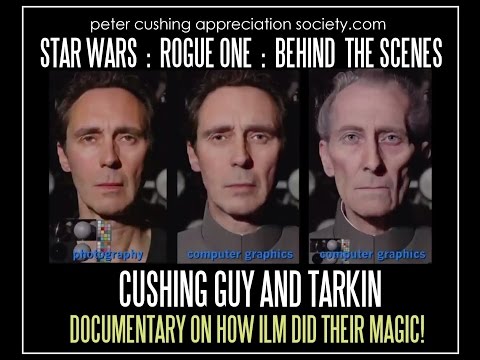
Things do not go so well for both the Rebels and Krinnic: Krinnic's control of the Death Star is undermined by the knowledge that he has let slip a security breach (oh, those uncontrolled servers) and this allows the Grand Moff Tarkin (Guy Henry, CGI'd to look like Peter Cushing****) to take control of the Death Star. His first target: the rebel base at Jedha. If you've seen "Star Wars," you're all too familiar with the sequence of events—a lot of switch-throwing, reaching for dials, and SSHHHHZZZZT! But, this is not the Death Star at full-power—it's firing just enough to wipe out a city, which it does with extreme effectiveness in a mult-plumed mushroom cloud. As K-2SO says, "There's a problem on the horizon. There IS no horizon!!"
The man battle and where things come to a head is the security facility on Scarif, which features an all-out assault between the Empire and the Rebels to get hold of those plans and director Gareth Edwards (he directed 2014's austere and weirdly effective version of Godzilla), where the disparate band of fighters with aerial support from Yavin fight to get those plans against everything the Empire has to throw at them, including things we only saw in the sequels. It's a terrific sequence that has genuine moments of edge-of-your-seat direness, and in case you think there's going to be a follow-up to this movie, there isn't...unless you count the original Episode IV.
And that's one of the things I like about Rogue One: it is its own movie, to be sure, but it is so tuned to the zeitgeist on the inspiration for "Star Wars" that it seems less removed from Lucas' sources than even Lucas managed. There are strains of Kurosawa throughout this, a level of disparity among the roles, not just in ethnicity but also in background story. Some are inspired by religion, some by revenge, some just because they're bad-asses itching for a fight. This Magnificent 7 are all scruffy, none of them polished—even K-2S0 is a might rusty—and the world they fight in is smudged, lived in and full of little goo-gah's that don't call attention to themselves, but exist as if they're part of the real world, not because they serve a dramatic purpose in the story-telling. 
The TIE-fighter doesn't appear in the movie, but it sure is cool-looking, in'it?
There's a strain of seriousness in the story-telling (not that there aren't lots of laughs along the way), it's just that Rogue One plays for keeps and is a bit more mature in its story-telling and less of (as one friend puts it) "a cheese-fest" than the rest of the "Star Wars" series. This is what happens when a "Star Wars" maker gets "serious" (oh, and is talented...there are way too many serious fan-flicks out there that suck) and is faithful to the spirit but not slavish to the style of a series. Great things can come of that. 
Rogue One doesn't diminish "Star Wars" (as I think The Force Awakens does). It builds on it, makes it a bigger Universe with more potential.

And that's what the series has needed since it started making sequels.
* Oh, don't worry. There are a lot of familiar faces...and face-plates...scattered throughout the movie, some of whom may surprise you.

** "The Whills" is a piece of Star Wars arcana dating way back to the novelization of Star Wars (released before the movie came out) written by Lucas and Alan Dean Foster based on Lucas' notes, the original "Star Wars" story was taken from "The Journal of the Whills" which was a tome...like the Bible...of ancient stories of the Galaxy. I remember there was a line attributed to Princess Leia Organa at the beginning—"They were at the wrong place at the wrong time. Of course, they became heroes."

*** They might have saved a half-hour of screen-time of Galen had just said in his already super-secret message that he took pains to smuggle out: "Look there's this thermal exhaust port, right below the main port—it's about two meters wide that if you send a proton torpedo down it, it'll set off a chain reaction and blow the whole thing up!. Get a really sharp pilot, you know, like a moisture-farmer who can bull's-eye womp-rats, like in Beggar's Canyon on Tattooine." But, he doesn't say that. He tells them to go get the plans at Scarif and figure it out for themselves. What, you can only have one secret per hologram in this Universe?

****