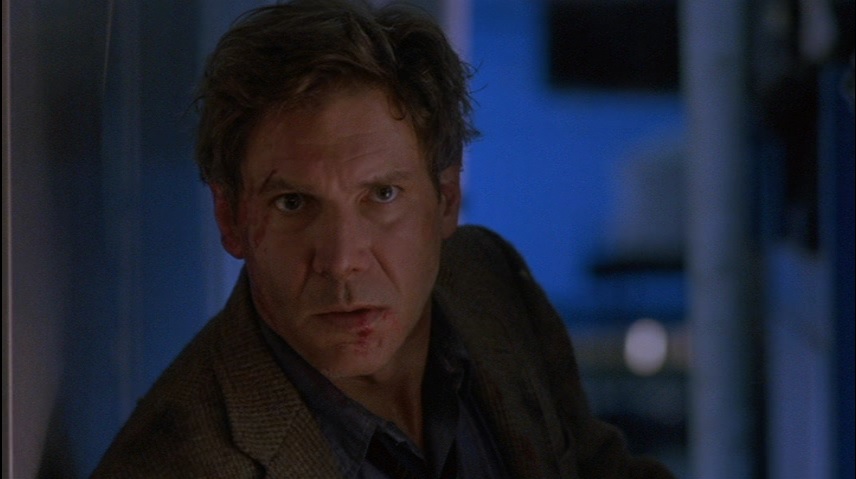
"Name: Richard Kimble. Profession: Doctor of Medicine. Destination: Death Row, State Prison. Richard Kimble has been tried and convicted for the murder of his wife. But laws are made by men, carried out by men, and men are imperfect. Richard Kimble is innocent. Proved guilty, what Richard Kimble could not prove was that, moments before discovering his wife's body, he encountered a man running from the vicinity of his home. A man with one arm. A man who has not yet been found. Richard Kimble ponders his fate as he looks at the world for the last time and sees only darkness. But in that darkness, Fate moves its huge hand."
One of my favorite TV shows growing up (as it remains through adulthood) was the four season run (literally, actually) of "The Fugitive." What was it about? The opening narration (read by William Conrad) told you ever week.
"The Fugitive, a QM Production—starring David Janssen as Dr. Richard Kimble: an innocent victim of blind justice, falsely convicted for the murder of his wife ... reprieved by fate when a train wreck freed him en route to the death house ... freed him to hide in lonely desperation, to change his identity, to toil at many jobs ... freed him to search for a one-armed man he saw leave the scene of the crime ... freed him to run before the relentless pursuit of the police lieutenant obsessed with his capture."
"The Fugitive" depicted an American nightmare: An innocent man—a selfless saint, they would have you believe—is convicted for a crime he didn't commit and given the death penalty. An opportune accident enables him to escape and he spent the rest of the series trying to stay alive, living a lie under assumed names, buying himself time to find the uni-dexterous individual who did commit the crime, so he could clear his name and stop running. The show had a lot of angst, and benefited from its two leads, David Janssen's understated, sympathetic but wary fugitive and Barry Morse's police lieutenant who stood by his convictions—it didn't matter if Kimble was innocent or not, he was convicted.

When word of a movie-remake reached the press, I was skeptical. The series ran for four years, 120 hour-long episodes, and had a neat arc as Kimble drifted around the country, making at least 120 narrow escapes from the police, while his pursuit, the "One-Armed Man," made ever increasing appearances during its run. Trying to do "The Fugitive" in a mere 2-hour feature? Impossible. It would never work.
 |
| The good doctor and wife Helen in happier times. |
But what 1993's feature did was what movies do at their best—it boiled the source material down, reducing it to the best parts and expanded on them. The Fugitive, efficiently directed by Andrew Davis (hitherto known for directing action movies starring Chuck Norris and Steven Seagal) took the sympathetic doctor (casting Harrison Ford, who was believable in action movies and as a vulnerable lead) and made his risks larger,* the time-frame much shorter the search area restricted to illinois (due to advanced police tracking techniques) and put a Davis-movie veteran who could be counted on for a touch of menace, Tommy Lee Jones, as Deputy Marshall Sam Gerard (I guess you can't picture Jones as a "Philip," as in the series).

The film begins with an evocative device it will use throughout the movie—an aerial shot of Chicago. Throughout the movie, random shots of terrain and city-scape will serve as transitions and entry points to scenes (the film had six editors!), giving the audience the central conceit and challenge for the characters—where do you find individuals in all of this?—providing both the access and difficulty in one simple moving image. Those overhead shots will occur again and again, showing us the haystack that will needle the characters— good guys, bad guys, and suspects alike—throughout the movie.

Having seen the obstacle first, the challenge begins: in high-contrast black and white, we see the murder of Helen Kimble (Sela Ward), the interrogation of her husband, Richard (Ford), who is a vascular surgeon at Chicago Memorial Hospital (a scene that was improvised by Ford and the two actors portraying Chicago police—one of them a former investigator), his conviction and sentencing to death, and transport to prison, where an escape attempt by other prisoners goes awry and puts their prison bus into the path of an oncoming train. It's a spectacular stunt, done with real vehicles (and shot by 23 cameras as it could only be staged once) and that shows Kimble, even in the course of a danger that is almost comically severe, still acting nobly even at the risk of his own life.
 |
| You'd be looking over your shoulder constantly, too, if you'd been chased by a runaway train. |
The wreck and its repercussions brings out the local jurisdiction. And while they're at the point of calling off the investigation, in steps Deputy Marshall Sam Gerard and his gang of four: Cosmo Renfro (Joe Pantoliano), Biggs (Daniel Roebuck), Poole (L. Scott Caldwell), and the rookie Newman (Tom Wood). Gerard is the character the audience will least identify with. In the series, Morse's Gerard was relentless, pursuing Kimble all over the country, and with a singular purpose—capture him and put him back on death row, as he was convicted by a jury and as a law officer he's beholden to the law.
 |
"The Big Dog" and his posse:
Daniel Roebuck, Jones, L. Scott Caldwell, Tom Wood, and Joe Pantoliano |
Kimble we could identify with, as we knew he didn't kill his wife and our sympathies are with him, but Gerard was/is another matter. His pursuit of Kimble makes him an antagonist, and he isn't privy to what we know—that he is pursuing an innocent man whose capture will result in a wrongful death. What the movie Fugitive does is give Gerard some back-up, quite literally. As a Marshall, he does not investigate alone, but with a cadre of fellow officers who do the background tracking, giving him the clues to the chase and whereabouts of Kimble. It helps to soften the doggedness, too; he's so thorough, he pushes these agents to the max, leading to some wonderful interplay (most of which was improvised on location, bringing a fresh feel to the dialogue).
 |
Kimble (in ambulance) heading for a blocked off tunnel; Gerard (in helicopter)
banking to meet him on the other side. |
That includes this interchange between Kimble and Gerard at their first sighting of each other, inside the spill-way of a dam. In the scurry of the chase, Kimble is able to retrieve one of Gerard's weapons and gets the drop on him. In the exchange, Kimble shouts out the one thing he thinks matters most and Gerard makes a perfunctory reply (ad-libbed off-script by Jones).
 |
Kimble: "I didn't kill my wife!"
Gerard: I don't care!" |
He doesn't care. That's what it boils down to. And it disarms Kimble and raises the stakes of the chase. If he is going to clear himself of the charges, he has to do it himself, and given that he is standing on the edge of the spill-way of a dam and the only other choice is to walk back into custody, he makes the only choice there is. He goes the other way, because that is the only chance, slim as it is, that he has.

When "The Fugitive" first aired in the 1960's, it initially caught flack from some circles for having as its basis that the law enforcement/legal system was flawed (one of the executives for the network on which it aired groused that the show was "a slap in the face of American justice, week after week"). In the '90's, that sentiment didn't hold as much water, as there were reminders of withheld evidence, coerced or tainted testimony, courtroom politics and racial prejudices that incarcerated innocent people seemingly every week. Plus, in the post-Watergate era official corruption was beginning to be seen as the norm and not the exception. The movie version of The Fugitive falls right into that collective mind-set, setting it apart from the television version.

Also, what worked for television was randomness—the murder of Helen Kimble was a random act from a drifter who split the area soon after the crime—one of the reasons the culprit wasn't caught by the police and Kimble's story wasn't believed. To find the one-armed man, Kimble had to hit the road and it's a big country. But, the movie, with a 2 hour running time, has to be compact, have a through-line, and a conspiracy is that much more easy to follow—trace it backward, follow the money. Swim upstream and go to the headwaters to the source. Kimble doesn't travel around the country to find out the why, he goes back to Chicago where he is most in danger of being caught (and it seems that every scene is punctuated with sirens or a police presence). Indeed, there are two instances where the audience is led astray to think that Kimble is about to be burst in on by police.

While Kimble is hunting, Gerard is following Kimble, only one or two paces behind, following Kimble's investigation, and starting to see the purpose of what he's doing—something the television Gerard understood, but never truly believed. So, the movie starts to follow two parallel paths, and if Kimble's work leaves some unanswered questions, the Gerard sequences make it clear. It is a complicated story, far more than the simple one of the television series, but the movie never leaves the audience behind, and wraps up with a frenetic ending centered around the Chicago Hilton that seems to make use of every nook and cranny of the building.

Davis' direction isn't flashy—when he does a flashback, memory, or in one instance, a quick fantasy-warning, it's jarring and unsettling—but not out of place for the paranoid situation that Kimble find himself. And his platoon of editors make great work of overlapping dialog and sound effects to bridge, shorten, and keep the film moving at a break-neck pace. And James Newton Howard's minor-key, melancholy score never overshadows with melodrama, but supports the story, and more importantly, the pace, with subtlety and artistry.
The Fugitive is one of those rare films that actually honors its source rather than making a hash of it, and it's also one of those action movies (that are few and far between) that respects the audience's ability to be able to keep up and follow along a complicated plot, amidst the ten-minute intervals between set-pieces.
"The Fugitive" is one of my favorite television shows. The Fugitive is one of my favorite movies.
 |
| "Richard..." |
 |
Among the cast of the movie are two extraordinarily talented actresses who
were about to get noticed in big ways for their acting abilities:
Julianne Moore (above) and Jane Lynch (below) |
 |
Mark Bennett's 1999 work "The Home of Richard Kimble" detailing the settings on the series.
Bennett does amazing blueprints of fictional homes of pop culture. A sample of his work is here.
I saw the original of this hanging at Microsoft Studios when it first opened. |
 |
Here's a detail showing the legend of it, detailing what constabulary
was featured and whether Lt. Gerard or the One-Armed Man also visited. |
* The only incident from the series (besides the opening train-wreck) that the movie kept was Kimble going to a city lock-up after reading that a one-armed man was arrested there (from the Episode "Never Wave Goodbye, Part 1") and barely evading Gerard, who came to see the prisoner at the same time.