Showing posts with label Chinatown. Show all posts

Sunday, May 16, 2021

Don't Make a Scene (Redux): Chinatown

The Story:   Chinatown is director Roman Polanski's film noir from 1974. It's a detective story with a wave at some real events that built and transformed The City of Angels (tarnished or not), Los Angeles, though highly fictionalized. And although it takes place during a scorching drought-dry Summer with searing bright days, there are plenty of scary things that go "bump" in the night. Those scary things can come in all packages, big and small, like the vanilla-suited knife-wielding weasel that performs an impromptu rhinoplasty (before it became popular in L.A.) on P.I. Jake Gittes. Unnamed in the script by Robert Towne except for the descriptive "Smaller Man," the role is played by the diminutive Polanski himself, as the director likes to insert himself into his pictures, and the character must have had some appeal.

Like all the characters in Chinatown, he is written distinctly with a unique patois ("Hey there, kitty-cat!"),* even if the particulars of the character (besides his stature, nervous tics, and temper) are left unexplored. He and Claude Mulvehill are just another pair of mismatched goons that fill out a villain's back-up in your standard film noir. They are flunkies sent to give warning, roust a doubter into knowing what's good for him, and in general, do the footwork that the kingpin will not soil himself to do. They are Rosencrantz and Guildenstern, spear-carriers, that is all.

Polanski plays the part in his heavily accented English and tough guy manner learned from pictures of the period—a combination of silly and sinister. He makes an impression, and reveals himself, like Hitchcock, as one of the most personal of filmmakers; no matter what caper is on-screen, his films have a sub-text, much like the carved message at the cave-entrance to the Oracle at Delphi: "Know Thyself." Enter the theater at your own risk.

The Set-Up: After having been set up by a false client resulting in the death of the city's head of water and power, private detective Jake Gittes (Jack Nicholson) is investigating a lead on a related mystery—why is water being diverted in Los Angeles during a particularly withering drought. In the middle of the night, he is waiting for a scheduled water-dump when a gunshot forces him to take cover in a nearby sluice.

Action!


110  GITTES IN FLOOD CONTROL CHANNEL - NIGHT

Then he's inundated with a rush of water which pours over him, knocks off his hat, carries him down the channel, banging into its banks, as he desperately tries to grab some of the overgrowth to hang on and pull himself out. But the force of the stream batters him and carries him with it until he's brought rudely to the chain-link fence. It stops him cold. He's nearly strained through it.
Swearing and choking, he pulls himself out of the rushing water by means of the fence itself.
Drenched, battered, he slowly climbs back over the fence and makes his way toward his car.
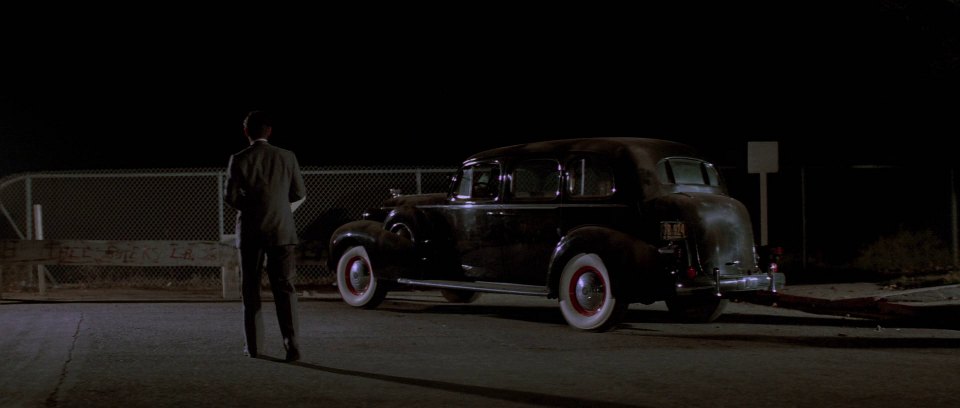
111  AT GITTES' CAR
He fishes for his car keys, looks down -- one shoe is missing.

GITTES(grumbling) Goddam Florsheim shoe, goddammit.
He starts to get into his car but Mulvihill and a SMALLER MAN stop him -- Mulvihill pulling his coat down and pinning his arms -- holding him tightly. The smaller man thrusts a switchblade knife about an inch and a half up Gittes' left nostril.
SMALLER MAN (shaking with emotion) Hold it there, kitty cat.
SMALLER MAN  Hold it!
GITTES Hello, Claude...
GITTES Where'd ya get the midget?
112  CLOSE - GITTES
frozen, the knife in his nostril, the street lamp over-head gleaming on the silvery blade.
THE SMALLER MAN You are a very nosey fellow, kitty cat... 
THE SMALLER MAN ...you know what happens to nosey fellows?
The Smaller Man actually seems to be trembling with rage when he says this. Gittes doesn't move.

SMALLER MAN  Huh? No? 
SMALLER MAN (continuing) Wanna guess?
SMALLER MAN  Huh? No? 
SMALLER MAN  Okay. They lose their noses.
With a quick flick the Smaller Man pulls back on the blade, laying Gittes' left nostril open about an inch further. Gittes screams. Blood gushes down onto his shirt and coat. 
Gittes bends over, instinctively trying to keep the blood from getting on his clothes. Mulvihill and the Smaller Man stare at him.
SMALLER MAN (continuing) Next time you lose the whole thing, kitty cat
SMALLER MAN I'll cut it off and feed it to my goldfish, 
SMALLER MAN ...understand?
MULVIHILL Tell him you understand, Gittes.

113  EXT. OAK PASS RESERVOIR - NIGHT
Gittes is now groveling on his hands and knees.

GITTES(mumbling) I understand...

Gittes on the ground can see only his tormentor's two-tone brown and white wing-tipped shoes -- lightly freckled with his blood.

114  THE SHOE
comes up and lightly shoves Gittes into the ground. the SOUND of FOOTSTEPS RETREATING, Gittes gasping.


Chinatown

Words by Robert Towne

Pictures by John Alonzo and Roman Polanski

Chinatown is available on DVD from Paramount Home Video.


* Which reminds me of a line from another brilliant film noir, Out of the Past: "The cheaper the hood, the gaudier the patter."

Friday, May 14, 2021

Anytime Movies #7: Chinatown

While I catch up on the reviews still in "Draft" phase here, I'll re-run a feature I ran when I first started this blog seven years ago,****** when it was suggested I do a "Top Ten" List.

I don't like those: they're rather arbitrary; they pit films against each other, and there's always one or two that should be on the list that aren't because something better shoved it down the trash-bin.

So, I came up with this: "Anytime" Movies.


Anytime Movies are the movies I can watch anytime, anywhere. If I see a second of it, I can identify it. If it shows up on television, my attention is focused on it until the conclusion. Sometimes it’s the direction, sometimes it’s the writing, sometimes it’s the acting, sometimes it’s just the idea behind it, but these are the movies I can watch again and again (and again!) and never tire of them. There are ten (kinda). They're not in any particular order, but the #1 movie IS the #1 movie.

This is one of the “Anytime Movies” that falls into the category of “Lost Causes and the Futility of Good Intentions,” but lest anyone think these films are depressing, they’re not.

Well, okay, this one is. But, a good movie never depresses me. It impresses me.

It’s also perfect. Given the nature of the trio of men who oversaw its creation—screenwriter Robert Towne, director Roman Polanski, and producer Robert Evans—the thing could have self-destructed like a fragment grenade. And, in fact, the planned trilogy of films featuring detective JJ “Jake” Gittes investigating three big changes to California's landscape (water, land, and no-fault divorce—which would put Gittes out of a job) stopped after the personality clashes that derailed the first attempt at filming The Two JakesPolanski couldn’t set foot on American soil due to rape charges, and Evans (who was producing the film and co-starring in it) and Towne (writing and directing this time) clashed on the set. The combination of expanded roles and egos this go-round, following upon the first film’s success, caused the production-gears, already turning, to stall (necessitating the destruction of returning production designer Richard Sylbert's already finished sets), and it was only the patience and dogged efforts of star Jack Nicholson, who took over directing, that allowed the film to be made...ever. They say that great films need a miracle – Chinatown had it, but its sequel The Two Jakes didn’t have a prayer.

“Middle of a drought and the water commissioner drowns. Only in L.A., huh?” 

Based loosely on the development and construction of the William Mulholland designed aqueduct, and the real estate swindles it engendered, Chinatown starts out as a mystery even more steeped in the locale of L.A. than Chandler’s Marlowe stories. Here, the very city is a part of the crime and corruption is steeped in its soil and water. Water is the heart of Chinatown. Its ebbs and flows are constantly monitored –the original object of investigation is the city’s head of the Department of Water and Power who then becomes the victim of a grisly murder. Water is never too far from the surface of the story. Even Jerry Goldsmith’s shimmering score suggests water in its low harp trills, and the sighing of, yes, water phones.
Chinatown gets all its details right—the language, the costumesRichard Sylbert’s period work is amazing, and a perfect cast makes the most of Robert Towne’s wise-acre dialog. A perfect cast? Right down to the smallest part. There’s a favorite moment of mine when Gittes, after badgering the secretary of the new head of Water and Power, is distracted by an odd squeaking noise. He, of course, has to investigate, and opens the outside door on the two work-men who are scraping the dead man’s name off the door. The one guy looks irritated—the other guy smiles, nods, and as the door is closing shakes his head ruefully—“Happens every time.” It’s a tiny little moment that feels so authentic, so much more than a mere movie might provide, it provides a moment of truth in a continuous string of truths.
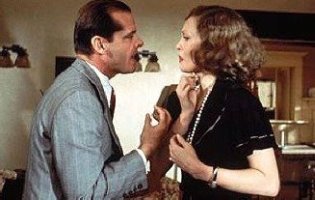
One of Chinatown's weird echoes:  the face of Mrs. Mulwray (Faye Dunaway)
while Jake and she talk about his past, walking the beat in Chinatown.

But, that is a moment you can appreciate as it happens. Chinatown lives on in the memory. After the mystery is solved, moments come back, as the pieces come together and the journey to the conclusion coalesces. They haunt. On repeat viewings, Chinatown is a treasure trove of call-backs and foreshadowing’s.* Little things, like the odd cadence of a name, mispronunciations that can be traced back, a birth-mark—lead you downstream to a resolution that you should, in retrospect, have seen all along. Like Gittes, its only at the end that you get the full story. Of course, like him, you follow the most obvious things that seem out of place or arouse suspicions. ** But the world is a more complicated place and long after the film is finished does it strike you that the two most suspicious people while watching the film are actually the most decent and altruistic ones acting with the best of intentions. Of course, in this world they come to a bad end.
“Do you know how long I've been in this business?

And here’s where that mix of personalities comes in. Towne’s original screenplay (before the Polanski re-write) is very grey—Jake Gittes at the beginning of the film—the very beginning—gets angry and abusive with his moaning client, Curly (In the film, there’s only an impatient irritation). Later dialog casts a sympathetic spin on water magnate Noah Cross. The original screenplay ends with, if not a happy ending, then a triumphant one. Evans loved the screenplay (though he didn’t quite "get" it), but in one of those odd bursts of inspiration that sustained him throughout an eccentric career as a producer, decided that the film needed a European sensibility, and so, brought in Polanski, who had left the country and Los Angeles following the murder of his wife Sharon Tate by the Manson family

His perverse take on the city and the material focused it, and made a stronger delineation between good that is good and evil that is truly evil—and provided the ending that doomed those most in need of rescuing. Chinatown ends in shock, and with a sense of tragic inevitability. That Jake, in a moment of selfishness and hubris, sets up a series of events that ends up completely bollixing up his good intentions, completes a circle and a character arc that had been percolating below the surface the entire time. He ends up ignoring the lessons he learned in Chinatown (the district, not the film), and paying the same consequences. The final words are ironic--“Forget it, Jake. It’s Chinatown.” Forgetting isn’t his problem. Remembering is. Towne would hammer the point home with the last line of The Two Jakes—“Kitty! You never get over it.”

But by that time it wasn’t necessary to say.

Jake wants the truth.
He can't handle the truth.

Anytime Movies:

Above, you'll see a link to a fascinating book by Sam Wasson called "The Big Goodbye: Chinatown and the Last Years of Hollywood." I just finished reading it, and it has a nifty little conceit: it takes the four principles—Polanski, Towne, Evans, and Nicholson—and relates how they struggled (separately and together and against each other) to make the film, saw its stunning successful and quite unconsciously (maybe) turning their lives into a version of the story...with ample help from history, ego, hubris, toxic masculinity, rampant sexism, too much opportunity and too much cocaine. Their failings get the better of them, and, with their eyes wide shut, they no longer become the heroes of their own stories. None of them come out looking good, and the one hero of the story seems to be composer Jerry Goldsmith (yay!), who received a knock on his door from Robert Evans one day, begging him to help replace a score that wasn't working to Evans' mind, and within 10 days had created a full score, the main theme of which made Evans weep. Fascinating read, with a lot of threads to it, and Wasson's style is fast moving and doom-laden. But, it doesn't have a happy ending.

* On my most recent viewing, I noticed a moment that shocked me. After Jake and Evelyn flee a scene in her car amidst a hail of gunfire, the superbly coiffed Evelyn touches her left eye—as if she has something in it. Whether it was Polanski’s or Dunaway’s choice, it’s a brilliantly sick one. 

** Towne’s screenplay is so fully formed that, unlike Chandler’s Marlowe stories, a first person narrative isn’t necessary. We are always aware of what Gittes is doing, and thanks to Nicholson’s performance, what he’s thinking.
"Forget it, Jake."

And...an extra.


This was part of a series of reviews of the ASUW Film series back in the '70's. Except for some punctuation, I haven't changed anything from the way it was presented, giving the kid I was back in the '70's a bit of a break. Any stray thoughts and updates I've included with the inevitable asterisked post-scripts. Chinatown was part of a "detective" double-bill with The Thin Man.

Chinatown (Roman Polanski, 1974)


Gittes: Hello Claude. Where'dja get the midget?
Midget: Yer a nosey fellow, kitty-kat, huh? Ya know what happens to nosey fellas, huh? No? Wanna guess? Huh? No? (slices Gittes' nose). Next time you lose the whole thing. Cut it off and feed it to my goldfish. Understand? Understand?!
Mulvehill: Tell 'im you understand, Gittes.
Gittes: I unnerstand!
As opposed to the whimsy of The Thin ManChinatown is a film of deadly earnest, a perfect example of what is termed "film noir"-which means, in melodramatic terms "when the streets are dark with something more than night," usually the feeling of purveying evil. That is certainly there in Chinatown, although it would be hard to pin that evil on the influence of the film's all-encompassing villain, or the influence of its director, Roman Polanski, who incidentally played that strangely accented "midget" with a knife you heard in that tape segment.*** Polanski shaped this film into a first-rate thriller, even more, into the best film coming out of a major studio in 1974, deserving of every Oscar that The Godfather Part II won that year.**** As with most of these films, each and every performance is perfectly played from the starring performances of Jack Nicholson, Faye Dunaway, John Huston and John Hillerman, down to a lowly sign painter.*****
Chinatown--a section of Los Angeles inhabited mostly by Asian-Americans due to a suppression of their people.

Chinatown--the former beat of two L.A. patrolmen, J.J. Gittes and Lou Escobar; a beat they think in "bad luck" for "you can't always tell what's going on."

Chinatown--the symbol of all evil to Jake Gittes, private detective, for it reminds him of his own tragic failures.

"Mrs. Mulwray, have you ever heard the expression 'let sleeping dogs lie?"

Jake Gittes is hired by a Mrs. Mul'-wray to investigate her "philandering" husband. But as Jake investigates, he realizes that Mr. Mul-wray' is not what he seems, Mrs. Mul'-wray is not what she seems, and Jake finds himself investigating a larger scandal, one encompassing city-wide fraud and personal tragedy. Jake knows all the moves he is supposed to make while investigating--tailing, picking up clues, following them to the next step--and the whole way, he thinks he has the whole case going smoothly. But he doesn't. It is much too big for him to stop. He ignores those little details that he, and we, only can remember later. And Jake Gittes, when the case is over, relives a tragic part of his past, and can only take consolation in the caring words of an associate--"Forget it, Jake. It's Chinatown."
"But, Mrs. Mulwray, I goddamn near lost my nose. And I like it. I like breathing through it.
And I still think you're hiding something."


The ending of Chinatown is a complete reversal of what the film had, supposedly, been leading up to. It will undoubtedly shock and disappoint you. Some critics have said it is ill-considered and "tacked on." But it isn't. It is perfect for the film that Roman Polanski made, and it makes the experience of viewing Chinatown that much more resonant.

Broadcast on KCMU-FM November 11th and 12th, 1975.

Some revisions should be made to this (if I were making revisions). I was being too much of a "nanny" critic, telling people how they should feel. And I kind of blew any surprise that ending SHOULD have had by telling an audience to expect it.

And Chinatown isn't "the symbol of all evil" for Gittes. That's giving him too much thought for the place. It's just a place to be avoided. Bad luck. Fool me once, shame on you. Fool me twice--

And Walsh's words to Gittes aren't "caring," he says it because there's nothing more to say. "Get over it. What'd you expect?"

I've written about Chinatown more extensively here (actually the article at the top of the page). But there's more to say. Reading a nearly final script by Towne of this film tells you that Polanski brought more sense of moral rage to the film (interesting, for Polanski). Evil is evil. Good is good. I've always "gotten" the sense that Hollis Mulwray is not only a good man, but practically a saint. There are things implied in Polanski's direction that point even further in that thought. But, in Towne's screenplay, more sympathy is ascribed to the villain. He is not pure evil as the film would have him appear. He is merely weak, and anything can happen in a moment of weakness. Evelyn Mulwray is also less of a victim in that screenplay, though her actions are seen to be a trifle hysterical. There are no easy answers in Towne's early screenplay. Things are not black and white, merely shades of gray. And given Polanski's history--the concentration camps, and his wife, Sharon Tate's grisly murder at the hands of the Manson gang, and his own past films, one would see why he'd tilt it to the side of the devils.
"He OWNS the police!"

In 1991, Chinatown became a part of the National Film Registry.

*** Yeah--you don't get the taped segment. Sorry. The transcript will have to do. I've always loved the way Nicholson drawled out "Hello, Claaaahde. Where'dja git the midgit?" It runs a close second to my favorite Nicholson line, from Five Easy Pieces: "Don't tell me 'bout the GOOD life, Eldon, 'cuz it makes me PUKE!"

**** Although The Godfather, Part II also deserved every Oscar it won. Except maybe score. And I don't think that's hyperbole saying the best film coming out of a major studio that year. That's also due to its Executive Producer, the extremely savvy producer Robert Evans. Say what you will about Evans, but under his stewardship, Paramount could not be topped as the dominant movie studio in Hollywood. Look at 'em now, folks.


***** Actually, Chinatown is one of the few films where every performance is perfect. And that sign painter--it's one of my favorite bits in movies, because it rings so true. The guy's watching his assistant scrape the name off a door, and that scrape gets detective Gittes to investigate, opening the door. The painters look up at Gittes, who, realizing what it is, shuts the door...and AS IT'S CLOSING, the guy in charge replaces his nodding greeting with a rueful shake of his head "Happens every time." Of course it does. But it's the sort of detail Chinatown is full of, as so few movies are.

****** And, on Sunday, we'll put up a "Don't Make a Scene" feature from each week's film.