Showing posts with label Chadwick Boseman. Show all posts

Tuesday, February 23, 2021

Ma Rainey's Black Bottom

A-One, A-Two, A-You Know What To Do...
or
When the Levee Breaks (When My Daddy Stay Out Late/He Don't Care a Thing for Me)

August Wilson died in October 2005, and is best known for his "Pittsburgh Cycle" of ten plays and there has been a concerted effort to bring the ten to the screen. Hallmark made "The Piano Lesson" in 1995, But the rest...? Part of that is that Wilson insisted that his black plays be directed by black directors ("the job requires someone who shares the specifics of the culture of black Americans") making the job more difficult. Well, bullshit. Let's just say it. Nobody wants to invest the money in a black play with black actors by a black director (unless, of course, it has the word "Hood" in the title) because they don't think they'll get their money back to which I say "Wakanda Forever!" So the effort is being made to toss out the seeds on the wind and see what takes root—Denzel Washington directed Fences in 2016 with outstanding performances by him and Viola Davis—she won the Best Supporting Actress Oscar, but I was surprised she wasn't nominated for Best Actress, as she stole the show. She does that.

And there would be that same danger with the second film to be done (of the second play in the cycle), Ma Rainey's Black Bottom, if director George C. Wolfe hadn't cast his film so perfectly, and then run away with it to make an honest-to-god film as opposed to a filmed play. Ma Rainey surges and glides and pivots and laterals, lifted aloft by the music and by Wilson's language cadences. And the acting is never short of fascinating. One hesitates to put the word "perfect" to anything but to my eye and ear, this one is perfect.
It is 1927, and Ma Rainey (Davis, almost unrecognizable—except the eyes always shine through) has interrupted her tour down South to do recordings for her manager Irvin (Jeremy Shamos) and studio executive Sturdyvant (Jonny Coyne) to meet the need for "Race Records" for those blacks who've moved to the North during the "Black Migration." In her entourage is her nephew Sylvester (Dusan Brown) and one of her dancers Dussie Mae (Taylor Paige), who will accompany her to the session. 
She'll get there in her own time, but first to arrive are the band: Cutler (Colman Domingo)-trombone, Toledo (Glynn Turman)-piano, Slow Drag (Michael Potts)-bass, and Levee (Chadwick Boseman)—trumpet. Levee is the youngest member of the troupe, and is all unbridled energy—he just bought a pair of fancy new shoes from his poker winnings the night before and his excitement for the session is for getting to do his own arrangement of the "Black Bottom" piece and sell his arrangements to Sturdyvant with an eye towards recording them and starting his own group.
The banter between band-mates escalates and falls, as the older band-mates scoff at Levee's braggadocio over his thinking that he might have some sort of control over what Ma will or won't perform for the session. It sounds good when Ma isn't there and its just the band he's angling with, but sounding good and producing are two different things. Power plays are at the heart of Ma Rainey's Black Bottom—who has it and who pretends to have it—and one can bluff all they want to, but there's a difference between a poker-hand and life, and the rules don't necessarily apply to both.
The dynamics change when Ma arrives at the studio; you play it her way or you don't play. In a studio, time is money. But that's money down the drain if you don't get product to exploit. So, things shift and drift, with the ultimate aim of a good recording from everybody—"Who this 'we?'" What you talkin' about 'we?' Come talking this 'we" stuff. Who's 'we?'"—with no solo's allowed. And Ma will push her power—punching up and down—as far as she can go because it's her voice, her material, her band, and her name on the release forms. Nobody makes any money until that happens. You want power? Watch how a diva plays it.
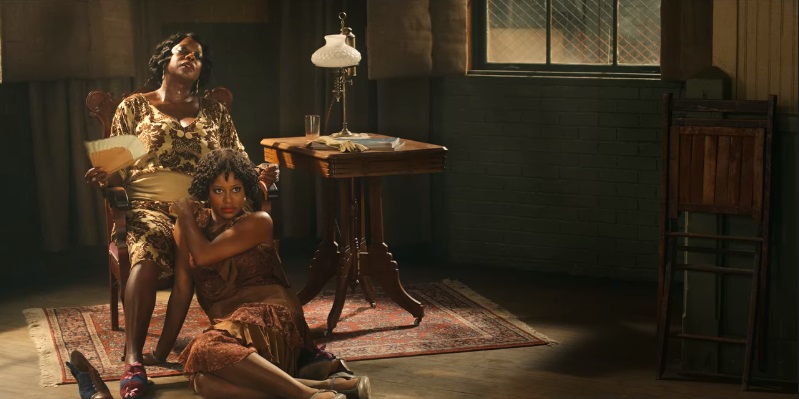
This would be a great solo showcase, just for the presence of Viola Davis ("No look goes uninvested," says director Wolfe) as Ma, and the participation of the late Chadwick Boseman in his last role—that's what all the publicity is about (and they are great, don't get me wrong, I've never seen either of them do anything but light up the screen)—but, everybody in it is great. Davis and Boseman are perfectly capable of blowing people away on-screen, but they are matched by Domingo, Turman, and Potts as the band-members; they are given their monologues and solo's and each are given their moments to shine, while dialoguing without any hint that what they're saying hasn't been lived and is coming straight from their minds to their lips. This is a near-perfect ensemble piece and it is thrilling watching what they do with it.
And director George C. Wolfe does a brilliant job of giving them the proscenium to perform. Even while you're hanging on every word, there are moments when his shot choices are nothing short of breath-taking, anticipating the arcs of the play and giving you something amazing to look at and contemplate, whether the action is happening in the frame, or just waiting for it to happen. Wolfe is a grand ring-master setting things up and paying them off, with three—and other minor ones—dynamics of power that come crashing together and either makes great music or explodes.
It is thrilling to watch this kind of work and one hopes against hope that Netflix makes this more available—beyond its platform—so that more people can see it and appreciate the way a stage-bound work can be opened up from within just by making inspired choices. 

This is the second of the planned "Pittsburgh Cycle" adaptations; one wishes that Wolfe will direct the remaining eight, as well. That will do justice to Wilson's legacy.
Some of George Wolfe's compositions:
Saturday, August 29, 2020

42: In Memoriam

Written at the time of the film's release. Chadwick Boseman has gone on to play James Brown in Get On Up and "The Black Panther" in Captain America: Civil War.

Chadwick Boseman died of cancer on Friday at the too-young age of 43. He was great.


Changing the Face of the American Game
or 
The Saint of Swat

One of the great "unmade" movies is the story of Jackie Robinson of the Brooklyn Dodgers, the baseball player who broke the color barrier in the quintessential American game.

Oh, it has been made before: Robinson, himself, older and showing the effects of the strain the game and his task had put on him, starred in a B-movie version, The Jackie Robinson Story, in 1950; Ken Burns' definitive documentary Baseball made his story the lynch-pin of the parallel stories of The Game and race relations in America in the 20th Century (and will probably always be the best telling of what happened).*


But Robinson's story has been kicking the turf of home plate for a couple of decades lately—Spike Lee has been working tirelessly to make a film of his story for that long, and I've always wanted to see his version of it, as his directorial voice would absolutely put a distinctively personal philosophical spin on the heroics of it.  A Spike Lee "joint" might also provide some angry tension that was part and parcel of the Jackie Robinson Story, but could never be expressed, lest the long-delayed abolition of sanctioned (but unspoken) segregation of baseball fail in a double-play of racism posing as informed sports commentary (which still goes on today for some reason).

Brian Helgeland's film about Robinson, 42 (the number Robinson wore for the Dodgers and the only number permanently retired in the MLB), doesn't have the inflamed spirit that Lee might have imposed, and is content to stick to the facts, which are enough as the events were charged with over-laying race issues, prejudice posing as business politics, and the uneasy first faltering post-war steps to civil rights legislation.

Make no mistake. It was a super-human task to be the first black man in an all-white league. He was a fine hitter, a better runner, and a brilliant strategist who would earn runs without connecting bat to ball, merely by "freaking out" pitchers by stealing bases. Plus, he had a defiant spirit that would not let prejudice stand. He wouldn't "just take it." But, the "handshake" part of his signing with the Dodgers was that he would have to "take it," whatever was thrown his way, be they death-threats, or murderous pitches. He promised his manager that he would not fight back, show restraint, and be the model player. 


Oh. The bottom line was that he had to perform, as well.

Robinson and Rickey on the day he signed with the Dodgers
Robinson knew the opportunity that his role would provide, not only for him but also for other "Negro players." He was described as "a race man," passionate about the lot of African-Americans in a country with Jim Crow laws in place, segregated bathrooms, water faucets and diners, and prejudices not so public under the guise of "tolerance," that actually seemed to take pride in a sentiment like "separate but equal." And he shouldered it, showing the humility and great generosity of his spirit, always saying the "breaking of the color barrier" was not his story but Branch Rickey's.
But, as dramatized in the film, it was also the story of everyone in the Dodgers organization, especially the players, initially reluctant to allow Robinson in, and upon seeing the rough treatment he was getting from fans, other teams, and previously friendly hotels and restaurants, becoming his ally, team-mate, friend, and first line of defense. Robinson's imposed tolerance in the face of hate, naked or subtle, inspired empathy with his fellows, and his play raised their game, making all of them better players, and in the words of Dodger announcer Red Barber "better men."
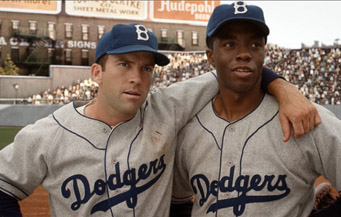
Performances are uniformly excellent. Harrison Ford is top-lined as Rickey, and Ford chews into the role the way John Wayne jawed Rooster Cogburn, growling and over-playing just a little bit to provide "character," Christopher Meloni of "Law and Order: SVU" does a fine job playing Dodgers coach Leo Durocher, soon replaced by "Barney Miller"'s Max Gail as Burt Shotton, Lucas Black plays Pee Wee Reese and Ryan Merriman plays Dixie Walker, and Nicole Beharie plays the devoted Rachel Robinson with a bracing mixture of grace and spine. Alan Tudyk surprises with a particularly unsympathetic portrait of Philadelphia coach Ben Chapman, whose taunts on-field But special praise has to be given to Chadwick Boseman's performance as Robinson, which he has down cold. There's enough footage of his play to copy, but what he nails is Robinson's expression, the enigmatic not-a-smile, and the wary eyes and darkened brow of the already burned and suspicious player, a bit of a caged lion not allowed to roar.
It's a good tribute to the man, if only missing a little bit of the fire that must have burned in the man to accomplish what he needed to, and that needed to be internalized amid so much pressure. He (with Rickey's patronage) turned the puerile accomplishments of a kid's game (the wins, the records) into something far greater for humankind (American division). He was the slugger who couldn't hit back, who turned the other cheek and turned America around. Babe Ruth was baseball's "sultan of swat."  

Robinson is its saint.


As dramatized in the film, Robinson posing with Phillies coach Ben Chapman who was criticized for shouting racial slurs at the player during a game. This photo op was Chapman's way of trying to fend off charges of "unsportsmanlike conduct." He was fired by Philadelphia in 1948. Looking at the smile on Robinson, casual and a bit cocky, "helping out" the guy by posing with him, always makes me smile.


* Just this year, Burns also produced a film dedicated solely to Robinson.

Thursday, May 3, 2018

Avengers: Infinity War

Getting the Stones
or
Playing the Marvel "Whose Contracts Are Up?" Game
or
"You're So Daaaark. Are You Sure You're Not from the DC Universe?"

Avengers: Infinity War is a bit brilliant in concept and a rather neat wrap-up to the first ten years of Marvel Universe movies. Directed by the Russo brothers who did the last two Captain America movies, it's a mash-up of characters and tropes from the various franchises, mixing and matching and trying to make combinations work, so much so that the directors are rather at a disadvantage in that they have to keep all the balls in the air rather than doing anything stylistically interesting. It has all the "by-the-numbers" feel of the first couple of Thor movies and the latter Iron Man films. From a directing standpoint, it's a big green-screen movie where folks have to do things fast and things don't linger much. There's very little "down" time to contemplate events. That's a big disservice if you're trying to create any sort of emotional resonance.

And, if you're a "tru-fan" of certain characters, don't expect to come away too happy walking out of the movie (but, then, a sequel will be coming out next year, so don't buy too many black clothes). But then, the DCMU killed off Superman and brought him back in the space of two movies (didn't do much for his career, though).

So, if you've been watching ANY of the Marvel Universe movies since...oh...Captain America: The First Avenger, when "the Tesseract" was introduced, you might be familiar with what Avengers: Infinity War is all about—you certainly are more "in-the-know" if you've stuck around, patiently (or obsessively) for all the post-movie previews jammed into the credits. That "Tesseract" contains one of six sacred stones of power—in this case, the "space" stone—and it's been curated in the "Thor" world of Asgard. There are five others, most of which have been tossed into the Marvel Movie Universe: the "mind" stone—formerly in Loki's scepter—merged with the super-android Vision (in Avengers: Age of Ultron); the green "time" stone (also known as "The Eye of Agamotto") provides Dr. Strange his time-warping powers; the "reality" stone (also known as "The Aether") showed up in Thor: The Dark World and has since been possessed by Benicio Del Toro's "Collector";  and the "power" stone was what Thanos was trying to get in the first Guardians of the Galaxy movie. There's a sixth stone—the "soul" stone (which might actually be the "Sly and the Family" stone) which we haven't seen yet, but it has been searched for by The Guardians' Gamora (Zoe Saldana), who also happens to be the daughter of Thanos (now played by Josh Brolin).
So...okay. More recently Asgard was destroyed (in Thor: Ragnarok) and all the Asgardians were being ferried to a new home on the Asgardian Ark (along with The Hulk—Mark Ruffalo, again—and Valkyrie)* By the time we've suffered through the brand new ultra-long Marvel Studios 10th Anniversary logo, we are aware that the ship is in distress.

Boy, howdy. Thanos has attacked the ship and torn it to shreds, looking for "the Tesseract" and after several confrontations with principal Asgardians and The Hulk (who all have their heads handed to them), he gets it and pops it into his little "Infinity Gauntlet," the most prominent one-gloved fashion statement since Michael Jackson left the planet. A couple of key Thor-mates are dispatched, but not before Hulk is sent spinning back to Earth.

Where he lands...smack-dab in New York (all things in the Marvel Universe lead to New York) in the middle of the Sanctum Santorum of Dr. Strange (Benedict Cumberbatch), where he warns that Thanos is bad (real bad) and probably headed for Earth. Better get Tony Stark, Iron Man (Robert Downey Jr.) because...well, Robert Downey Jr.'s in all of these movies. Besides, what is Nick Fury (Samuel Jackson) going to do?** Glare at it? Only a few minutes behind Hulk—just enough time for Stark and Strange to eye each other and be mutually snarky (they're both the same guy, frankly, just in different fields), Thanos' bagel-ship arrives in New York creating havoc, and attracting the attention of Spider-man (Tom Holland)—his "Spidey-sense" is portrayed by the hairs on his arms standing on end—to escape a field-trip and join the fray.
"I don't know what it is, but it sure is bi...well, wait, it looks like a piston ring"
Thanos' troops kidnap Dr. Strange (he has one of the stones) and Spidey and iron-Man go to the rescue, and decidedly un-hulky Banner contacts Captain America (Chris Evans)...because Stark and Rogers had their falling-out in Civil War. Cap, Black Widow (Scarlett Johansson) and Falcon (Anthony Mackie) go to Scotland to help ward off attacks on the other stone-wilder, Vision (Paul Bettany) who is keeping a low profile with the Scarlet Witch (Elisabeth Olson).
Meanwhile, in space, the Guardians of the Galaxy (aw c'mon-you know all of them, do I have to put them ALL in here?***) hear a distress signal from the Asgardian Ark, and when they get there, run smack-dab into Thor (Chris Hemsworth), who has seen what Thanos can do and is determined to stop him from stealing the reality stone from "The Collector," in his "Knowhere"-land, but is determined to get a Thanos-sword to kill him. He recruits Rocket and Groot to take him to the planet Nidavellir, where his own hammer was once created. The other Guardians decide to travel to Knowhere to scout out what's happening to the stone (the answer: nothing good).
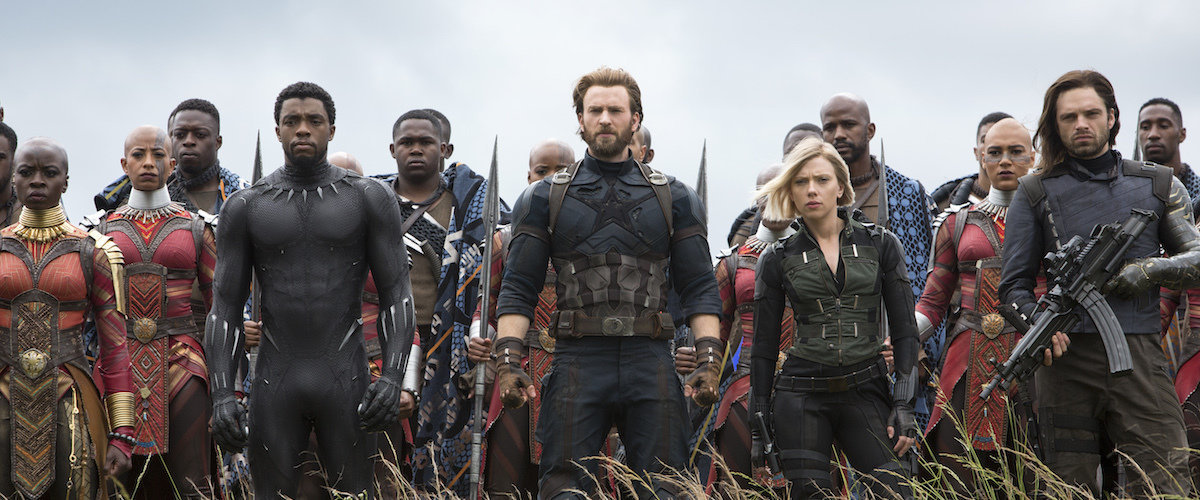
Back on Earth...in the States...Cap, Widow, Falcon, Banner, Vision, Witch, and Rhodey (Don Cheadle) join forces in dissing Secretary of State Thaddeus Ross (William Hurt) and travel to Wakanda, the kingdom of Black Panther (Chadwick Boseman) where they hope the advanced technology there can be used to remove the "mind" stone from Vision without killing him. Then, they can destroy the stone to prevent Thanos from achieving the ultimate power he craves...in order to "balance" the Universe.
Okay, so the entire Marvel Universe (with the exception of Ant-Man and Hawkeye) is spaced out around the movie, in little cluster-groups, trying to prevent Thanos' plan, which, so far doesn't look too promising for half the Universe. Thanos, it seems, is a bit of an environmental extremist as well as a sociopath. He believes that the Universe is limited in resources and can only support half the life that exists—he never sights any charts or field-studies, he just believes it. And so, his ultimate goal is to eliminate half of all life...with the snap of his fingers, and with all six sacred stones providing the bling in his "Infinity Gauntlet" he is capable of doing just such a thing.
Bad Thanos. VERY bad Thanos.
Which is where Avengers: Infinity War gets very interesting.

In these super-hero movies, there is the interesting dynamic between antagonists. You have heroes and villains splitting the attention of the viewer. It used to be that there would be an even match in the combatants, but that has changed as the number of these films have exploded.

The villain here, Thanos, is obsessed with balance, and the writers (here, Christopher Markus and Stephen McFeely, who wrote the Captain America films and the lackluster Thor: The Dark World) of the superhero genre surely must sympathize, trying to create a challenge without overshadowing the challenged. It always seems the Joker gains more attention in the Batman movies—whether it's Jack Nicholson or Heath Ledger— When the villain is well-known, there's always that danger.  But, of late, especially as franchises get deeper in digits that the villains become more anonymous—Iron Man 3 tossed away a major villain, The Mandarin, as a joke, and one is hard-pressed to remember the villains of Iron Man 3, Thor: The Dark World or Captain America: Civil War, who came across as arrogant tall poppies in need of being cut down as quickly as possible.
But, in Infinity War, you can say that the heroes are given short-shrift, while the emphasis is on its hulking, committed villain, indeed of all the many characters in the film, he is the one filling the most screen-time. And, given that, he is the only one—so far—who has much of a story-arc. A villain in the mold of Richard III or MacBeth (with just a touch of Lear), his is the journey with the most interest and the most surprises. Rather than a mega-god of great power and not much else (see Justice League's Steppenwolf), his titan seeks his ultimate goal of culling the Universe, and triumphs—a lot—but also suffers—quite a bit. To win, he must lose, and his tragedy is that he chooses to throw away all that he cares about in seeking the power he craves and  the burden that he, alone, sees the need to take on.
He also seems to get some of the best lines in the film, which is tough to do in an Avengers movie. He's complex, smart, and maybe right, but wholly devoid of second-thought and emboldened by hubris. He's quite recognizable, and as portrayed by Josh Brolin, commands screen-attention, no matter how many stars in spandex vie for center-stage. It's the first time I can recall in a Marvel movie where the villain has upstaged the heroes.
Upstaging them is the least of his crimes. By the end, one wonders what one can do to solve the puzzle and undo the damage—if the intent is to undo it at all. Only the surety that money talks in Hollywood tells me that once the second still untitled movie comes along, things will be set right in their proper proportions. And there are certainly hints of what will happen, with unfulfilled story-promise and character relations featured prominently amidst the maelstrom. There are a couple well-used formulas (instead of "fourteen million six hundred and five") that might reverse things if I recall my comics past, and a gauntlet-ful of key characters that seem underutilized this go-'round that will probably come to the fore.
But, it's a very good, very enjoyable, if unsettling little entry, where one actually feels the stakes are high. 

And one hasn't felt that in the presence of the Marvel Universe in a very long time.

* First asterisk: And by now, your "Spidey-sense" should be tingling that this is a complicated movie. It is.

** I'll tell ya (SPOILER ALERT): He doesn't show up until the movie's credit tag.

*** Okay Chris Pratt, Zoe Saldana, David Bautista, Pom Klementioff, and the voices of Bradley Cooper and Vin Diesel.


Wednesday, February 28, 2018

Black Panther (2018)

Black Panther 1; Hamlet 2
or
It Takes a Wakandan Village

First off, let me express my prejudices; I am becoming increasingly disenchanted with super-hero movies. I find them to be a bit one-note and superficial and I really (really) am tired of the "revenge scenario" that seems to dominate super-hero movies, especially when it's the hero who seeks revenge. I'd rather my heroes be heroic. Is that too much to ask—to fit the job-title? And I'd rather that their aspirations be un-ironically for the good. Too often these superhero movies have toughened up their heroes, dressing them in leather and dimming the lights to make them "credible" in a live environment. Credibility isn't a bad thing, it's just that it has a tendency to muddy up the motivations of do-gooder's. I mean, if you want to do good, don't mope about it, or don't be so cavalier that you tend to come off like a jerk. I like humble heroes. I like them spreading the wealth. I like them having a good purpose and a good soul.

I love Black Panther. Oh, it has its issues—some dodgy CGI (don't they all...really?), very confusing early action sequences—you see director Ryan Coogler (Fruitvale Station, Creed) gain confidence and communicate arena-geography very quickly on a steep learning curve—a derivative story-line (but derivative in an interesting way), the usual things that make me hesitant going to "another" super-hero movie.
But, this one has a good heart. That may be because its story is a bit of a fairy-tale about a distant mystical land and the stuff of kings. There is a child-like wonder to it, its kingdom of Wakanda (located in Nigeria) has a fleshed-out, fully-formed quality to it that you don't get no matter how many times we've seen Asgard in the Thor movies, and the major characters all have a purpose and a clearly defined function that makes you care for each and every one of them. Nobody's an empty plot-device, nobody is marking time, this is a community on film all to the service of the story and (mostly) to the service of the newly-crowned King, T'Challa (Chadwick Boseman) who is taking the mantle for his slain father.*
Wakanda has been blessed (? cursed?) with a huge store of the Marvellian super-metal vibranium—deposited aeons ago by meteorite—and has kept it secret for its own gain, establishing itself as a technological power while keeping the knowledge of it "off the grid." To the world, Wakanda is a peaceful land of textiles and subsistence farming, while beneath an obscuring force-field, the five tribes of Wakanda maintain an alliance of wealth and power which is ruled by succession mitigated by the challenge of ritual combat, their leader taking on not only the mantle of King, but also that of The Black Panther, protector of Wakanda, who is given extraordinary powers by imbibing the broth of a native herb suffused with vibranium.
Except for the vibranium story (which is given a nice "Tell me a story" beginning with a reverberating end question), this is all pretty much communicated by plot and visual story-telling, which, frankly, is just plain wonderful film-making. We, the audience, learn as we go, even as our eyes are popping with incredible art-design and costuming, making the learning part and parcel of the whole experience. Coogler and his artisans have done such an effective job that one wonders if, when the inevitable sequels come out, that uniqueness will fade as it has with other Marvel films, and for a similar leap in imagination, Star Wars, but it's a bit premature to be worrying about that. One should be grateful for what's there that such a worry even exists.
The story proper begins in 1992 in an Oakland project. While the neighborhood kids are out playing B-ball with a basket made of a broken milk-crate, two men are approached by the guards of the King of Wakanda, T'chaka (Atwanda Kani—the son of the actor who plays the older, late King, John Kani). He greets one as his brother, N'jobu (Sterling K. Brown), but it is not a joyous reunion; N'jobu has been sent to America as a Wakandan spy—the nation's only way of keeping tabs on the outside world without betraying its advanced status. It seem N'jobu has been dealing with an international arms smuggler, Ulysses Klaue (Andy Serkis—and not just a CGI Andy Serkis—who's been hovering around the last couple Marvel team movies) to get weapons for giving the villain much prized vibranium. This, the King says, cannot be allowed. There is a family quarrel about this and N'jobu ends up dead for his duplicity. Hidden by a cloak of clouds and night, the Wakandans take off back to Africa, leaving the basketball players to look up in wonder.
That is the past. In present day, T'chaka's son, T'challa, is on his way back to his kingdom to claim the throne, ferried by his personal guard Okoye (Danai Gurira) of the Border Tribe and head of the elite Dora Milaje forces. But first, they must pick up T'challa's former love Nakia (Lupita Nyong'o) of the River Tribe, who is working undercover as a Wakandan spy, freeing kidnapped Wakandan women from a slaver group. All safe and sound, they enter the camouflaging force-field hiding the technologically advanced city from the eyes of the world and are greeted by T'Challa's mother Ramonda (Angela Bassett), his techno-whiz-kid-sister Shuri (Letitia Wright) and Zuri (Forest Whitaker), the tribe's spiritual leader. Amid much pomp, T'Challa is installed as King, but not before he is challenged for the position by M'Baku (Winston Duke) of the Jabari Mountain Tribe in a fight for supremacy against a de-powered Black Panther. In a fight to the death, T'Challa convinces the proud M'Baku to yield because "your people need you!"
Already, Black Panther has set itself apart from other "superhero flicks:" it's hero is a combatant, but he must continually prove his place as champion—he has a birth-right, sure, but he has to earn his stature, and he can lose it if he falls short—that sets him apart from the heroes-by-accident and privilege of most of the genre. And that "your people need you" cry has a charitable diplomatic streak that you don't find, either, amongst the "all of nothing" spandex-set. He also has a vast support-system surrounding him, guiding him in his actions, whether supportive or adversarial, to find a path that is most beneficial to all sides. This tests the new Wakandan leader to become the King that he might not otherwise be if left to his own devices.
T'Challa goes to "the spirit realm" to talk to panthers with "Kubrick" eyes.
He'll need it. His greatest challenge in this particular chapter will come from an incident in the past that will ultimately alter the course of the nation of Wakanda in the form of Killmonger** (Michael B. Jordan), who has sided with that Klaue guy to steal vibranium. Here's another thing I like about Black Panther—they do make room for the standard "revenge-story" trope that I find so tiresome in super-hero motivation. However, it is Killmonger who is in the "you shall be avenged" business, following Hamlet, The Lion King and Inigo Montoya to seek revenge for the slaying of his father to the obsessive point of caring about nothing else. That "bit" feels far much more comfortable as a villain motivation than for a hero and as bad a dude as Killmonger is, the film still manages to evoke some sympathy for the guy and his circumstances—an empathy that provides one of the best "grace" notes of the film and sets the movie far above the usual fare by making its "super-hero" a...well...an actual hero.
After so many years of these films, have film-makers actually started to get it right? There are very few really good super-hero films that are good as merely films, but I can count on one hand how many espouse some sort of selfless heroism—the first Christopher Reeve Superman, Captain America: The First Avenger, Wonder Woman...and this.*** And I will be so bold to say that of every superhero movie I've seen, this and that first one are the only ones I'd recommend for kids. It's the spirit of the thing. And their eyes will pop at the sight of it all. It's good imagination-stirring stuff.
Now, the challenge comes. The second films of the Marvel Studio series all take a large step downward in quality (with the exception of Captain America: The Winter Soldier). Black Panther is on such sure footing, one hopes that the second isn't a mis-step. Director Coogler is saying he'll be back for another and that gives me the most hope that it will be just as edifying—even if the visuals will not be as surprising—as this effort. Very worth seeing.
"I did not yield. And, as you can see, I am not dead.
The challenge continues."


* As seen in Captain America: Civil War —"Jaunty" Jim

**  I know, I know "Killmonger" (shudder), but, trust me, it could have been worse—in the comics, M'Baku is known as "Man-Ape."

*** Okay, I know YOUR favorite may not be there, but I'm talking about completely heroic movies that go right out and un-ironically espouse and show heroism and not make some crack about it. So, yeah, Dark Knight, sure, Winter Soldier and Civil War, okay, Ant-Man, Guardians of the Galaxy, The Avengers...then....