Showing posts with label Arthur Hill. Show all posts

Tuesday, September 14, 2021

The Chairman (1969)

The Chairman
(aka The Most Dangerous Man in the World) (J. Lee Thompson, 1969) Oh, the memories I have of this one. I saw it when it was first released at the long-gone John Danz Theater, and even then, I knew the film was a bit of a mis-fire...but not for want of trying.
 
American Nobel-winning chemist John Hathaway (Gregory Peck) is recruited by the military working out of the American Embassy in London for a special assignment on behalf of an uneasy alliance between the U.S., Britain, and the Soviet Union. His old University professor, Soong Li (Keye Luke) has traveled back to his native China, now undergoing upheaval with the Cultural Revolution. They all think that Soong has some secret formula or other that all the governments want. Hathaway wants nothing to do with the intrigue, but is convinced to go by a personal phone call from the President (as that would be Nixon at the time, he'd be going there in a few years, anyway—why didn't he go ask about the formula?)
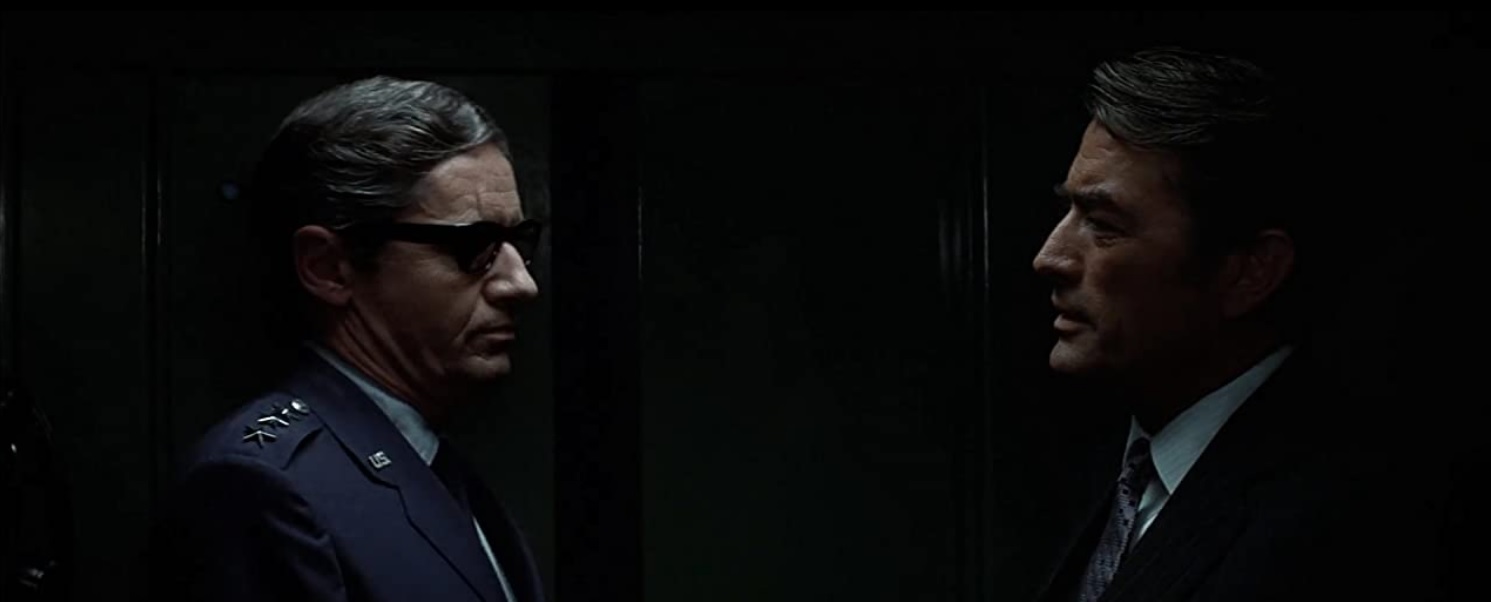
Lt. General Shelby (Arthur Hill, sporting glasses with the right lens blacked out) is the American liaison overseeing the trip from the Embassy, and he has a cute little scheme—as the governments want a constant report from Hathaway on his progress, they tell him they're surgically implanting a transceiver in his skull—in the days of land-lines and in a communist country where all radio communications are monitored, it's a handy-dandy way for Hathaway to report back—by appearing to talk to himself in his hotel rooms...and it can also track his movements, pre-GPS. It can also do something else, but more on that later.
Hathaway has the surgery, then makes the journey—after visiting his long-suffering lady-friend (Anne Heywood, second billed, but only in the movie five minutes) for maybe the last time, given the danger of the mission. It's at this point that the movie gets interesting. Given the nature of the film, shooting in Hong Kong (then as part of the separate state of Taiwan), Thompson gets his "travelogue" footage by shooting it surreptitiously in markets (where the over 6 foot Peck just happens to be standing out in the crowd). Hathaway is led around, baited with a honey-trap, and formally introduced to Mr. Yin (Eric Young), who's pleasure it is to follow Hathaway around for the Chinese government in full sight because they're in charge, why be secretive about it?
Hathaway is escorted around and then one day, Yin tells him he's going to meet the most important man in the world, and is taken to see Chairman Mao (Conrad Yama)—who, rather inanely is introduced playing ping-pong. He engages Hathaway in a game and then proceeds to quiz his guest about his intentions by taking on Hathaway's role while making him see his point of view. The result? An unlikely agreement that Hathaway can visit Soong without any interference—Mao believes that Soong's working perfecting an enzyme that encourages plant growth in any environment would be good for China...and the world (as long as it works).
But, what Hathaway doesn't know—or his unwitting host for that matter—is that little implanted transceiver that nobody's supposed to know about—also has an explosive device cooked into it. If something goes wrong, or Hathaway is captured—BOOM!—one of Hollywood's great profiles gets obliterated. There's an amusing scene where Shelby and his British counterpart realize that they're listening in to a conversation between Hathaway and Mao, and going rushing off to a super-secret telephone—requiring two keys—to alert the President of what's going on and suggesting that (let's explore the possibility) they could set off the explosive right then and kill Mao at the same time. There's a pause on the other end of the line and the words "Great idea.....don't do it."
The rest of the movie is fairly standard undercover work—Hathaway finds out where things are kept, he's a chemist so he gets some acid to gain access, Soong gets attacked by an angry mob of students to show their loyalty to the Communist Party—at the behest of Soong's daughter (okay, that's different), and once our hero gets what he needs he makes an escape for the Chinese border on the Russian side...but there's just the possibility that he could get caught, and so the program to explode his skull begins to count down. 
 
And, yes, it's probably where the creators of "The Suicide Squad" got the idea.
 
It's a staid little film—in the way Arthur Jacobs productions can be—but there's just enough cheek and outre ideas to make it interesting...and memorable after 53 years.
"I hear ticking...."

Saturday, April 4, 2015

The Andromeda Strain (1971)

The Andromeda Strain (Robert Wise, 1971) Robert Wise's return to science-fiction (The Day the Earth Stood Still) after years in the musical field (West Side Story, The Sound of Music, Star!) proved that he was still as effective as a gritty story teller as he was a choreographer. Michael Crichton's first best-seller (he'd paid his way through medical school writing pulp novels and thrillers, then abandoned a potential medical career to continue writing) hit the wave of nervousness fearing "moon-germs" infesting Earth from the first Apollo moon-landings. Crichton had a fascinating little gambit—he filled the book with graphs and text and bibliography references that gave the book the air of legitimacy, when, in fact, he made everything up whole cloth, even the citations. Nobody cried "fowl," or hauled him before Oprah to be pilloried. He merely went on to write his series of oddly-cautionary fast-reads of the dangers of current technology, all like prose-screenplays waiting to be filmed, only occasionally departing from the formula to write something of his own interest ("The Great Train Robbery," "Eaters of the Dead"). His characters were largely cyphers, until after a brief flirtation with movie-making, all of his male lead characters seemed to be based on Sean Connery (who starred in Crichton's film of his own The Great Train Robbery).*
But, that's the future. For The Andromeda Strain, Wise pulled off a similar cinematic trick to keep it real—he didn't cast stars, just good character actors (and a couple of formidable stage actors) for the leads, filmed what was essentially a "bottle show" (mostly taking place in a contained space with few exteriors in an unfussy, clean style in wide panavision and split-screen, and included the first instance of on-screen date/time/location computer updates graphiced across the screen to orient ourselves. It's played out in as un-melodramatic a way as was possible with minimum effects.
Arthur Hill, David Wayne, Kate Reid and James Olson:
just fine actors who could "sell" the impossible.
Wise and screenwriter Nelson Giddings do a thorough job of negotiating Crichton's juggled narrative and technical jargon, not withholding anything essential to the investigation no matter how arcane, and then boil it down like a detective story to the central puzzle: why two disparate survivors of a decimating encounter with a returning space capsule escaped having their blood crystallized, specifically, how is a perfectly healthy, squawling baby similar to a decrepit vagabond with a bleeding ulcer and a taste for drinking sterno. Obvious answers are discarded one by one and it's a neat exercise in re-thinking a problem. 
Meanwhile, there's a lot of specific and very intricate laboratory work going on, that not only shows the process, but the sheer grinding duplication that such a thorough testing and deciphering must entail. And for once, the examination that is made of Andromeda is not dumbed down with off-screen work and a bursting entrance through a door announcing what new discovery has been made; a casual observer with no history of medicine or biology will learn a lot about organisms and infections and how they function, as well as the odd lesson in decision-making, the prejudice against epilepsy-sufferers and feng shui as related to color.
It's smart. And it assumes the viewer is smart enough to follow along, and that's refreshing (especially compared to its mouth-breathing, knuckle-dragging remake—see below), and it's core cast (the irreplaceable Arthur Hill and Kate Reid, David Wayne and James Olsen) does a terrific job of underplaying the drama (the smaller, more bureaucratic roles have a tendency to drift towards melodrama and easy caricature), and it has a smashing pay-off with one of the best cliff-hangers in sci-fi history (as did the book, and you'd have to be pretty incompetent (see below) to keep it from being a nail-biter.
It's a neglected techno-thriller from two of the masters of their respective crafts at the top of their games.
______________________________________________________________________
601-601-601-601-601-601-601-601-601-601-601-601-601-601-601-601-601-601-601-601-601-601-601-601

From the top of the game to the bottom of the barrel. The A & E network aired a two-part miniseries that "updated" "The Andromeda Strain." "Update" must be Hollywood code for "screwing up." As produced by the Scott brothers (Ridley and Tony), directed by Mikael Solomon (cinematographer for Ron Howard and James Cameron, so he's done hazard-duty), and scripted by Robert Schenkkan (a Pulitzer Prize winner for the play "The Kentucky Cycle"), this botched version of the novel by "J. Michael Crichton" (as he was listed in the credits. He never went by that pen-name ever) takes the biological warfare angle from Wise's film and makes it the central subject of the movie. The Wildfire crew is expanded from four experts to five ethnically and discipline-diverse researchers (to make it CSI-familiar—how novel), and they're all sniping unpleasant people--Jeremy Stone (Benjamin Bratt) is a fair-weather father/absent husband, who's had a past affair with one of the other crew, and chooses to revive it while the world is supposedly coming to an end—just the kind of guy I want in a crisis. The film-makers play up the ick factor with "Andromeda" expanding its field to drive low inhabitants crazy, and work its way up the food-chain, although the special effects boys peter out at the end and become content to represent the infection as a red optical smudge. The President of the United States becomes a major figure, albeit one who sits around being befuddled, but always has a sage bit of wisdom for each new development. And there's the creepy, snarky reporter who's looking for The Big Story (no matter who it hurts) and he's played by Eric McCormack ("Will & Grace") with vacillating priorities.

The central question—what does a baby have in common with a sterno-drinking bum—is tossed off, ignored, and rendered irrelevant (as are the survivors) in favor of new-science voodoo of worm-holes, time-discrepancies and other space-rot, that, if anybody actually sat down and thought about it, makes the Andromeda bacillus completely devoid of a point of origin. But hey, if you can combine the original with "
CSI," and plot-elements of Contact, and, yes, Star Trek IV: The Voyage Home, it should be good enough for an unchoosy Sci-Fi Channel subscriber, one who's happy with the sub-par "original movies" along the lines of "T-REX Mutants!" Somewhere along the way, the broadcast channel got upped to A & E (that stands for "Arts and Entertainment"—it's where you can see such low-hanging fare as "Duck Dynasty" and "Storage War$")—and, still, they must feel snookered at the result.*

It's a nasty, stupid piece of work, done with little care for its viewers or source material. Hopefully, Crichton got some money out of it (he had nothing to do with it, not even producing).

With all this new technology why do these schmoes insist on re-making GOOD science fiction films (they
 also "updated" Wise's The Day The Earth Stood Still, which, when it was released, was, frankly, still-born)? Why don't they make a better version of Damnation Alley, or Saturn 3, or even Crichton's Terminal ManThose might be worth a try, given their history. Maybe something good could actually come of it.
* Let's list them:  Munro from "Congo", Norman Johnson from "Sphere," Alan Grant from "Jurassic Park," and, of course, John Connor from "Rising Sun."

** They didn't. Trade ads crowed that ten million souls watched this drek.

Tuesday, June 24, 2014

Harper (1966)

Harper (Jack Smight, 1966) The modern private eye, post-Chandler has always been a smart-aleck, but most of them have the charm to at least be surprised by the pecadilloes of their clients.

Not Lew Harper* (Paul Newman).  He's been in Los Angeles so long, he's seen everything and is so jaded, everything rolls off his back like polluted water.  Been there, done that, sneered at it and held his tongue, did his job and took a shower afterwards.  

Most detectives of the ilk don't take their work home with them.  Not Harper.  Now, in the middle of divorce proceedings from his wife (Janet Leigh)—well, not in the middle, he's just not signing the papers, hoping he might be able to charm her back (fat chance)—his work is his home, living in his rat-trap of an office.  When he's not working, he looks like he's a derelict.  But, he's Paul Newman, so he "cleans up" very nice when he's got a job to do, getting his hands dirty..
Harper cleans up real nice
But business has not been good, and he's been depending on the kindness of friends.  His attorney buddy Albert Graves (Arthur Hill), has a very lucrative client—an eccentric oil millionaire, Ralph Sampson—who has gone missing. An interview with his brittle, incapacitated wife (Lauren Bacall) shows a disdain for the man, disinterest in his whereabouts, and only a cunning interest in how it will affect the family dynamic—she despises her step-daughter, the lithe and somewhat vacuous Miranda (Pamela Tiffin)—and the financial situation if Graves should wind up...you know...dead or, worse, out of money. 

The man is eccentric and invisible.  Mrs. Sampson has been through it before—the disappearance for weeks at a time, the affairs, the drunken remorse, then Sampson washes, rinses, then repeats.  She just wants to know where he goes on these benders.  First, stop: round back to the pool, where Sampson's pilot (Robert Wagner) is enjoying not working, with Miranda, Sampson's daughter, who is fulfilling her part in, what can be described in the 60's as "the Raquel Welch role," dancing in a bikini to generic rock n' roll.  Both are curious where Daddy is, but not enough to do anything about it.  And the last time the pilot saw Sampson, he'd just flown him to L.A. from Vegas, and the man had made a phone call to be driven to the bungalow he keeps in Bel-Air

Pamela Tiffin, comfortable with boogaloos and bungalows
The trail leads Harper through a series of California cast-off's, a way-past-her-prime actress (Shelley Winters) and her husband-handler (Robert Webber), a junkie lounge-singer (Julie Harris) and the leader of a religious cult (Strother Martin) that's a front for smuggling illegals into the U.S.  They're all semi-competent, deeply flawed to the bone and more than a little desperate.  Just when Harper thinks he might be onto something, there's a call from the Sampson's saying that the old man's been kidnapped and the perpetrators are asking for $500,000.  The money is dropped, then disappears.

Then people start dying.

It's an odd, slightly bungled mystery with not an awful lot of suspense, but more of a jaundiced eye towards the desert wasteland of Los Angeles and the buzzards who circle it.  Harper seems to mark a tipping-point for the detective movie—where the evil that men did was in the past done by a minority of professionals, now it's done by amateurs, and seemingly anybody.


What I think the central interest of Harper is in the subject of loyalty.  It's a stand-by of detective yarns as far back as The Maltese Falcon when Sam Spade rambled on about the raison d'être for taking the case.


When a man's partner is killed, he's supposed to do something about it. It doesn't make any difference what you thought of him. He was your partner and you're supposed to do something about it. And it happens we're in the detective business. Well, when one of your organization gets killed, it's bad business to let the killer get away with it, bad all around, bad for every detective everywhere.

Chandler took that moral quandry to the next level in his novel "The Long Goodbye"**(there are odd echoes of Chandler's books throughout Harper, but none of the moral authority).  There, a friend of detective Philip Marlowe's, Terry Lennox, asks him, no questions asked, to drive him to Mexico.  It is revealed later that Lennox's wife has been murdered, and suspicion immediately falls on Lennox, and, as an accomplice, Marlowe, being in the detective business, doggedly investigates whether his friend's a murderer. When Robert Altman made his 70's version of The Long Goodbye, he took a step far afield of the norm and the book—in the movie, Lennox does kill his wife, and Marlowe's answer to the loyalty question is simple: he shoots Lennox dead.  Loyalty's one thing, but murder's another.
Harper is somewhere in between, where loyalty is tested by actions of friends and the detective has to decide what he's supposed to do about it, whatever he thinks of him.  The ending, where Harper decides to do the right thing, expecting a bullet in his back so he doesn't have to ("Aw, hell!") is an example of not decisive action, but of passive-aggressiveness.  Newman was becoming well-known as an anti-hero actor, and his detective, while not being heroic, is not exactly anti-, either.  That would take a writer the likes of Mickey Spillane, crafting the hero as thug (because, "hey, why waste time, I've got a bottle of scotch getting warm"). William Goldman, after Kenneth Millar, doesn't go that far, and ends it unresolved.  The mystery ends, but justice is never served.  Life goes on, and seems disappointed at the prospect.  Hardly noir.  Hardly much of anything.


* Harper is based on Ross McDonald's Lew Archer character from the novel "The Moving Target," but Newman had enough clout that he could change the name to Harper (because he had a string of box-office hits with titles that began with "H.")

** "The Long Goodbye" was actually published four years after the the book that was the basis of Harper, "The Moving Target."