Showing posts with label Ariana DeBose. Show all posts

Wednesday, February 7, 2024

Argylle

Accent on the "Arrrgh"
or
Henry Cavill's Failed James Bond Audition (Part 3)

Aubrey Argyle (Henry Cavill), an agent for an intelligence division (headed by Richard E. Grant) is on a mission in Greece to find a source of information (doesn't matter what it is...it never matters). In contact with his associates, Wyatt (John Cena) and Keira (Ariana DeBose), he infiltrates a dance club where he asks the seductress LaGrange (Dua Lipa) to dance the "whirleybird," a dance where he basically wears his partner as a muffler. She reveals that the whole set-up is a trap to kill him. She exits, while everyone in the club pulls out an automatic weapon. With such a circular firing squad, Argylle escapes, but is fired upon by a waiting LaGrange. Keira pulls up in a range rover to pursue her, but is shot through the heart. He alerts Wyatt that LaGrange is making her escape, and makes the choice to leave the wounded Keira and hijacks a vehicle to pursue LaGrange himself. As she speeds off down a winding, switch-backing road, Argylle takes the shortest route, over the roof-tops of local buildings, crashing down stair-cases, causing all sorts of damage to the scenery, architecture, and his own vehicle, that, if there was any sort of local press, would create so much havoc that the term "secret mission" would no longer apply. And, it's all for not, as Agent Wyatt, reaches out to the passing LaGrange and merely plucks her off her speeding motorcycle. Okay. So, (one may ask) why the carnage? These guys are talking to each other...why didn't someone just say..."You're strong. Grab her by the designer-label and yank her off her bike?"
Cut to: a book lecture. Author Ellie Conway (
Bryce Dallas Howard) is finishing reading what we'd just seen to her rapt audience. They all applaud her awaiting her to sign her latest book, the fourth in her "Argyle" series about a fictional secret agent with a Dexter Poindexter hair-cut, who's big, strong, impossibly handsome and somehow does undercover work that nobody notices. Nobody brings up that point during her Q-and-A (maybe because screenwriter Jason Fuchs is moderating the talk).
But, after her talk she goes home to her cat, Alfie (director Matthew Vaughn's nepo-kitty, Chip), and her Argylle action figures and tries to write another chapter of her forthcoming book. But, she's stuck, so stuck that even the fantasy-Argylle in her imagination starts to get a little irritated with her. Phone-call to mother (Catherine O'Hara), who advises her that the manuscript to her latest book feels incomplete and she shouldn't end it with a cliff-hanger—why doesn't she come by for a visit and they can resolve it (Sure, that's what I always do when I'm stuck in writerly quick-sand!), and she takes a train—she hates to fly—to go visit.
She and the cat intend to spend an isolated train-trip while she researches, but the train compartment's a bit crowded—anyone wanting to take the seat across from her is rebuffed with a "someone's already sitting there." Except for this one guy (Sam Rockwell), who rather blithely sits across from her, irritates her cat (and her) and wants to make small talk. Elly nose-dives into her book and doesn't engage—he recognizes her and is a big fan of her work (swell!). But around the time she asks him what it is that he does for work—"Espionage" is his answer—she's approached by an autograph-seeker, whose pen sprouts a hypodermic needle and the guy, Aiden Wilde, takes the guy out with a few swift moves.
Aiden is not what he seems (nothing is, as we're to find out). Suddenly, everybody in the train compartment starts to attack Aiden trying to get to Elly. While she sits there, horrified—and imagining that it's her agent Argylle doing the fighting—he flails, kicks, somersaults, and uses everybody's weapons against them. This is some well-organized kidnapping that's been planned out—all those assassins with all those tickets—then, you'd think that they'd all rush at once instead of waiting until their turn at bat. And in the next car, is a bunch of guys with automatic weapons. Big automatic unconcealable weapons. Is Amtrak that lax? And is there no such thing as innocent by-standers in this movie?
Apparently not. Argylle
is one of those spy-fantasy flicks along the lines of Flint, Matt Helm, Austin Powers and Vaughn's own "Kingsman" series, that make the Bond series look like "kitchen-sink" dramas. Things happen very fast so you don't have time to consider the lack of story-logic, gravity, mass, physics and the day-to-day realities of life and the Universe that would stop this movie cold if anybody in the audience raised their hand and said "Excuse me...that makes no sense." In Matthew Vaughn's universe, that audience member would instantly be executed (with colorful smoke!) by every other audience member.
It's eye-candy, not brain-candy. It's a comedy, not an adventure, or a thriller, or a mystery, or an espionage film, or a drama...or much of anything, really. One is never engaged in any means to an end because  It's designed that you sit back, relax, eat your pop-corn, and silence your brain along with your cell-phone (as a matter of fact, it's one of those movies that you could text, make a phone-call, play a game, and not miss a detail—nothing matters and anything might be contradicted fifteen minutes later). The Elly-fantasy sequences are just as realistic as the Elly-"reality" sequences, and if you have a memory retention of more than thirty seconds, you're going to get irritated. Enjoy the popcorn; it's much more substantial.
Great cast, though. John Cena knows how to play comedy merely by timing and not by expression, Bryce Dallas Howard's quite good for what she's been given to work with. Bryan Cranston knows what the material's worth and just chews, chews, chews, and Catherine O'Hara's a bit wasted. Henry Cavill...well...the man's a poser and one wonders how many of these things he's going to do before the internet just throws up their hands and says "James Bond? Anybody but him." The film is also a bit of a bait-and-switch as Cavill and Cena's screen-time amount to about twenty minutes of screen-time. "Such small portions." The film has something to disappoint everybody.
The one thing I clung to throughout the entire movie was Sam Rockwell. From the moment he shows up to the final frame, he's invested in his character and makes it work. Where many in the cast are posturing and playing over-the-top, Rockwell's off-the-cuff insouciance and embracing of the weird feels natural and oddly charismatic. It may be too much to say that Rockwell believes the performance and sells it his manic energy, but he provides a genuineness in something that feels so faked. The one thing you come away sure of after the movie is how damned talented Rockwell is. He's a treasure, worth far more than any plot McGuffin is worth.
Thinking about the movie too much depresses me, but if you want further thoughts—and a lively panel discussion—Argylle is the subject of Episode 721 of the Lambcast (I'm the one grumbling throughout).
 
The best part of the movie (aside from Sam Rockwell) is the trailer.  Here it is. Save yourself the trouble. 

Yeeeeaah...it isn't...and it won't.
"The Bigger the Lie," indeed.

Sunday, February 4, 2024

I.S.S.

Saturday is traditionally "Take Out the Trash" Day...

"Houston...YOU'VE Got a Problem!"
or
Chekhov's Environmental Control System

I.S.S., of course, stands for International Space Station, that dragonfly-like polyglot of modules—Soviet and American—that were first launched into space in 1998 for construction and was first occupied by people in November 2000. It has been circling up there for 24 years, perpetually crewed—273 individuals from 21 countries—performing observations and doing micro-gravity experiments in "astrobiology, astronomy, physical sciences, materials science, space weather, meteorology, and human research, including space medicine and the life sciences" (according to its Wikipedia page). The darned thing even has a blog. Several documentaries and one fictional film have even been shot in it (I'm sure it's streaming "somewhere"). Five space agencies are involved: Russian, American, Japanese, European, and Canadian all getting along just fine circling the Earth perpetually, quite separate from life on Earth, which has struggled to survive with changing global conditions, wars—civil and not, famine, disease (at times reaching global pandemic levels), changes of governments and coastlines, earthquakes, volcanoes, and an increasing experimenting with autocracy and xenophobia, despite the fact that everyone came from somewhere and migration has been going on for a very long time. Space may be a hostile environment, but it seems positively utopian next to the pale blue dot its circling.
The new movie by Gabriela Cowperthwaite, I.S.S., tries to be as many things as the station, itself. A thriller (paranoid variety), a bottle movie, a "what if?" scenario, a cautionary tale, and a sociological statement of sorts. It pretty much "screws the pooch" (as the astronauts say) on every level, although it does try hard. But, "trying hard" usually just means your booster's going to explode on the pad.
It's the first time up in space for former Marine and NASA astronaut Dr. Kira Foster (
Ariana DeBose—I like her), who is traveling to the ISS for an extended time and she's being counseled by her pilot Christian Campbell (John Gallagher Jr.)—because evidently they don't have training anymore for astronauts. The trip is quick in movie-terms—she gets launched and, all of a sudden, the station is out the window. She advises that the Russians traditionally knock three times before opening the hatch, and this is the one instance where the information they give you doesn't telegraph something's going to happen later in the movie, because they never do it again.
She meets the astro- and cosmo-nauts already there: Commander Gordon Barrett (
Chris Messina), Weronika Vetrov (Masha Mashkova), Nicholai Pulov (Costa Ronin), and Alexey Pulov (Pilou Asbæk). Everybody gets along perfectly fine; Barrett and Vetrov, more than fine, as it's floating around that they're sharing equipment (wink, wink). The veterans show Dr. Foster the ropes—and, apparently, the wires that make everything look like they're in a micro-gravity environment. If one is being charitable, one could say that everybody tries very hard to create the illusion, gently swaying as if they're on a boat in gently-choppy waves, but once one gets used to the fact that everybody looks like there's gravity weighing them down, you just go with it, because there are other issues on board that command greater attention.
Like learning where "the cupola" is. That's the part of the station that provides a lovely panoramic view of the Earth (and is, apparently one of the most popular places on the real space station). Oh, and did anybody mention the station has an "altitude problem" where the station is getting low enough in orbit that the atmospheric drag will start decaying their trajectory around the Earth enough that the whole thing is going to start flaming back down to Earth. Somebody should look into that. Oh, well...let's wait to hear from the ground about it before we do something.* It's a long mission...what's your hurry?
The answer comes soon enough. Foster is Earth-gazing one day and sees a flash just off the Yucatan peninsula. Then, another. Then, more. The flashes starting to spread. "Hey guys? Could you come here please?" she yells back to the crew. They look in horror as the flashes start to spread...and there's no explanation from Earth. All contact with Mission Control, Russian or American, has gone dead.**
Well, that ain't good. The Russian and American teams hover over their radios sending out hails, but nothing's coming back (Hey, I've got an idea...how about firing your boosters and pushing yourselves higher in orbit, so you don't go crashing and burning back down to Earth...ya know, just to give yourselves something to do to pass the time....yeah, no, they don't do that.) Both crews speculate idly, wonder what could happen, and stop talking to each other. Because if their communications systems are dead, why not stop talking at all? Things and people get suspicious and just a little paranoid while awaiting word from Mother Earth.
And, of course, things don't get better. What they get from Mission Control is short and terse: "An act of war has occurred between U.S. and Soviet militaries. All Americans abort all orders and experiments. Priority is to take over I.S.S...by any means necessary." And the Soviets are behaving oddly. They have a problem with their communications antenna—frankly, at that point, who doesn't—and it will require a space-walk to fix it. Barrett volunteers. Nobody else does. But, he decides to go anyway. "Massive lack of protocol," Foster tells him. But, he goes, anyway.
By this point, I had given up. I went to see I.S.S. because I'm a space-nerd. And, it's an interesting premise—what if you're in space and everything goes to shit back on Earth? George Clooney made an interesting, haunting version of this with The Midnight Sky. But, I.S.S. has no such ambitions. It's a ship of recycled parts—The Thing (but without "The Thing"), Alien (but without the Alien), and Solaris for the psychological elements of the paranoia, isolation, and conflict that close quarters can produce in humans. But, that's about it. It's an interesting premise—what do you do when you're the survivors of a war but your continued survival is limited? It's the space-age version of a refugee situation. Do you start fresh, or retain your memories and your grudges and try to regain the past? Interesting questions.
None of which are even approached by I.S.S. It takes the stupid route—let the actions be decided by the blindly militant or the short-sighted paranoids. War breaks out on the space station and any negotiation is disrupted by one of those two types. One might as well be back on Earth if they're going to take that route. There's no forward thinking (as one expects in speculative fiction) only the backwards thinking that produces wars in the first place. Thanks, but I can see that at home.
Still, there were a couple of moments that provoked something approaching interest. At one point, during his space-walk, the commander unbuckles his life-line because he can't reach his next hand-hold and I audibly sneered "you idiot!" (it's okay, I was the only one in the theater), knowing full well that any script that would have something that stupid happen would follow it up with said idiot being bumped off the station. No spoiler alert necessary; the whole movie is a spoiler alert.
But, this is how bad it got, and how low the bar became. At some later point, there is some tension about a knife in the kitchen. And the paranoid character slams the knife petulantly onto the kitchen table-top. Where it LAYS there (in micro-gravity, remember). It doesn't float. It lays there. And I gave the movie-props (what little I could) for not giving us an insert shot displaying some label like "MAGNO-KNIFE©" to explain why it's not floating around in zero-g. That's doing some complicated mental charity that the movie doesn't deserve, but at that point I was desperate to come up with anything good to think about the thing.
 
It's that bad.
They won't be showing I.S.S. on "movie night" aboard the real I.S.S.
Evidently, things get a bit sullen when the Russians are "the bad guys" in the movies. 
(Actually, given the quality of I.S.S., they should consider themselves lucky)

* Um. To put it simply...why? Why wait? The booster rockets they need to get them higher in orbit...are ON THE SPACE STATION. They can't do it themselves? Sure, it's always best to check with Mom and Dad back on Earth, but...if it's an issue, why not DO something about it? "He who hesitates" and all that.
 
** I've talked about the micro-g simulation attempts, but how are the other special effects? Depending on the shot—and there are several crews involved—they can be quite lovely, or Marooned-level terrible. It was actually surprising the discrepancies from shot to shot. The budget, by the way, was comparatively miniscule—$13.8 million (which is about what Star Wars cost in 1977). Godzilla Minus One has a budget just below $15 million.

Friday, December 10, 2021

West Side Story (2021)

Para Siempre
or
"Keep Looking for Better"
 
Why re-make it you ask? The original's a classic.
 
Yes, a flawed classic that we've become blind to. Robert Wise's 1961 version is beautiful to look at, technically stunning, the dancing is amazing, the music is always good, and Natalie Wood's gorgeous. And Rita Moreno. And Rita Moreno.
 
But, everybody's too old. Too clean. It feels like play-acting (certainly play-fighting). The Sharks are, for the most part, white guys in tan make-up, as is Russian Natalie Wood's Maria. And no one believes Richard Beymer for a second. Handsome guy, sure. But not for a second. Then, the story-line has always had issues, particularly in its hysterical third act. It did on stage, and even trying to correct it in the movie didn't work.
 
So, yeah, it needed to be done. And Steven Spielberg (who loved the original) has been wanting to re-make West Side Story since he was sixteen. Sometimes, when you hear a factoid like that, it's a case of being careful what you wish for. A Spielberg version of it would (one would think) at least be an interesting amalgamation of his youthful ideals with his more mature film-making stance of late, the "Gee-Whiz" Kid meets the Craftsman.*
So, how is it? Glorious. And calculated. If you're worried about the emotional "chill factor," the story and the music and the songs still punch you in the heart in the same way when you were an impressionable teenager and would cry over the punctuation of a love note (not enough "!!"'s) or the tragedy of "Romeo and Juliet" (do we really have to explain the piece's origins?). But, it's a different, less vacant world than the one of the '61 version. People look out the window and look at you crazy if you're singing by yourself in the middle of an alley-way. It's a cluttered, messier world and people talk over each other and speak Spanish in emotional dudgeon before being scolded to "speak English!"
It's messier and transitioning. New York's inner city looks like a war zone (It is). Gentrification is going on with blocks being demolished for an in-coming "Lincoln Center." The film starts with an overhead shot of rubble—including (grim foreshadowing smile here) fallen fire-escapes. Then, a Jet pops through a roof-door and the gang starts skipping down the street (not in Jerome Robbins-tight choreography) carrying paint cans. Kicking over a "Man Working" sign, it's apparent they're on a mission, but first they have to leave a slum area in decay to a busy slum area where the people haven't given up yet.
It's smart, less random, and in its own way, sets the precedent for the whole strutting-dancing-fighting correlation that needs to be crossed for "West Side Story" to work. It ends up in a brawl, but no one is high-kicking each other, the punches crunch, one kid gets a nail through an ear-lobe, and there is blood.**
The point is made. This is going to be a tougher "West Side Story" with resentments about things other than turf. At one point, Jets leader Riff (a very good, very weasly Mike Faist) says "Ya know, I wake up to everything I know being sold or wrecked or being taken over by people I don't like" (just in case anybody accuses the movie of not being "relevant") and they're pegged by a New York city cop (Corey Stoll) as being just "slum clearance."
That's the milieu; how are the leads? Reviews I've scanned have problems with both of them, but I think that's wrong. For me, the biggest problem of "West Side Story" was always Tony. You're not sure what his motivation is, other than not to be part of the gang—while being part of the gang. Spielberg and screenwriter Tony Kushner have beefed up the character by giving him additional back-story. Here, Tony is just trying to stay straight: he's been in prison for a year for nearly killing a kid in a past rumble, sort of like John Wayne's Sean Thornton in The Quiet Man—he's haunted by his past actions—and now, he's out on probation, keeping his nose-clean, and working for Valentina (Rita Morena) running Doc's drug store in the old neighborhood. Tony is played here by Ansel Elgort, who's done great work in The Fault in Our Stars and Baby Driver. Elgort can dance, although he doesn't do much of it here, and he has a fine singing voice and isn't shy about hitting the high notes—if I have a complaint about him it's that he seems to be concentrating on the technical side of the singing rather than the acting. But, his Tony is interesting, the guy everybody looks up to (because he's a head taller than everybody) and he only gets MORE interesting once he meets Maria at the dance.
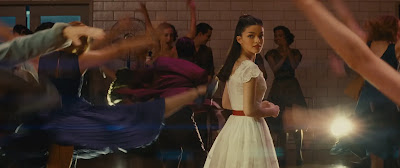
At first—the way Spielberg stages it—she's just someone he sees out of the corner of his eye dancing with another guy, enjoying herself (it's her first dance of the night). Then, he walks the outside of the dance floor, stalking, riveted, and it's almost like that attention is what makes Maria notice him. And from that moment on, he's like Brando's Terry Malloy in On the Waterfront—completely gob-smacked, struck stupid by "the thunderbolt" to the point where he'll do anything—anything—for her. And that previous internal conflict just goes away. "
All my life, it's like I'm always just about to fall off the edge of the world's tallest building. I stopped falling the second I saw you." So, she's gotta be something special.
And Rachel Zegler is. There's something preternaturally attractive about her and not in any traditional way. Her eyes are Disney Princess-huge—of COURSE, they've cast her in the live-action Snow White—sunk deep in her skull and they cut across her entire face. She's doll-like, unnatural, but in the way that sinks into the alligator cortex, turns into goo, and makes you want to buy a puppy. And Maria, the character, is a tough sell, with fast emotional transitions and, if done wrong, can seem like the architect of such chaos that one has no sympathy for her, not even at the end. Some wickedly tough songs, too. Fortunately, Zegler is up to the task, and Kushner has given her far more spine than previous versions. You want these kids to work it out and get out of this dump.
Spielberg takes advantage of every moment—and sometimes just beats of music—to tell his story. There is sure to be some grousing about musical choices and positionings, particularly how the song "Cool" is used—it's moved in transitions from stage to screen to screen, and here it's Tony's number (which, given his role as thwarted peacemaker, works)—and there is one song that I was horrified when it started to come up in the position that it did, but it gives a needed distraction after the big rumble, and raises emotional goal-posts setting up a particularly savage transition for Maria's character to make. 
And some may disagree how the work's most famous piece, "Somewhere," is used—and who it's given to—but the choice is an apt one, making its meaning more ethereal and more universal. Emotionally it feels right.
And the big show-pieces are wonders. The show-stopper is always "America" ("I like the island Manhattan/Smoke on your pipe/and put THAT in") and Spielberg opens it up in keeping with maintaining as much location work as possible. I've made no mention of David Alvarez as Bernardo, the boxing leader of The Sharks or his girl Anita, who is played by Ariana DeBose, and that oversight may be criminal. The two are meant to be more flashy than Maria and Tony and they are the life of the party, all flash and dash, smirk and flirt. Their spontaneity can't be contained, so instead of staging the number on a limited rooftop, it moves from back-alleys to city-streets, whirling and sashaying and running at full gallop until not only the show stops but New York traffic as well. The exuberance is contagious, but freer and feels more risky, more dangerous, more alive.
Why re-make it, you ask? (I dunno. Why remake "Romeo and Juliet?") Because with new interpretations come improvements—or not. It's the chance one takes with producing art. They're not going to stop re-staging it in theaters, nor should they. But, if one must cling to the original, there's always what author James M. Cain said when an associate (John Leonard) criticized a film-version of a novel of his: "They haven't done anything to my books" (pointing to his study) "They're still there on the shelf. They paid me and that's the end of it. They're fine." The original is still there—I have it on DVD—and naysayers can watch it anytime they want. I prefer this version, and I'll prefer it...until a better version comes along.


* Robert Wise, when he made West Side Story, had been making films for 17 years. Spielberg has been making them for 47 years. Hmm.
** Later, Spielberg will have a fight where he borrows a few set-ups from a brawl in A Clockwork Orange. He's not kidding around.