Catching the Cold War
or
"That's Not How the Game is Played"
There's a great scene in Bridge of Spies where James B. Donovan (Tom Hanks) is having a drink in a dark bar with the CIA operative (Scott Shephard) who had been following him on a dark rainy street. The agent, Hoffman, is cocky. He's been following Donovan for the CIA because the insurance lawyer has been tapped (for his work on the Nuremberg trials) to defend one Colonel Rudolf Abel (Marc Rylance), a gray little man, a painter, who just happens to be "red" all over—a Soviet spy operating in New York. The Rosenberg's are dead for selling atomic secrets to the Russians and with Nikita Krushchev in power, tensions between the two atomic powers are getting critical. The CIA in general, and Hoffman in particular, are keeping tabs on Donovan, and in their drizzly cat-and-mouse game Hoffman has come out the better.
Catching the Cold War
or
"That's Not How the Game is Played"
There's a great scene in Bridge of Spies where James B. Donovan (Tom Hanks) is having a drink in a dark bar with the CIA operative (Scott Shephard) who had been following him on a dark rainy street. The agent, Hoffman, is cocky. He's been following Donovan for the CIA because the insurance lawyer has been tapped (for his work on the Nuremberg trials) to defend one Colonel Rudolf Abel (Marc Rylance), a gray little man, a painter, who just happens to be "red" all over—a Soviet spy operating in New York. The Rosenberg's are dead for selling atomic secrets to the Russians and with Nikita Krushchev in power, tensions between the two atomic powers are getting critical. The CIA in general, and Hoffman in particular, are keeping tabs on Donovan, and in their drizzly cat-and-mouse game Hoffman has come out the better.
But, that's on the street. In bars and and offices and meeting places and board rooms, Donovan holds the floor when he wants to. And he's had enough of Hoffman's needling little irritations and superior attitude and condescending appeals to his patriotism. He "bottom-lines it" for the agent. "What makes us Americans? The rule book. The constitution. And that's what makes us Americans. So don't nod at me, you son of a bitch!"
Donovan finishes his drink and gets up to leave.
"Do we have to worry about you, Donovan?" the agent talks to his back.
"Not if you leave me alone to do my job," he says exiting, not looking back.
It's a simple little scene, filled with tension and the implied threat of power. It's a negotiation—one of many in the film—where two sides stand with a certain knowledge of the other's potential for doing good or doing harm and standing firm. The directness of the scene struck me. It felt like the 50's, where men like my father spoke their mind, but held their aces and weren't fancy or poetic about what they said, but spoke economically with no room for misunderstanding. No irony. No code-words. No sports metaphors. No corporate-speak. Zig Zigler had not published yet. No bullshit. I suppose that's what it comes down to in simple terms.

Steven Spielberg's new film is based on Giles Whittell's 2010 non-fiction account of the first negotiated exchange of prisoners during what was called "The Cold War" between the United States and the Union of Soviet Socialist Republics during the 1950's and 1960's...before both countries nearly suffered economic melt-downs by over-extending their reach. A Soviet spy is arrested, and in the red-scare 50's, no lawyer will volunteer their services. So Donovan is asked to take on the defense. His partner (Alan Alda) is all for it. Donovan knows the man needs a defense, and worries that his reputation will be hurt for defending a Soviet spy in the U.S. and is assured that it's an open-and-shut case.
"Great," he jokes. "Everybody will hate me, but at least I'll lose."
The man he meets as his defendant is curt, straight-forward and without pity—for himself or anyone else—he is extraordinarily practical and unpretentious (Mark Rylance gives an understated performance that still manages to steal every scene he's in and makes the most of his dialog written by original scripter Matt Charman, with a polish by Joel and Ethan Coen). He knows how the scenario will fall and, like a good comrade, he will march to the tune that is played.

Donovan has no such sheet music. Abel is his client, and however reluctant he was at the beginning he will take his arguments all the way to the Supreme Court, if necessary. Plus, he likes the guy. In Francis Coppola's Tucker: The Man and His Dream, there's a nifty little dialog between Jeff Bridges' auto manufacturer and his accountant (played by Martin Landau) where Tucker asks him why he goes along with his hare-brained schemes all the time, and the money-man tells him the story of how his mother used to warn him not to get too close to people or he'd catch their dreams. What she meant was "catch their germs" and it's amusing to recall that scene as Abel seems to have a perpetual cold that Donovan acquires through the rest of the movie. Ultimately, he is unable to do anything for the man except get a possible death sentence commuted. But the stage the drama is set in extends far beyond the confines of a courtroom.

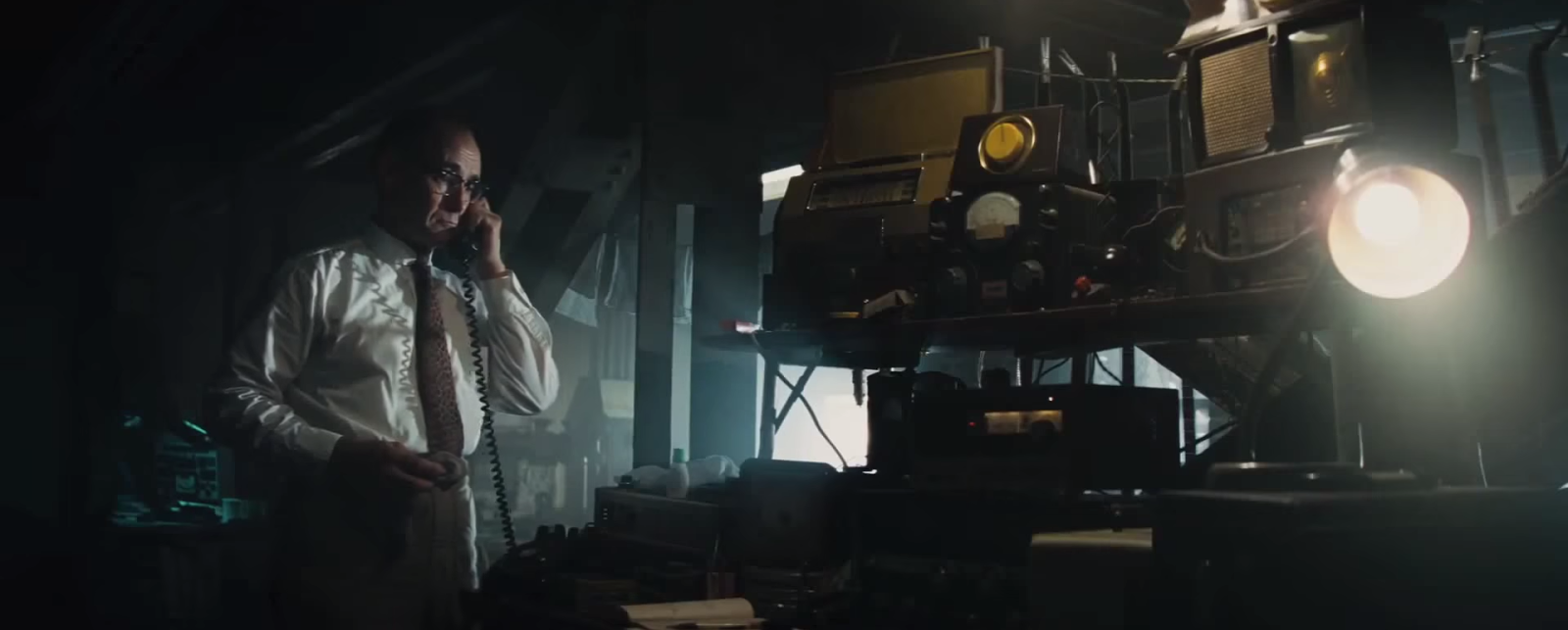
The spy game takes a technological leap from men in rooms with radio equipment with the development of the U-2, a high-altitude jet that take high resolution photos of the subject below. One of the super-secret planes gets shot down, it's pilot Francis Gary Powers (Austin Stowell) is taken prisoner and convicted of spying in the Soviet Union. The U.S. wants him back, more so because they don't want any technical data about the U-2 being betrayed than for getting Powers back. Donovan gets wind that the Russians might swap Powers for Abel, and he undertakes a mission to Berlin at the dangerous time when the Berlin Wall is being erected to try and cement those rumors and make the whispers across channels into fact.

I've written about Spielberg's career extensively in his 4-part "Now I've Seen Everything Dept." entry (and I chose not to run with leading up to the Bridge of Spies release because, frankly, you can only repeat those things so many times before it looks like you're only doing re-runs). When I wrote them, I did them in parts like a High School-College demarcation—Freshman, Sophomore, Junior, Senior—because Spielberg is a life-long student of film and that labeling seems perfect when regarding a movie like Bridge of Spies. This is not some high-octane crowd pleaser as Spielberg has made in the past. This is a mature movie by a film-maker at the top of his game with nothing left to prove other than telling the story well and getting out of the way of it—not unlike his film of Lincoln. There is no showiness, no obvious call-backs to earlier movies, no invocation of the "Spielberg style." Hell, there aren't even any upturned Spielberg "faces" shots. It's just a well-made, well-shot story where the period is immaculately evoked and the tough stuff is in the shaping and tuning of the script to be true to the times and not condescend to the potential audience.*

*Sigh* The Audience. There's been a lot of flack for Bridge of Spies not being a good Spielberg film. I'm not even sure what that means. It's not Jaws? Close Encounters? Jurassic Park? E.T.? Of course not. Those were from the "gee-whiz" Spielberg who was making popcorn spectacle of the type he liked as a kid—and he made Jurassic Park so Universal would fund Schindler's List. No, this is the Spielberg who made Schindler, and Empire of the Sun (but still with the "look at this" camera showmanship), Munich and Lincoln, and down-played his role as director to work more subtly to make them better, more mature films and less of the "Spielberg film" variety. Fact is, in his role as producer and head of Dreamworks, he can assign those "gee-whiz" films to other directors and concentrate on making the ones important to him, more than to the studios' bottom lines. And, with his pick of any subject and working with some of the best writers available, his work is in marked contrast to "this week's superhero movie," (which Spielberg dismisses as a phase "which will go the way of the western") rather than "tent-poles" that will shore up the ledgers of movie studios. He could have mentioned the "disaster" movie. Or the "paranoid thriller." No, in his Senior years, Spielberg will be making movies for the ages, not highest weekend gross. And that's a good thing.

Francis Gary Powers got the cover of Time, Robert Abel a Soviet stamp, but James Donovan, who freed them both, got nothing.
* Although the opening "catching up" titles are hilarious: "1957. The height of the Cold War. The United States and Russia fear each other." No kidding? Now, I understand that some in the audience might not know the context, and that younger members of the audience did not live through it, or that some audience members might have not one iota of historical knowledge. But, really?