Sunday, February 4, 2024

Don't Make a Scene: No Time To Die

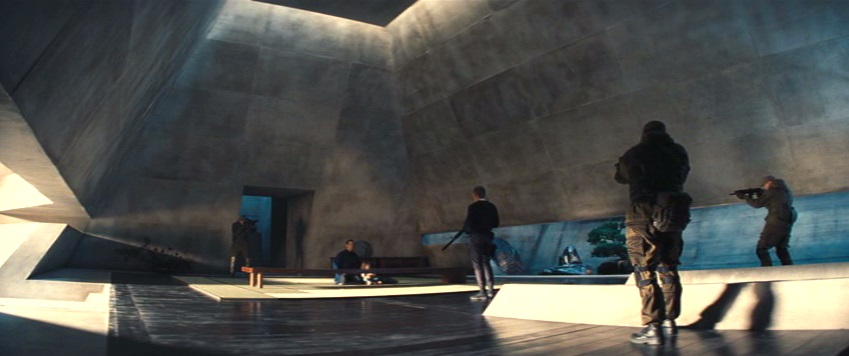
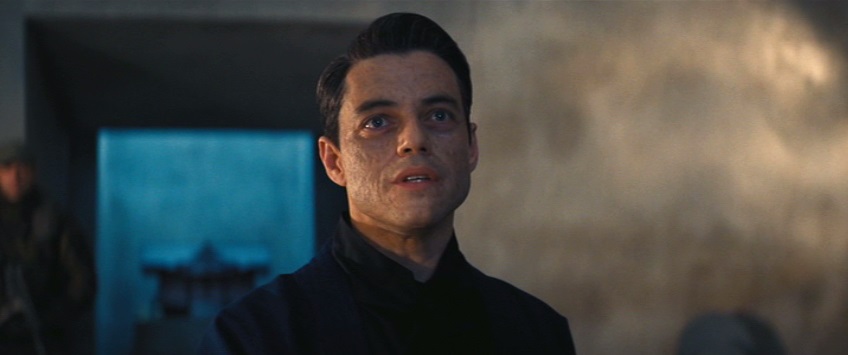
The Story: It's a philosophical argument with very real distractions for the "villain confrontation" in No Time to Die, the last (hoo-boy, is it ever!) of the Daniel Craig James Bond films.

It begins...as every-other discussion in the Bond films seems to do...with an observance that the two antagonists are equals of a sorts—both have dying for a living. Blah, blah, blah. A show of equal footing, perhaps. But, also a show that the villain thinks he's not to be trifled with.

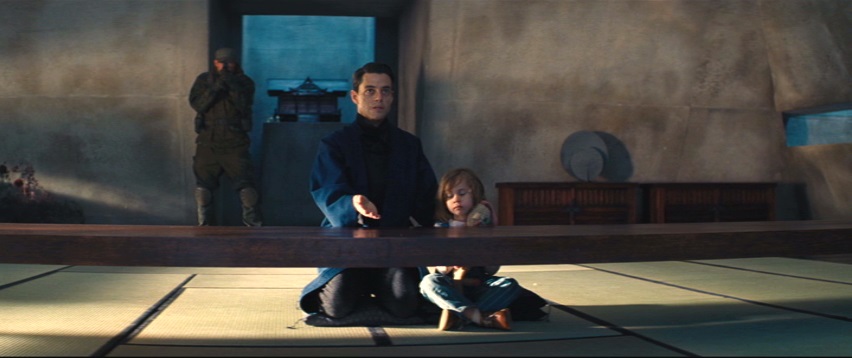
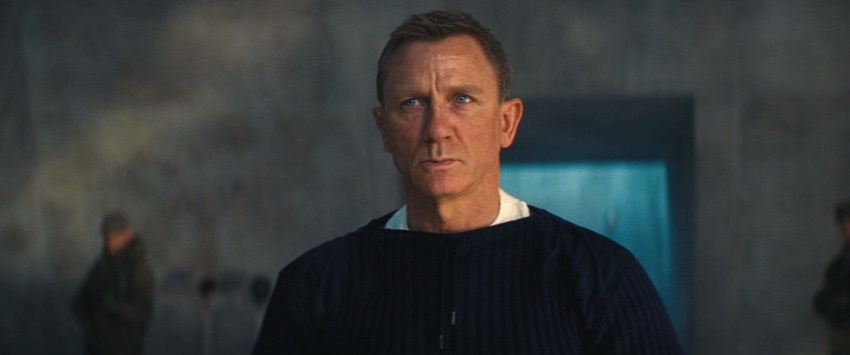
In these things there's usually a "guest" observing the verbal fencing, but this one plays a more important part—she's the advantage the villain has over Bond. She is Mathilde, daughter of Madeleine Swann—and thus, grand-daughter of the man who killed the family of this villain Safin. She also...at this point, we're not sure...might be the daughter of the other half of the conversation, James Bond, retired agent of MI6's "00" branch (and not that it matters, but recently re-designated "007" to make sure he still has a "license to kill"—because "legalities".)
 
Mathilde is the thing to fight over. Safin lets Bond know—right away—that she can be killed at any time. And Bond doesn't want that to happen; he is constantly glancing her way to make sure she's alright—until Safin holds her right in front of him, the better to keep Bond focused, the better to dispatch Mathilde. 

No matter how distracting, this conversation is interesting, reminding one of the that first "here-are-the-stakes-and-I'm-going-to-needle-you-at-the-same-time" tête-à-tête with Dr. No. We hadn't seen something like it multiple times then, so there's quite an exposition dump served with the main course.

Here there's no formal dinner, just two actors chewing the insides of their cheeks with tension. There's no exposition, because they (and we) know what's up. Safin has the upper hand and Bond is trying not to lose his cool—as he had previously in No Time to Die, killing their main source of information. He doesn't want to make that same mistake now. 

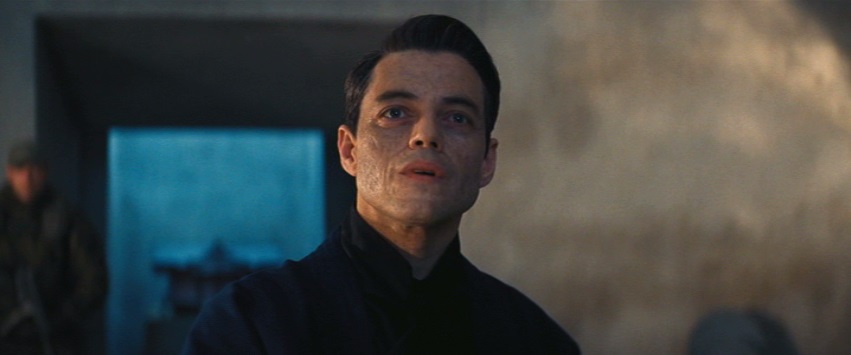
So, rather than, like in the past, riling him up by making a crack about his deformity and that he's a lunatic, and criticizing his tailoring, he tries to ping off the "we're alike" gambit by emphasizing that both of them were orphaned at young ages and "I know what that's like" to try to gain some traction.

No soap. Instead, Safin goes off on a bit of a tangent. Bond sees things a certain way; Safin has another.

In reviews at the time of the film's release, there was a lot of criticism of the Safin character being weak and of this conversation, in particular. But, the more I dug into it, the better I liked it. Safin thinks the vast majority of people are sheep, desiring to be led, if only to the slaughtered. "We want to be told how to live," he opines "and then die when we are not looking." "People want oblivion," he says. At least, the ability to live their lives, go to their jobs, and not worry about the BIG PICTURE. Too much work. They have enough on their plate. Let somebody else worry about that stuff.  And he's enough of a megalomaniac to volunteer for the job.

I hate to say it...but, he's not altogether wrong. We're all pretty dumb. We'd rather keep up with the Kardashians than our local representatives. Gripe if there's a public affairs program interrupting our football (Tch! Like that would ever happen). And even give up our privacy to corporations and foreign governments to show off our dance-moves. Our news is now entertainment—even if they're trying to convince us they stand for Truth. 
 
Nope. Safin may have it right. We want oblivion. We seem to prefer it. I don't mean total destruction, but obliviousness. Same root-word: from the Latin "oblivisci": "to forget." Don't worry. Be happy.

Oh. And how does Bond get the drop on Safin? Appeal to his ego, act submissive...and carry a concealed weapon.

That might have worked, but Safin has a concealed trap-door.

Guess it's a bit of a draw.
 
The Set-Up: Lyutsifer Safin (Rami Malek) is the only survivor of a family who supplied toxins for the crime organization SPECTRE. In turn, the head of SPECTRE, Ernst Stavro Blofeld (Christoph Waltz) instructed his agent Mr. White (Jesper Christensen) to kill the family using their own dioxin chemicals and take over their island manufacturing facility. Now, Safin, in revenge, has wiped out Blofeld and the entire SPECTRE organization using a DNA-targeted poison (dubbed "Heracles" by the British government who were financing it as a deterrent), and, presumably, also Mr. White (who died in the previous film in the series), who happens to be the father of Madeleine Swann (Léa Seydoux), lover of James Bond (Daniel Craig) and mother of Mathilde (Lisa-Dorah Sonnet)—both of whom he has taken to his family's island in the South China Sea. Bond, five years in retirement, and the current 007, Nomi (Lashana Lynch) are sent to rescue Swann and Mathilde and destroy the Heracles toxin. 
 
Inevitably, in these things, there comes a time for negotiation.
 
Action.
 
Bond enters the games room from an underground staircase. 
His rifle at the ready, 
sees Safin holding Mathilde. 
SAFIN Welcome. 
Safin’s GUARD stands behind him, TWO more GUARDS have their weapons trained on Bond from behind the staircase. 
SAFIN (CONT'D) (refers to weapon) On the floor. 
Bond puts his rifle on the floor. 
As he comes up he shows his empty hands. 
SAFIN (CONT'D) And your sidearm. 
Bond hesitates. Safin references Mathilde -- 
SAFIN (CONT'D) Careful. 
SAFIN (CONT'D)
She’s as light... 
SAFIN (CONT'D)
...as a...
SAFIN (CONT'D)
...feather. 
Safin tosses a cushion. 
It flies in the air and then explodes in a barrage of SILENCED GUNFIRE from the GUARD behind SAFIN. 
BOND Alright! 
Mathilde covers her ears. 
Point taken. Bond takes out his sidearm
and lays it on the floor. 
SAFIN Please, sit. 
Bond sits opposite Safin. 
BOND
(to Mathilde) It’s going to be alright. 
BOND
I promise you it’s going to be alright. 
Safin leans back. Appreciating his cards. 
SAFIN
James Bond. 
SAFIN
History of violence. 
SAFIN
Licence to kill. 
SAFIN
Vendetta with Ernst Blofeld. 
SAFIN
In love with Madeleine Swann. (beat) 
SAFIN
I could be speaking to my own reflection. 
BOND
We’ve made slightly different choices. 
SAFIN No, 
SAFIN
...
we’ve just developed different methods for the same goal. Only your skills die with your body, mine will survive long after I’m gone. 
SAFIN
And life is all about leaving something behind, 
SAFIN ...isn’t it? 
SAFIN He smiles at Mathilde. 
SAFIN
(CONT'D) (smiling, simple) This doesn’t have to get ugly. 
SAFIN
You leave my baby alone, I’ll leave yours. What do you think? 
Beat. 
BOND
I think you’re right. 
SAFIN
(surprised) Thank you. 
BOND
I think we are the same. 
Beat. 
Safin says nothing. 
BOND
(CONT'D) We both know what it feels like to have everything taken from us, before we’re even in the fight. 
(beat) 
BOND
It would have been nice to have a... chance, don’t you think? 
BOND
We all should get a chance. 
BOND
But this thing that you’re building, it puts everyone -- 
BOND --
the whole world on a battle field. Nobody gets a chance. 
Beat. 
SAFIN
The thing that no one wants to admit...
SAFIN
...
is that most people want things to happen to them. 
SAFIN
We tell each other lies about the fight for free will and independence. 
SAFIN
But we don’t really want that. 
SAFIN We want to be told how to live, and then die when we are not looking. 
SAFIN People want... 
SAFIN
...oblivion, 
SAFIN
and a few of us are born to build it for them. So here I am:
SAFIN
their invisible god, 
SAFIN
sneaking under their skin. 
BOND
You know that history isn’t kind to those who play God. 
SAFIN
And you don’t? 
SAFIN
We both eradicate people to make the world a better place. 
SAFIN
I just want to be a little... 
SAFIN
...tidier. 
SAFIN
Without collateral. I want the...
SAFIN
...world to evolve. 
SAFIN
Yet you want it to stay the same. 
SAFIN
Let’s face it, 
SAFIN
I’ve made you redundant. 
BOND No. 
BOND
Not as long as there are people like you in the world. 
BOND
And with all due respect to the enormity of your...‘tidy’ achievements all you’re really doing is standing in a very long line of angry little men. 
SAFIN I’m not...
SAFIN
...
angry, just passionate. 
SAFIN
(losing patience) Disable your explosives, get off my island
SAFIN
and you can take this precious little...
SAFIN
...angel... 
SAFIN ...with you. 
Pause. 
BOND
And Madeleine? 
SAFIN
She stays. 
BOND
You know I can’t do that. 
SAFIN
That’s a shame. 
SAFIN She really hoped you would. (then) 
SAFIN
She knows...
SAFIN
...it’s her only path to survival. 
BOND
(Well) You have her tell me that. 
SAFIN
What mother wouldn’t sacrifice herself for her own child? 
BOND
Is that what happened to yours? 
SAFIN
My mother lay at my feet as I watched her die. 
Safin grips Mathilde, 
as if we were going to throw her like the cushion -- 
BOND
Wait, 
BOND
wait, wait!
Safin hesitates --

BOND
(CONT'D) I’ll do whatever you want. 
SAFIN
Yes you will. 
Bond bows, thinking quickly -- 
BOND
I apologise. 
BOND
I’m sorry. 
SAFIN
Simple choices Mr. Bond. 
SAFIN
Like do you want to die in front of your daughter... 
SAFIN
(beat) Or do you want your daughter to die in front of you? 
BOND No, no, 
BOND
...
no. 
BOND I’m sorry.
BOND
I’m sorry. 
Bond bows lower. All the way down to his face. 
Safin is enjoying this. 
SAFIN
Look at your father, Mathilde. 
Safin’s hands drift off of Mathilde’s shoulders. 
SAFIN (CONT'D) This is power. 
BOND
I’m sorry. 
BOND
Truly. 
BOND
Truly sorry. 
Bond’s hidden PPK is out in a flash. 
BANG BANG BANG BANG BANG BANG
-- 
First the GUARD behind SAFIN, 
then the TWO GUARDS behind him. 
As they fall Bond spins his gun to Safin. 
But Safin’s disappeared through a trapdoor in the floor, and Mathilde with him. 
Bond runs, 
his gun pointed down at the place they disappeared 
just as the sliding doors close.


No Time to Die is available on DVD and Blu-Ray from M-G-M Home Video.

I.S.S.

Saturday is traditionally "Take Out the Trash" Day...

"Houston...YOU'VE Got a Problem!"
or
Chekhov's Environmental Control System

I.S.S., of course, stands for International Space Station, that dragonfly-like polyglot of modules—Soviet and American—that were first launched into space in 1998 for construction and was first occupied by people in November 2000. It has been circling up there for 24 years, perpetually crewed—273 individuals from 21 countries—performing observations and doing micro-gravity experiments in "astrobiology, astronomy, physical sciences, materials science, space weather, meteorology, and human research, including space medicine and the life sciences" (according to its Wikipedia page). The darned thing even has a blog. Several documentaries and one fictional film have even been shot in it (I'm sure it's streaming "somewhere"). Five space agencies are involved: Russian, American, Japanese, European, and Canadian all getting along just fine circling the Earth perpetually, quite separate from life on Earth, which has struggled to survive with changing global conditions, wars—civil and not, famine, disease (at times reaching global pandemic levels), changes of governments and coastlines, earthquakes, volcanoes, and an increasing experimenting with autocracy and xenophobia, despite the fact that everyone came from somewhere and migration has been going on for a very long time. Space may be a hostile environment, but it seems positively utopian next to the pale blue dot its circling.
The new movie by Gabriela Cowperthwaite, I.S.S., tries to be as many things as the station, itself. A thriller (paranoid variety), a bottle movie, a "what if?" scenario, a cautionary tale, and a sociological statement of sorts. It pretty much "screws the pooch" (as the astronauts say) on every level, although it does try hard. But, "trying hard" usually just means your booster's going to explode on the pad.
It's the first time up in space for former Marine and NASA astronaut Dr. Kira Foster (
Ariana DeBose—I like her), who is traveling to the ISS for an extended time and she's being counseled by her pilot Christian Campbell (John Gallagher Jr.)—because evidently they don't have training anymore for astronauts. The trip is quick in movie-terms—she gets launched and, all of a sudden, the station is out the window. She advises that the Russians traditionally knock three times before opening the hatch, and this is the one instance where the information they give you doesn't telegraph something's going to happen later in the movie, because they never do it again.
She meets the astro- and cosmo-nauts already there: Commander Gordon Barrett (
Chris Messina), Weronika Vetrov (Masha Mashkova), Nicholai Pulov (Costa Ronin), and Alexey Pulov (Pilou Asbæk). Everybody gets along perfectly fine; Barrett and Vetrov, more than fine, as it's floating around that they're sharing equipment (wink, wink). The veterans show Dr. Foster the ropes—and, apparently, the wires that make everything look like they're in a micro-gravity environment. If one is being charitable, one could say that everybody tries very hard to create the illusion, gently swaying as if they're on a boat in gently-choppy waves, but once one gets used to the fact that everybody looks like there's gravity weighing them down, you just go with it, because there are other issues on board that command greater attention.
Like learning where "the cupola" is. That's the part of the station that provides a lovely panoramic view of the Earth (and is, apparently one of the most popular places on the real space station). Oh, and did anybody mention the station has an "altitude problem" where the station is getting low enough in orbit that the atmospheric drag will start decaying their trajectory around the Earth enough that the whole thing is going to start flaming back down to Earth. Somebody should look into that. Oh, well...let's wait to hear from the ground about it before we do something.* It's a long mission...what's your hurry?
The answer comes soon enough. Foster is Earth-gazing one day and sees a flash just off the Yucatan peninsula. Then, another. Then, more. The flashes starting to spread. "Hey guys? Could you come here please?" she yells back to the crew. They look in horror as the flashes start to spread...and there's no explanation from Earth. All contact with Mission Control, Russian or American, has gone dead.**
Well, that ain't good. The Russian and American teams hover over their radios sending out hails, but nothing's coming back (Hey, I've got an idea...how about firing your boosters and pushing yourselves higher in orbit, so you don't go crashing and burning back down to Earth...ya know, just to give yourselves something to do to pass the time....yeah, no, they don't do that.) Both crews speculate idly, wonder what could happen, and stop talking to each other. Because if their communications systems are dead, why not stop talking at all? Things and people get suspicious and just a little paranoid while awaiting word from Mother Earth.
And, of course, things don't get better. What they get from Mission Control is short and terse: "An act of war has occurred between U.S. and Soviet militaries. All Americans abort all orders and experiments. Priority is to take over I.S.S...by any means necessary." And the Soviets are behaving oddly. They have a problem with their communications antenna—frankly, at that point, who doesn't—and it will require a space-walk to fix it. Barrett volunteers. Nobody else does. But, he decides to go anyway. "Massive lack of protocol," Foster tells him. But, he goes, anyway.
By this point, I had given up. I went to see I.S.S. because I'm a space-nerd. And, it's an interesting premise—what if you're in space and everything goes to shit back on Earth? George Clooney made an interesting, haunting version of this with The Midnight Sky. But, I.S.S. has no such ambitions. It's a ship of recycled parts—The Thing (but without "The Thing"), Alien (but without the Alien), and Solaris for the psychological elements of the paranoia, isolation, and conflict that close quarters can produce in humans. But, that's about it. It's an interesting premise—what do you do when you're the survivors of a war but your continued survival is limited? It's the space-age version of a refugee situation. Do you start fresh, or retain your memories and your grudges and try to regain the past? Interesting questions.
None of which are even approached by I.S.S. It takes the stupid route—let the actions be decided by the blindly militant or the short-sighted paranoids. War breaks out on the space station and any negotiation is disrupted by one of those two types. One might as well be back on Earth if they're going to take that route. There's no forward thinking (as one expects in speculative fiction) only the backwards thinking that produces wars in the first place. Thanks, but I can see that at home.
Still, there were a couple of moments that provoked something approaching interest. At one point, during his space-walk, the commander unbuckles his life-line because he can't reach his next hand-hold and I audibly sneered "you idiot!" (it's okay, I was the only one in the theater), knowing full well that any script that would have something that stupid happen would follow it up with said idiot being bumped off the station. No spoiler alert necessary; the whole movie is a spoiler alert.
But, this is how bad it got, and how low the bar became. At some later point, there is some tension about a knife in the kitchen. And the paranoid character slams the knife petulantly onto the kitchen table-top. Where it LAYS there (in micro-gravity, remember). It doesn't float. It lays there. And I gave the movie-props (what little I could) for not giving us an insert shot displaying some label like "MAGNO-KNIFE©" to explain why it's not floating around in zero-g. That's doing some complicated mental charity that the movie doesn't deserve, but at that point I was desperate to come up with anything good to think about the thing.
 
It's that bad.
They won't be showing I.S.S. on "movie night" aboard the real I.S.S.
Evidently, things get a bit sullen when the Russians are "the bad guys" in the movies. 
(Actually, given the quality of I.S.S., they should consider themselves lucky)

* Um. To put it simply...why? Why wait? The booster rockets they need to get them higher in orbit...are ON THE SPACE STATION. They can't do it themselves? Sure, it's always best to check with Mom and Dad back on Earth, but...if it's an issue, why not DO something about it? "He who hesitates" and all that.
 
** I've talked about the micro-g simulation attempts, but how are the other special effects? Depending on the shot—and there are several crews involved—they can be quite lovely, or Marooned-level terrible. It was actually surprising the discrepancies from shot to shot. The budget, by the way, was comparatively miniscule—$13.8 million (which is about what Star Wars cost in 1977). Godzilla Minus One has a budget just below $15 million.

Friday, February 2, 2024

Nyad

Leave Them Wanting More
or
"Jesus, Mary Oliver!..." *sigh* (Can You See it? Can You See It?)
 
On her 60th birthday, Diana Nyad (Annette Bening) is in a funk. She doesn't want a party—she gets one, anyway, by her friend Bonnie Stoll (Jodie Foster). It's been awhile since she was famed for her marathon swimming. For 30 years she's been working for ABC Sports and she's left with the feeling of "where's the excellence?" She has finally gone through her mother's things, collected after her death, and found a book of poetry that she starts obsessing over. She does that...obsessing.
 
One of the things that she obsesses over is one thing she didn't do in her life—swim the 103 miles between Cuba and Key West, Florida. Her attempts in the 1970's were unsuccessful given currents and unfavorable conditions; they made all of her efforts time-consuming and energy-wasting, and success is measured by strokes and calories, wasting any of them you increase the number of miles and the time needed to do it so that the goal becomes increasingly out of reach. Now, she's determined to do it...by any means necessary.
 
Despite being over 60 years old.
Nyad, on Netflix, tells the story of how that obsession takes over the thoughts and life of the swimmer, and, in turns spills over into the lives of her crew assisting in the effort. It may look like a solo effort, but that it's to be done in open ocean complicates matters. Sailors on perfectly fine boats have sunk, gotten lost, or merely disappeared without a trace in the area, and she's just one person, one tiny speck, in a big ocean. Without supervision, navigation, occasional nourishment, one person is sure to be swamped by time and tide—not to mention the predators that share the space and care more about feeding that making records. That crew needs to observe and document, as well, or the achievement won't be recognized. Going solo? That's not a goal; it's a death wish.
So, Nyad trains, day and night. At the same time, Stoll assists in looking for funding, sponsorship, and a crew, taking into account all the factors that presented Nyad from accomplishing the goal previously. Before, she'd done it swimming in a moving shark-tank. She puts the nix on that immediately. Also, the navigation she'd relied on had her swimming off-course, so she finds a local navigator/boat-runner John Bartlett (
Rhys Ifans) who knows the waters between Cuba and Key West so well as to be an irritant—he's not going to make a mistake and will err on the side of caution, rather than blindly plunge forward (something Nyad would do, even if not hampered by stress-induced poor judgment). 
And for her coach, it's Stoll. No one else. Not so much for expertise on sports medicine—she can hire people for that...and does—but because she knows Nyad so well, the bad and the good. Friends for 30 years, and having dated ("for like 30 seconds") back in the past, she knows Nyad's strengths...and weaknesses—it's why they're merely devoted friends—and knows what the swimmer is capable of—endurance, obstinance, and mania—and can negotiate the rocky shoals of Nyad's narcissism and insufferability to see the right thing and do the right thing when Nyad's tunnel-vision can't. It will test their friendship, despite their long history, to the breaking point, just as Nyad's tenacity is capable of breaking her own endurance.
Which is where the actresses playing the leads come in. Both Benning and Foster are acknowledged as being legendary thespians, but their work here, separately and together, is a notch above what you already expect. Foster, for her part, plays Stoll as a long-suffering aide-de-camp, team-player and punching bag, not afraid to call out magical thinking and just BS, but manages to do it in such a breezy and utilitarian way that one can't begrudge her. One sees the paradox etched into Foster's face as she uses facial muscles that she hasn't flexed in a lifetime of performances. And her bantering with Benning perpetually feels like she's making it up on the spot. It hardly feels like a performance, practiced and perfected, as it does a free-wheeling dance of improvisation. There isn't any past fall-backs here; Foster is exploring new ground.
And Benning? You always knew she was "that" good. But, here she commits to the physical demands and the sheer blinkerdliness of Nyad's obsession. She understands that Nyad's devotion to her own physical perfection to be ready for such a feat makes her such a creature of the internal that the outside world is a bit of an irrelevance and frequently merely a road-block. She spends so much time in her own head that empathy could be a symptom of weakness and her own care-and-feeding of her ego and importance becomes a side-effect of her strenuous preparation.
She's in another world than everybody else. She has to be to endure the tortures and the distractions that will come from the mechanical rigors of moving arms forward and back and kicking for every inch of forward momentum. She may protest that the sea is the perfect place for her to be, but she works and practices and trains as if its her enemy, the more dangerous element of a world that potentially blocks her way. Only in her head is she safe, despite the pain in her muscles, the cramps in her legs, the building weariness and decomposition that she is only too aware of and fights to ignore.
You got to be crazy to do something like that, and Benning leans in to the crazy, quite recklessly, not caring that it might sacrifice audience sympathy (after all, Nyad, herself, wouldn't). It's gutsy and unapologetic and just plain fierce.
The directors, 
Jimmy Chin and Elizabeth Chai Vasarhelyi, need something like that. This is their first dramatic film—they've only done documentaries before this, one of which was Free Solo, so they know about athletic rigors and the discipline and the potential for mental anarchy that can ensue. Athletes themselves—they're avid rock-climbers as Free Solo demonstrated—they know about risk and discipline and distraction (a good section of Free Solo was the crew discussing how they could make their work not be a distraction for climber Alex Honnold) and they do a good job of creating the painful monotony (without over-doing it for the audience) of such a challenge while imagining the head-space that Nyad must make for herself. It's a nice "all things considered" approach that only raises the stakes and ensures audience involvement. You fret. Which means the filmmakers have done their job.
It's an amazing piece of work and it would be nice ("nice") if there was some recognition for this during awards season. But, one has to admit, that it's likely to be swamped by its considerable competition. You can't train for that.
 
Time and tide, after all...

Thursday, February 1, 2024

The Lost Weekend

We're getting down to the bitter dregs of reviews I wrote for the "old" web-site, so, appropriately, here's another one directed by Billy Wilder, that—cautionary tale that it is—still manages to hold up through force of writing and some astringent direction.

The Lost Weekend (Billy Wilder, 1945) Don Birnam (Ray Milland) is an aspiring writer, drunk and sober, caught in a self-defeating loop of dependence and neurosis. His dependence on, and devotion to, alcohol has put him into a tail-spin of false confidence and self-loathing where his dreams are only out of reach because he can't pick himself off the floor. His "rye" attitude drowns his dreams and feeds his nightmares and without it, he's brittle, paranoid and living in the future, waiting for the shot-glass aimed at his destruction.

Sounds like so much fun. Sounds like a "speech" or a lecture coming on. Sounds like one of those movies "for your own good." Sounds like I'd rather have a drink. Fortunately, Billy Wilder's in charge, and yes, it's preachy at times, but most of the time, it's tough as nails and doesn't hold back on what a louse Birnam is without alcohol, and how pathetic he is with it.
But, it's not "Pity-Party: The Movie." Wilder makes it clear that Birnam is his own worst enemy and the alcoholism is just a symptom. At the movie's start with Birnam barely through a week of sobriety and packing for a trip in the clean country upstate New York with his brother (Phillip Terry), it's all he can do to keep from eyeing the bottle he has hanging out his apartment window. Milland's performance is brittle, officious—like Cary Grant without the stick pulled out. But, once his brother and girlfriend (Jane Wyman, pathetically co-dependent) are out of the way, Milland's eyes go snaky looking for alcohol in his apartment's old familiar places. Then, once he's got a burn going on, Milland is in full glory as an actor—an amazing performance, eerily reminiscent of Gloria Swanson's Norma Desmond four years in the future (and also directed by Wilder).
There are joys aplenty in this film, not just from some cracker-jack writing, but also Wilder's direction—putting Milland in front of a subtly discombobulating projection-screen for his long "wild turkey" chase to find a liquor store open on a Jewish holiday, the nightmare sequence of the alky ward and the subsequent "screamin' meemie" sequence in his apartment. There are also great performances by
Howard Da Silva as a particularly wary bartender, and a wonderfully creepy performance by Frank Faylen, who is eerily complacent telling Birnam about the tortures of DT's.
Part tract, part horror film, but without the absurd homilies of Reefer Madness hysteria, The Lost Weekend lets you off with a warning this time.The Lost Weekend was a co-winner of the Grand Prix at the very first Cannes Film Festival (Ray Milland won Best Actor), and it went on to win Oscars for Best Picture, Best Director, Best Screenplay and Best Actor. Only two films in history have won both the Palme and the Best Picture Oscar.*

Premiere Magazine voted it one of it's "25 Most Dangerous Movies."
**
* This was written many years ago—see the addition below—but since that time, it's only happened one other time since, with the Korean film Parasite in 2019. It's still a pretty damn rare happenstance.

* Paramount was pressured by both the alcohol industry AND temperance societies not to release the film. It did so on a very limited basis to critical acclaim, encouraging the tee-totaling studio to take a chance and open it in more theaters. I originally ended the piece by saying  "All that, and it has yet to be chosen for the National Film Registry.(What are they? Drunk?)" . It was voted into the National Film Registry in 2011