No, I've been wanting to put this scene up because I've already done the similar President/Premier exchange from Dr. Strangelove and it's interesting to do a compare and contrast. The two stories are very much the same—just the occurrence that sparks it and the ultimate horrifying conclusions being a bit nuanced (as if playing with mega-tonnage can be considered "nuanced). Strangelove's source was a 1958 novel by Peter George called "Red Alert", while today's film came from an American best-seller by authors Eugene Burdick (who'd co-written "The Ugly American") and Harvey Wheeler. An out-of-court settlement from a "copyright infringement" suit over "Fail-Safe's" origins resulted in Strangelove being released first, to critical and box-office success, then the next year, Fail-Safe—to critical applause, but negligible box office. Once you see the satire, the serious version seems a lot less serious.
It's why Kubrick took the route he took. He was specifically working out a scene where the U.S. President aids and abets the Russian military to destroy U.S. bombers. Kubrick was not shy of portraying horrific military ironies—he had a French general firing on his own troops in Paths of Glory—but, he balked at this. It IS nuts! No one would believe it. Just like no one would believe a President would bomb one of his own major cities in a retaliatory strike to prevent Armageddon. But, Fail-Safe does that, and with a straight-face and with absolute sincerity. And it comes across as absurd.
It did back then, anyway. These days, who knows what politicians are capable of? They keep surprising us every damn day, with some new absurdity and rather than apologizing, doubling-down on it. I wouldn't be at all surprised to see a politician nuke an American City—especially one that didn't vote for them. That's what we've come to. Apes with nukes.
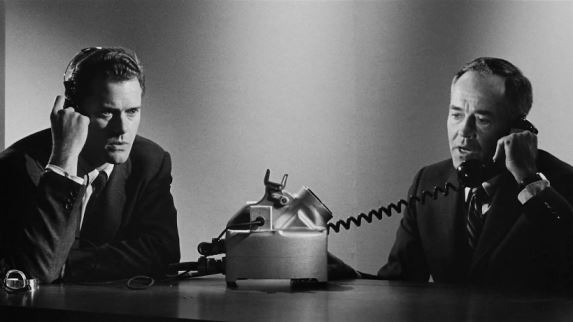
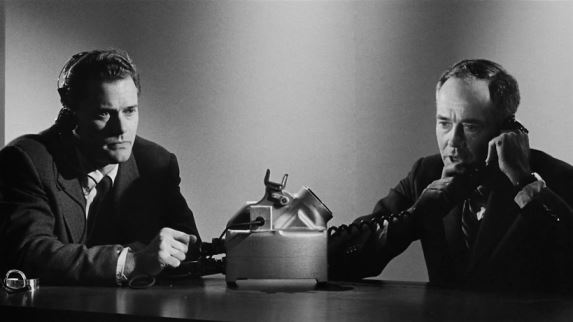
Well, the scene: It's a full 6 minutes (by Lumet's clocking on the film's commentary track) without a cut, just Henry Fonda and Larry Hagman (Lumet thought it was his first film—it wasn't, he'd been doing TV and theater for awhile), hashing it out with a telephone (the prop was the type of phone they use to relay orders on demolition sites using high explosives) between them without a net and the camera in both of their faces the whole time. It's a high-wire act, and they're both amazing in it.
But, again, you can't help but not think of the crazy: the Premier's coming on-line and asks "How are you?" or Hagman fumbling with his glasses because they won't work with his head-phones—and realizing the absurdity of THAT at a time like this. Fonda gives Hagman a reassuring smile before the phone-call, an odd reflex, and when the call's over, he grabs a glass of water and pushes the decanter to Hagman. This is farce. And they're playing it straight.
Sincerity just doesn't cut it when you're presenting something that beggars the imagination.
The Set-Up: Something's gone wrong! An unidentified aircraft has entered American air-space! No worries! It's an off-course civilian airliner. But Air Force jets have been scrambled—apparently not the only thing—and one of them, Group 6, is on-course to bomb Moscow due to a computer glitch. The president (unnamed, but played by Henry Fonda) is sequestered to a bunker buried far beneath the White House with his translator, Peter Buck (Larry Hagman). There, after learning that USAF attempts to knock down the bombers have been unsuccessful, he calls the Soviet Premier to tell him the bad news.
Action.
THE PRESIDENT:
Buck, I'll talk to the Soviet premier now.
PRESIDENT:You'll translate
what he says to me.
He'll have his own translator
telling him what I say...
PRESIDENT:but I want something more
from you.
-
BUCK: Yes, sir, whatever I can do.
-
PRESIDENT: I think The premier will be saying what he means...but sometimes there's more
in a man's voice than in his words.
PRESIDENT:There are words in one language
that don't mean the same in another. You follow me?
-
BUCK: I think so, sir.
PRESIDENT: It's very important the premier and I
understand each other.
I don't have to tell you that.
So I want to know what he's saying
and what you think he's feeling.
PRESIDENT: Any inflection of his voice,
any tone...
any emotion that adds to his words...
I want you to let me know.
BUCK: Yes, sir. I'll do my best.
-
PRESIDENT: I know you will.
PRESIDENT: It's all any of us can do.
Don't be afraid
to say what you think.
Don't be afraid all this
is too big for you.
PRESIDENT: It's big, but it still depends
on what each of us does.
History lesson number one.
THE PRESIDENT: I'll talk to Moscow now.
The phone beeps.
BOGAN: It's the premier, sir.
THE PRESIDENT: Mr. Chairman, this is the president
of the United States.
Do you hear me clearly?
BUCK (translating): Fine, Mr. President.
How are you?
THE PRESIDENT: I'm calling you
on a matter of great urgency.
I hope it turns out
to be a small matter...
but it's the first time
it's happened.
If it's misunderstood,
it could be...
BUCK (translating): Does it have to do
with the aircraft...
we have detected
flying towards Russia?
THE PRESIDENT: Yes, Mr. Chairman.
BUCK (translating): I suppose it's another of your
off-course reconnaissance flights.
Mr. President,
we have warned you again and again...that this constant flying
of armed aircraft...
THE PRESIDENT: This is a mistake, a serious mistake.
BUCK (translating):Very well.
Tell me. Tell me the mistake.
THE PRESIDENT: A group of our bombers each loaded
with two 20-megaton bombs...is flying towards your country.
BUCK (translating): We shall watch with great interest...while you recall them.
THE PRESIDENT: So far we have been
unable to recall them.
BUCK (translating): Are...are the planes being flown
by crazy men?
THE PRESIDENT: We're not sure.
It...it, it might be a mechanical failure.
All I can tell you
is that it's an accident.
It's not an attempt to provoke war.
It's not part of a general attack.
BUCK (translating): How do I know you do not have
hundreds of other planes...coming in so low
our radar cannot pick them up?
THE PRESIDENT: Because I hope to prove to you
that it's an accident...that we take full responsibility...that we're doing everything we can
to correct it.
BUCK (translating): Go on.
THE PRESIDENT: You must have seen...that we sent fighter planes
to shoot down the bombers.
BUCK (translating): American fighters...to shoot down American bombers?
THE PRESIDENT: That is correct.
BUCK (translating): And you gave that order?
THE PRESIDENT: I did.
BUCK (translating): How do I know that the planes
were not simply diving...
to a low altitude
to escape our radar?
THE PRESIDENT: On our plotting board, the action
could only be interpreted...as planes out of control.
THE PRESIDENT: You have the same equipment we do.
What did it tell you?
BUCK (translating): It did not tell us what is
in your mind, Mr. President.
THE PRESIDENT: I'm telling you that.
BUCK (translating): And you ask me
to believe you?
THE PRESIDENT: You must believe me.
BUCK (translating): You ask for belief
at a curious time.
THE PRESIDENT: If we don't trust each other now,
Mr. Chairman...
there may not be
another time.
BUCK (translating): We saw, we saw your planes
fall into the sea.
I wanted only
to hear your explanation...and whether it was done
at your own order.
BUCK (translating): It is a hard thing to order men
to their death, is it not?
THE PRESIDENT: It is.
BUCK: Sir, there's someone trying
to persuade him it's a trick.
They want him
to strike back at once.
BUCK (translating): Soviet airspace has still not
been violated, Mr. President.
But if it is, we will be forced
to shoot down your bombers.
BUCK (translating): And then we will come to full alert
with all our missiles and planes.
THE PRESIDENT: I understand that. I hope you're able
to shoot down our bombers.
But I urge you not to take any steps
that cannot be recalled.
BUCK (translating): You know we must
protect ourselves.
THE PRESIDENT: You also know that if you
launch missiles, we must do the same. If that happens, there'll be
very little left of the world.
BUCK (translating): I understand.
Is there anything more
you wish to say?
THE PRESIDENT: If I may make a suggestion...I will arrange to open
a conference line
between our headquarters
in Omaha and your similar officials
in the Soviet Union.
We will do all we can
to help you.
BUCK (translating): We do not need your help.
We are...
BUCK (translating): ...perfectly capable
of defending our country.
THE PRESIDENT: As you wish, but I must tell you
what my people tell me.
No matter what you do...at least one of the planes
will get through to the target.
BUCK (translating): What is the target?
THE PRESIDENT: Moscow.
BUCK (translating): I'll call you back when I see
what our fighters do.
"The Following is a Product of Female Imagination" says the title once the opening narration ofWomen Talkingis finished—opening line: "This all happened before you were born"—and it's a bitterly defiant statement as we've just learned that the women of a Mennonitecolony--who are being systematically drugged with cattle tranquilizers, raped, beaten and often impregnated--have been chastised by the men of the colony that their accusations are hysterical, or that they're being visited by ghosts or demons or that it is all a product of "wild female imagination," and holds no truth in reality. Their reality.
"Wild female imagination." "Female Imagination" does not bruise and it cannot make pregnant. Men do that in their male imaginations and plots. Because they can. Because they think they can get away with it. Because they can't do it any other way. Because they're allowed to get away with it. Because their authority can't be questioned.
And because accusing the men of it (they say, because it's "their colony") will mean that the women won't be able to go to Heaven for their "lies." The men, presumably will, because there's nothing in The Ten Commandments about hypocrisy.
The men have now gone into the neighboring town to try and make bail for the accused attackers. They will be gone for more than a day, and, when they return, the women are expected to apologize...and if they don't recant, they will face excommunication and, of course, not be able to reach the Kingdom of Heaven.
So, while the men are gone, the women take a vote—their first—and because they are prohibited from learning to read or write, It's done with pictographs and X's.
There are three choices. Stay and Submit. Stay and Fight. Flee. Leave the colony.
The vote is split between "Stay and Fight" and "Leave the colony" and so, the women choose representatives to discuss what will be done, the ramifications, the logistics, what will come next. And to keep a record of their discussion, they recruit the one male left behind, August (Ben Whishaw)—whose family was excommunicated due to his mother's objections to the men's dictates—to record the minutes of their meeting, a record to be left behind.
Three generations of women discuss what comes next: elders Agata (Judith Ivey), Janz (Frances McDormand), and Greta (Sheila McCarthy), daughters Ona (Rooney Mara), pregnant with the child of her attacker, Mariche (Jessie Buckley) and her children, and Salome (Claire Foy) all gather in a barn-loft to discuss their options and make the decisions before the men-folk come back. They know the situation is intolerable—although Jenz decides that she will stay and leaves the discussions early—and they have to decide what sort of life they want for themselves. And for their children, who are also subject to the men's attacks—the most recent attack was on Salome's four year old daughter.
It's a particularly appropriate time to have movies like this, as women's autonomy is under attack in this country and throughout the world (it's why the recent adaptation of "The Handmaid's Tale" recently resonated so much in the collective zeitgeist—while the 1990 film of it couldn't make its costs back—and as the #MeToo movement exposed the pervasive inequities in the power structures as women cemented their places in the workplace and in government). The only way to fight the entrenched power structure is in an organized group-dynamic that can up-end the status quo and maybe drown it out.
Women organizing and re-asserting power is as old as "Lysistrata," but writer-director Sarah Polley (Away From Her and Stories We Tell), has other things to discuss in Women Talking besides Fight or Flight. Good Lord, one of these days the Library is going to have a "Revenge" genre in their DVD selections, and that easy solution is dissected and vivisected in the course of the movie, because some of the women just want revenge. This multi-generational congress weighs options based on need, principals, philosophies, and viable futures...which includes going to heaven. In a way, it is it's own version of Twelve Angry Men—call it Eleven Angry Women—where prejudices are revealed, motivations are explained, and minds are changed. And it's performed by some of the best and subtle actors in the field.
If there's a complaint, it's that the introduction is a little rushed, some of the circumstances of the women involved not made clear from the outset, leaving an audience-member confused rather than intrigued. And Polley desaturates her images so far into the gray scale that it could almost be black-and-white. As some directors (Welles and Bogdanovich and Ford) have pointed out, sometimes color can be just too pretty for what you're trying to convey and the film-matter, though set on acres of fields is far from verdant. The film is a tough-sell, anyway, perhaps the distributors insisted on a color film, and this was Polley's solution.
And for anyone who grouses that the film is any sort of "stretch" it's based on a book that took as its inspiration, what was called "The Ghost Rapes of Bolivia," where, beginning in 2005, women in a colony began to be subjected to this type of outrage and decided to leave, trusting in God that She would provide.
This was written at the time of the film's release. Damn my eyes for being prescient.
And thematically, it has a lot to do with the film we'll present tomorrow (which I'm furiously editing to make it more about THE FILM, and less of a rant—it might be pretty short!).
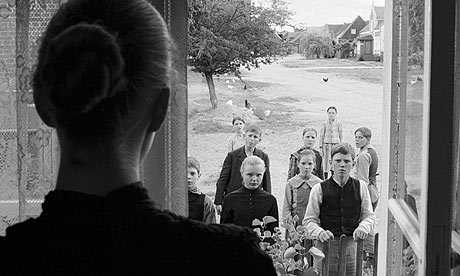
"Das Dorf der Verdammten"
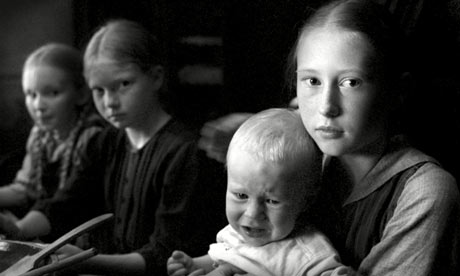
In memory, a tailor recalls 15 extraordinary months when the village of Eichwald, Germany was beset by tragedies that divided the populace, as small as it was. The town is a self-sufficient cell, run by a Baron, who is a somewhat benevolent provider and moral leader in the Protestant community, the town's schedule built around the growing seasons and the natural order of things. All is calm in the Lynch-ian manner of normal.
But, the tenant-farmer's wife is killed in an industrial accident when she falls through a rotten floor-board into the gears of machinery, the doctor cannot save her, and the family is thrown into despair—some seeing it as an unfortunate accident, others blame the Baron for the negligence of the floor's up-keep. It becomes either The Way Things Are, or a conspiracy and a schism occurs amongst the reverent.
Soon, other "accidents" occur: the doctor suffers an injuring fall when his horse is fallen by a trip-wire. The Baron's cabbages are scythed into pulp, and his son is found hog-tied and beaten. The Baron's wife is horrified and takes her son to a retreat in Italy. Relationships implode and families are torn asunder, and no one can figure out why. The incidents escalate, and no one does anything.
Parallel to this story the teacher (who will age to become the Narrator) begins a chaste romance with the Baron's nanny, and notices a change in his students—they're becoming more rebellious, less prone to obedience, something noticed also by the Minister, who, in an attempt to impress his brood, ties a white ribbon in his eldest daughter's hair and a white sash around his first son's arm to remind them of their "innocence and purity" when they were younger. But, what was once a declaration of love and pride in their early years is now a punishment.
This is another of what we can now call director Michael Haneke's "Fables"—small stories of incident with lessons that reflect a larger truth about mankind and history. Shot in color, but processed in a distancing and denatured black and white, the shadows of the interiors of the houses are sometimes impenetrably dark and some individuals are made out only at the bare margin of perceptibility. Perception is important in The White Ribbon, (aka Das weiße Band)as it reflects what we see when we want to see it and how we interpret it. That parts of the escalating problems plaguing Eichwald in The White Ribbon are due to hubris and denial.
The film and incidents end at the assassination of the Arch-duke Ferdinand, where, of course, everything starts to go down-hill, but even at the start of the slide, implies Haneke, the seeds of the Holocaust were sewn in the fields of a blind aristocracy.
There is something ingenious, if not precious, about the conceit: a murder mystery featuring the creator of the modern detective story.*
Sure, every depressive knows Edgar Allen Poe as the writer of morbid, anguished poetry with repeated lines at the ends of stanzas. But, with his publication of "The Murders in the Rue Morgue" in 1841, he began a new genre of mystery story, based, not only on the dark corners of the human psyche, but it's very opposite, the power of reasoning and deduction—or what he called "ratiocination." With the success of his Dupin stories, came the inspiration for Doyle of Sherlock Holmes (he never shied from admitting it or his other sources) and, from there, the progeny of the countless numbers of problem-solving busybodies that have expanded and pushed the envelope of the Dewey Decimal System for decades.
Homage must be paid.
The Pale Blue Eye(love the title...) begins with an image, a surrealistic scene veiled in fog, of a man handing by the neck from a tree. But, something's off. His feet are on the ground, rather than being suspended above it. The explanation for that image will take the entire movie to explain, but already you're hooked, and that image is a wonderful metaphor for a mystery. Something deadly has happened, but why, and by whom, needs to be sussed out. Only one person knows and that is the one who did the deed.
It's 1830. Retired constable Augustus Landor (Christian Bale) lives a solitary life in his rustic, but well-libraried cabin, another in a long line of isolated men, known for "getting a confession with just a stare." His wife died many years ago, and his only daughter, whom he mourns, has disappeared—a mystery that still haunts him. One day he is greeted by Captain *ahem* Hitchcock (Simon McBurney) from nearby West Point Academy. One of their cadets has been found dead—he'd been hung, apparently, but the most grisly aspect of the deed is that his heart has been carved out of his chest.
Landor has some restrictions put on him by the Academy Superintendent, Thayer (Timothy Spall):he is to report to him and Hitchcock daily on his progress; he works for them as an employee as long as they approve of his work; interviews with cadets must be done with Hitchcock's supervision; he can't drink on the job. There is a tavern in the town, however, which he visits after hours. He runs afoul of the Academy's physician, Dr. Marquis (Toby Jones), when he proves himself unsatisfied with the doctor's autopsy—but Landor's thorough work does win him enough grudging respect that he is invited to the doctor's home, where he meets his somewhat-hysterical wife (Gillian Anderson, always great, even when she's not doing the autopsies) and his children, cadet Artemus (Harry Lawtey) and his lovely daughter Lea (Lucy Boynton).
The cadet interviews do not go well. The young men are less than forthcoming-especially under the baleful eye of Hitchcock. But, there is one young Virginian cadet who attracts Landor's attention, not only because he has an obvious intelligence and grand-if precise manner of speaking. He's also a bit of an outsider at the Academy, a frequent object of scorn among the students...and the instructors.
This is cadet E.A. Poe (Harry Melling), not the finest example of military discipline, frequently seeking permission to be excused from outside drills, citing poor health and spending his time writing poetry. When Landor first meets Poe, he is struck by his eloquence and directness, but more by his opinion that the perpetrator may have chosen a mundane way to kill the victim, but the cutting out of the heart "makes him a poet." Poe's creepiness makes him a "usual suspect" as far as murder mysteries go, but at a later meeting in a tavern, Landor suggests to him that they should work together on the case, as Poe might have opinions—and access—that Landor could use.
Then, there is Landor's mentor, Jean Pepe (Robert Duvall), an elderly recluse, with a vast knowledge of all things ritualistic and arcane. It's always good to see Duvall in anything, and his presence reminds one of the useful—but supplementary— characters that inform and give a certain historical sub-text to many a fictional detective.
The investigation twists and turns like a speckled band—no, the story doesn't involve snakes—but, is enhanced and complicated by young cadet Poe's besotted enchantment with the doctor's daughter Lea Marquis, prone to seizures that might be due to epilepsy—or maybe it's just a family curse.
Oh, this one is a corker, with a resolution that will surprise casual mystery watchers, and inspire appreciative smiles from aficionados with its echoes of Poe's own detective fiction. There might be a bump or two in motivation, a red-herring here and there (aren't there always?), but, by the end, one will be properly sanguine with the mystification they experience.
And the cast is top-notch. Bale isn't grand-standing here with tics and business, but relies on a relaxed body language that he rarely employs, and the relationship between he and Melling's overelegant Poe is a nice study in contrasts in a mutual admiration society of two. Director Cooper keeps things moving swiftly and takes full advantage of cinematographer Masanobu Takayanagi's ability to create astounding images of nature and the unnatural. And Howard Shore's score is lovely, another wonderful example of why he should be doing more music for films these days.
It's a very well-done film, that is only undermined by the fact that it will never light—and darken—a theater screen, where it can be truly appreciated, and, although it is nice that Netflix gave it a healthy paycheck to be produced, why it should be relegated to a small screen, is a real mystery.
* When the Mystery Writers of America organization hands out their little trophies, they are dubbed "The Edgars." There are some scholars who begrudge Poe the title. But, they can't do anything about the little statues.








.jpg)