Sunday, September 6, 2020

Don't Make a Scene: Beat the Devil

The Story: The thing about any conspiracy is that all the parts have to work in order for it to be pulled off. The problem is--it rarely does. Oh, conspiracies work in thrillers of the "paranoid" variety, but most of the time in real life, the "conspiracies" don't work—because of that added element of "not knowing what you don't know." The "Mission: Impossible" TV series got that right—all that careful planning can be undone when your safe-cracker gets his hand busted in an unexpected closing door, or (in Dial M for Murder) the husband hasn't planned for his murderer to put back the entry-key, or (The League of Gentlemen) nobody thought about kids collecting license plate numbers.

Yet, we think everything in a conspiracy will work because the MOVIES tell us so. Every time the hero borrows a guard's uniform to remain undetected, it fits. Nobody sweats from nervousness. That intricate gear you brought, it'll always work...first time, every time, and no tinkering will be involved.

John Huston knew that movies weren't like life. That's why in his movies, those big quests end with everybody losing everything—and they laugh about it. Beat the Devil started out as a "Maltese Falcon"-type story (where Bogart and Huston began their successful collaboration)—at least that's what the original novel felt like—when Huston suggested to Bogart that he buy the rights and they'd make it together. But, Huston's scriptwriters at the time, Peter Viertel (who wrote the Huston roman a clef, "White Hunter Black Heart,") and Anthony Veiller produced a script that he found uninspiring.

At the suggestion of star Jennifer Jones' husband, the producer David O. Selznick, Huston—at the last minute—hired the young Truman Capote to re-write the script while the filming was taking place and Capote would stay up nights writing, re-writing and amending a mere couple days before that particular scene was filmed. As a result, there is a bit of a "chaos factor" to Beat the Devil, a satire of the sort of thriller Huston had, by now, grown tired of. Cynical and world-weary, the movie has that cynical laugh Huston usually reserves for the end of his movies and keeps it running throughout. 

After all, in a world where everybody is looking out after themselves, how can any conspiracy be maintained.

The Set-Up: Billy Dannreuther (Humphrey Bogart) has been going through a period of adjustment down-sizing. Once a wealthy owner of a villa, he is now reduced to working with a business partner, Peterson (Robert Morley), who, with three other "colleagues" are engaged in trying to purchase land in East Africa, rich in uranium. This would be an easier partnership if anybody trusted anybody else. After a seemingly unending series of complications, the group is stuck in an African coastal town when they've abandoned their passage by lifeboat. The local official, Ahmed (Manuel Serrano), suspects they might be revolutionaries given their unlikely means of arrival, and the group's squabbling have not reassured him. Dannreuther has managed a distraction so that he might be alone with Ahmed to get down to some real negotiating. 

Action.
AHMED: Tell me more about Rita Hayworth. You really know her very well? 
BILLY DANNREUTHER: Do I know Rita? Do I know her. I'll give you a letter of introduction. 
DANNREUTHER: She'll fall an immediate victim to your charms. 
AHMED: You really think so? 
DANNREUTHER: Oh, most certainly. A man like you: suave, intelligent, darkly handsome. You have everything, Ahmed, except money. 
DANNREUTHER: And if you listen to me, a boat...  
DANNREUTHER: ...will be placed at our disposal. A very slow boat. So that fat gut's check will have plenty of time to clear. 
AHMED: And you will trust me for your share? 
DANNREUTHER: Does one man of the world ask another to trust his own brother? 
DANNREUTHER: Oh, no, Ahmed. You'll give me a check for half. 
AHMED: Your demands are very great under the circumstances. 
DANNREUTHER: Well, why shouldn't they be?  
DANNREUTHER: Fat gut's my best friend. I will not betray him cheaply. 
AHMED: You are certain that you are the friend of the peerless Rita? 
DANNREUTHER: Come, come, Ahmed, 
DANNREUTHER:  ...mind back to business. 
AHMED: Very well. Fifty-fifty. 
DANNREUTHER: Oh, uh, by the way... 
DANNREUTHER: ...fat gut's nature isn't noble like ours. He might try to bargain. 
AHMED: I do not bargain with a puffball like that. It's beneath my dignity. 
DANNREUTHER: It'll be dawn soon. The correct hour...  
DANNREUTHER: ...for a firing squad. 
AHMED: But if we have him shot, what about the money? 
DANNREUTHER: Well, I was just thinking...  
DANNREUTHER: ...that if he heard a volley at the psychological moment, he might not be so inclined to haggle. 
AHMED: I believe you must have Arab blood. Westerners are not usually so subtle.

Beat the Devil

Words by Truman Capote, John Huston, Peter Viertel and Anthony Veiller

Pictures by Oswald Morris and John Huston

Beat the Devil is available on DVD and Blu-Ray from Twilight Time and other sources (and as it's in the public domain), you can also find it for free on the Internet...like here.

Friday, September 4, 2020

Women Make Film: A New Road Movie Through Cinema

Women Make Film: A New Road Movie Through Cinema (Mark Cousins, 2018) Turner Classic Movies has a month dedicated to "films made by women" all month with the lynch-pin being this new documentary by the fellow (man) who made The Eyes of Orson Welles and, more importantly, The Story of Film: an Odyssey.

Now, you might be saying "Of course, women make films" ...because Patty Jenkins. Ava DuvernayGreta GerwigOscar winner Kathryn Bigelow. Hell, Barbra Streisand. But, then, there are so many others: Jane Campion, Lena DunhamLina Wertmuller, Mary Harron, Ida Lupino, Sofia Coppola, Penny Marshall

Lynn Shelton. Adrienne Shelly.

Some may pick out Agnes Varda or Dorothy Arzner or Leni Riefenstahl. Still, there are so few women compared to men, that it is still the exception rather than the rule.

And while that is so, the need for a documentary of this type, on this subject, becomes necessary, as much for documentation, rather than to point out any aesthetic difference noticeable behind the camera. Communication through film is an art, one of reflection and illumination—the creator must look inward in their consideration of what will communicate outward. The frame of film limits what one can see and so what one shows and how they show it must hit the sense-memory and the imagination of those who see it. 


But, one has to see it in order to appreciate it, and that's where the numbers come into play and are significant. A lot of what is presented hasn't been seen, whether it has been limited by market or availability—there are a lot of foreign films (foreign to the U.S., that is) but the universal communication that happens with an image transcends borders and language. As the blurb at the bottom of the blog says: "Not everyone can be a great artist, but a great artist can come from anywhere."


As long as one sees and feels, one can be a film-maker—and I'm not even sure about the first one...there have been some great one-eyed film-makers.


The mission statement is made clear in the first episode (entitled appropriately "Openings") narrated by Tilda Swinton: 
What follows is not about the directors' lives. It's not a chronological history. It's not an analysis of how women directors are different from men. And it's not one of those lists of the best films ever made.
No, it has cleaner lines than that. Our film is about the films...the scenes. It answers practical questions:  What's an engaging way to start a film? How do you set its tone? How do you make it believable? What's an inventive way of introducing a character? How do you make a tracking shot magical? The sort of questions you ask when you're making films...or watching them. What about dream sequences? Dance routines? The work-place or politics? How do you film bodies? What's a great way to show love, tension, memory or death. 
We'll ask 40 such questions in 40 chapters. 40 montages on the road. 40 stories about great cinema. This is a film school of sorts...in which all the teachers are women. An academy of Venus.
It's full of examples, hundreds of examples, a montage of scenes from movies across the world...and from many decades.
Your favorite films might not be here. Your favorite directors might not be here. We're not trying to be comprehensive. In fact, we've avoided some of the mores famous films. But, there are surprises in what follows. Revelations.
Feel free to be angry because some of these great films have been overlooked. But, feel free to be delighted at the medium of film, and of the women on whose shoulders we stand.
The sub-title after the colon, at first glance, is a little precious—as are Cousins' many shots of highways, bi-ways, roads and paths that serve as interstitials and buffers. But, it is apt given that explanation of what the documentary is NOT, and of the roads and paths it doesn't take on its journey.

It's a sampler, of sorts, of the extraordinary and exceptional. It has no agenda other than to be an appetizer to satisfy a curiosity and encourage exploration (which the film certainly does and TCM has provided airings of some of the films, complete). As a document, it is a map of the possible that just hasn't been seen...yet.

There are destinations ready to be explored. Let's go.

Thursday, September 3, 2020

Time After Time (1979)

Time After Time (Nicholas Meyer, 1979) He really wanted to direct. 

Nicholas Meyer enjoyed a couple of best-selling books—one of them, "The Seven Percent Solution", had been made into a film for which he supplied the screenplay—and dabbled in screen-writing—he wrote the script for "The Night That Panicked America" about Orson Welles' Hallowe'en broadcast of "The War of the Worlds." But, directing...that was a tough job to get even if you were a lauded writer, screen-writer, and proved you could crack the public's consuming zeitgeist. I mean, who d'you think you are...John Huston?

Meyer had been given fifty-five pages of a novel that a friend was writing and wanted Meyer's opinion—seeing potential in it, he optioned the story which featured 19th century author H.G. Wells going into the future via time machine to pursue Jack the Ripper into the 20th Century. Meyer took that nugget of story, wrote a screenplay and sold it to Orion Pictures with the caveat that he was to direct.

Meyer's "time" had come.
H. G. Wells (Malcolm McDowell) is upset about the current times of 1893. He holds a dinner party for some friends (are you getting a sense of deja vu yet?) to show them his recent invention—a time machine, which he intends to use to seek out his vision of "Utopia" by using the device to travel into the future. But, his device isn't so fanciful as the one in his novel; it has a couple of safety features of his own devising to prevent such accidents as might happen when traveling through time...and should one mis-lay their time machine in their travels.

His little dinner party is interrupted, however, by the police who are investigating the Whitechapel murders and its perpetrator, known as "Jack the Ripper." A search is made of Wells' house and two things are discovered: a doctor's bag containing bloody gloves that belong's to Wells' guest, the surgeon John Leslie Stevenson (David Warner); Stevenson has gone missing, and with him Wells' time machine. "Jack" has escaped into the future, and Wells, with no machine, cannot pursue him.*
Ah, but those safety devices that might prevent the time machine from being used by "Morlocks" or something—here's where they come in handy. One of them is a key, or, more specifically, a "non-return key" that, as long as it's in the machine, keeps it in the designated time. Stevenson, not having it, is left in the future as Wells' machine travels back to its original time after a certain period. Pretty handy, that. As is the second device a "vaporizing equalizer," another key, which prevents the traveler from journeying through time without the device.

Wells' time machine returns like a well-fed dog and he ascertains that Stevenson has traveled into the future, specifically November 5th, 1979 and, with keys well in place, he takes the journey in his machine—a safe bet, after all, as it seems to have worked for Stevenson. Wells makes it, finding himself still in his time machine, but which seems to have made its way to 1979 San Francisco (explained because the machine—at the time—is loaned to an S.F. museum for an exhibition on H.G. Wells). Wells starts to become acquainted with 20th century customs like fast fried food, aeroplanes, television, the vagaries of fashion, and "fish-out-of-water" tropes in movies. 
But, he's after Stevenson and his first bit of detective work is to divine where a man of his century would go to exchange money of the 19th century for that of the 20th. There, he meets Bank of London employee Amy Robbins (Mary Steenburgen)—who seems to be getting more of these requests than she's ever seen in her employ. She directs him to where the previous gent asking about the exchange rate for old currency is currently keeping himself.
Wells finds Stevenson and he seems to be adapting quite well to the new age. All Stevenson has to do is turn on his hotel room television and show Wells the carnage going on in the world, telling him "Ninety years ago, I was a freak. Now, I'm an amateur." Wells insists that Stevenson return to their time and face justice, but Stevenson will have none of it, trying to get the "non-return key" from Wells, and, in a struggle that spills out of the hotel and into the streets, Stevenson gets hit by a car. Wells, thinking Stevenson is dead, stops his pursuit.
But, Wells knows nothing of cars or of modern hospitals...or of the implacability of his quarry. Stevenson is quite alive...and up to his old ways. And one of his intended victims is Amy, whom he has rightly deduced led Wells to him. And as Amy and Wells have developed a budding relationship, the stakes become very personal...especially after a short jaunt to prove the viability of his time machine has shown her that (via a future newspaper headline) that she will become one of the Ripper's victims in three days' time.
It seems strange that one could make a charming romance out of a story using one of the most infamous of serial killers, but Meyer's Time After Time manages to do it. That has less to do with the Jack the Ripper plot, but more with the way Meyers makes a romance between McDowell's Wells—who thinks he's ever so sophisticated for a man of his time—and McDowell's Amy—who's decades ahead of his Victorian thinking and is more than casual about it. Meyers has fun with it—he loved taking the Star Trek crew out of their element in Star Trek IV: The Voyage Home—and his dexterity keeping the Wells-Robbins scenes frothy are the parts that will delight someone seeing this film for the first time.
It's Meyer's first film directing, but the film has the flair of a much more accomplished director, partly because Meyer seems to have taken his direction from more classic films—it just seems to have the edge of a Billy Wilder, while also retaining his romantic quality. Part of that might be the atmosphere provided by Miklós Rósza, who provides the sort of sophisticated, ardent film score that he had previously produced for Hitchcock...and Wilder and brings the sense of a by-gone era that fits well bridging both the 19th and 20th centuries.
It's a good, literate little film that provides the thrills and wonder of its earlier inspiration—Wells' novel and the George Pal film made of it—while also bringing something new to the party, this time around.


* "Sure, he could," you say. "All he has to do is build another time machine and go" (In this instance, time does wait...) Yes, I counter, he can build it, but to go where—or more correctly, when? He doesn't know where Stevenson/Jack has gone—into the anonymous past or into the unknowable future. So, Meyer's little safety devices are necessary...or else we'd have no movie at all.

Wednesday, September 2, 2020

Action in the North Atlantic

Tom Hanks has a movie out on AppleTV+ called Greyhound, based on C.S. Forester's "The Good Shepherd." For the similar scenario from the time-frame in which it occurred, there was this movie...

Action in the North Atlantic (Lloyd Bacon, 1943) Rousing war-time propaganda film about the Merchant Marines and their attempts to distribute supplies for the war effort while fighting off Nazi air and sub attacks. Directed by Lloyd Bacon whose experience in the WWI Navy lends an undisputed air of authenticity to the scenario, if the visuals don't exactly hold up due to some sub-par model work mixed with chock-a-block stock footage (expertly shuffled by soon-to-be director Don Siegel). Still, the opening sub attack on the vessel Northern Star is impressive for its brutality and its dangerous looking fire work. The actors look convincingly too close for comfort, and the sense of peril is very real. And that's just the beginning of the film. After that first explosive set-piece, there is a lull as the survivors get back to the home front (Skipper Raymond Massey goes home to a young Ruth Gordon, who's a treat to watch). Then it's back to sea as part of an intricately planned flotilla, delivering supplies to...Murmansk, Russia. We're all in this together, comrade.
Massey's the skipper, but the star is Humphrey Bogart, two steps away from gangsterism, and cracking wise. He's First Mate Rossi, whose "too easy-going to be a skipper," but given a chance could be a cracker-jack commander. Bacon sets up the rules and procedures for the vast convoy, but an attack in the mid-Atlantic separates the "Sea Witch" from the rest of the ships, and the rule-book goes overboard as the ship plays a cat-and-mouse game with a lone sub determined to sink it. 
While the flotilla attack is dependent on that unconvincing model-work, there's a later Luftwaffe attack on the ship that features amazing wire-work effects, not only on the planes maneuvering through the clouds, but also of bodies being blown from their stations when the ship takes a direct hit. There's no sugar-coating the dangers of war, but the difference between the sides seem to be that the Nazi's scream when they go their watery grave, while the Americans merely have their quips halted. Various strategies are employed to evade the sub, including "going quiet," thanks to the Scottish engine-man who will remind any watcher of a certain star-ship engineer willing to eke out "a wee bit more."
The action doesn't slacken as Bogart's Rossi makes a bold move setting the "Sea Witch" on fire to draw in the sub, and the film ends with a Rooseveltian declaration of solidarity (probably voiced by Stan Freberg), which would prove to be problematic in the 50's when McCarthy went after Hollywood. All in all, an interesting film for all sorts of historical reasons beyond the propaganda factor.
Bogart has a great speech about bravery mid-way through the flick that's worth noting:
"Let me tell ya something about my "iron nerve," son. It's made of rubber, just like everybody else's, so it'll stretch when you need it. Ya know, people got a funny idea that being brave is not being scared. I dunno, I always figured if ya weren't scared, there's nothin' to be brave about. The trick is...how much scarin' you can take?"

Tuesday, September 1, 2020

Che

Written at the time of the film's release. I saw Soderbergh's "Roadshow" version, before it was split into two parts.

"The Face That Launched a Thousand...Poster Sales"

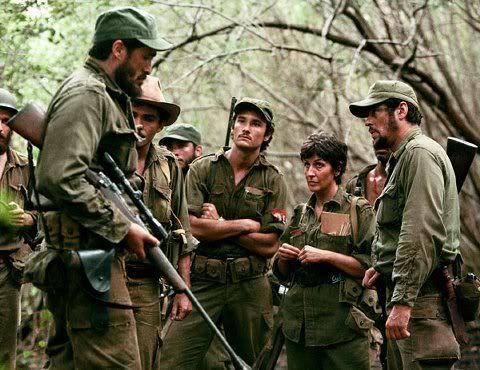
As I did with W. here are some very brief political comments on the subject of the Ernesto "Che" Guevara bio-pic "Che":* I don't look at the world with red stars in my eyes, and think History has proven that Communism is a flawed political system where human beings are concerned. In the Cuban Chapter of that story, Che was The Revolution's question to George W. Bush's answer: An ideologue who thought nothing of spreading his vision to nations other than his own, whose patriarchal attitude towards foreign peoples blinded him to the hypocrisy of spear-heading "revolutions" that he had no part of. While Castro settled in to enjoy the spoils of his coup, Che felt the need to "spread freedom" throughout the world, a "freedom" that was inherently in his country's best interests (sound familiar?). This, and other ironies are not explored too deeply in Steve Soderbergh's massive 4 1/2 hour epic, which is less a biography of Che, as it is a necessary chapter in the evolution of the "War film."

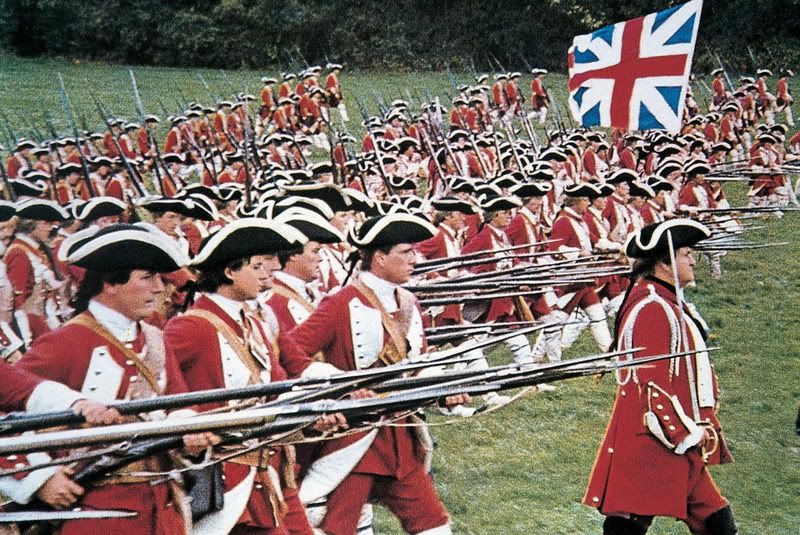
Blame the American Revolution, I guess. When those up-starts chose to battle the British in extremely non-formal (and un-cinematic) patterns, film-makers have been struggling to bring some sort of cohesion to the chaos of men at war. Face it. Watching patterns of soldiers moving forward in massive lines is great cinema. Crowds of men (you've supposedly come to know as characters) rushing forward pell-mell in a panic is tougher to capture and make sense of (though Welles did well, and Gibson). Better to keep the numbers fewer, or better yet focus on one participant, be he John Rambo or Oliver Stone's Pvt. Taylor. Bush-fighting—that's another story.

Soderbergh starts his two films** with maps: of Cuba in Part 1 (subtitled "The Argentine"); Bolivia (And South America), in Part 2 (subtitled "Guerrilla"). The major cities, territories and geographical locations are pointed out one by one, each with their own color (which made me wonder "Is that the color filter he'll be using in that location?") But it's a great technique—so great I'm surprised it hasn't been done more. The familiarization of the territory means you never have to orient the viewer again about what's happening where. And so, Soderbergh and his screenwriters Peter Buchman and Benjamin A. van der Veen don't have to do major scenes of exposition talking about over-arching plans before battles (especially in an improvised war). Tossed off mentions of cities will suffice. The audience will remember.
This allows Soderbergh to streamline the momentum of both movies; We're allowed to focus on characters, survival tactics and the problems of motivating volunteers on a perpetual camping trip with a dodgy supply of weapons and the opportunity for disaster around every corner (but isn't that any soldier's view of war in the field?). Nor is there the need to stop every few minutes and have a Juan Esposito character come in and talk about "The Big Picture." We've been given the run-down of the territory (and despite these being revolutions, all wars boil down to real estate.
That this revolution was a jungle war of fighters coming down from the mountains as self-employed mercenaries to either win hearts and minds of the native populace (it is stated repeatedly that Che was not Cuban, but Argentinian—it's even in the title of the first film) or to re-supply or target a government stronghold. As with any war, a lot of it depends on luck and a lot of it depends on what the other side does not know but suspects. Both elements helped the rebels defeat the Batista government forces...who were Cuban, and felt a loyalty to their homeland, and an affinity to the rebels as they were countrymen. They also didn't have much fight in them, when push came to...nothing much.
Despite a "to-the-bone" performance by Benicio Del Toro (the film is almost completely in Spanish, although those who would speak English do so), Guevara remains an enigmatic figure. There are attempts to de-mythologize him--his frequent asthma attacks make him a hindrance to the fight, but as a physician he is able to treat it to a certain extent. He starts as being the Chief Medical Officer, and gradually works his way to being a field commander and strategist. By the end of the first film, he is clearly in charge of his small brigade and the film ends with an extended house-to-house battle in Santa Clara that features a surprisingly well-orchestrated train derailment. Soderbergh shoots in an effective hand-held style, as in a news-reel (mostly shot by the director himself) that gives the street-fighting a see-it-now authenticity, rather than a well-orchestrated set-piece (which it had to have been to film).
Taking the myth out of the fight and the romance out of the struggle is a lot of what makes the marrow of Che. We see the day-to-day problems of the guerrillas fighting disease, starvation, infection and the occasional opportunist. Soderbergh and his screenwriters put forth a Che Guevara who is principled to "The Revolutionary Code," with a piece-meal sense of morality. The portrait is a noble one, but the film-makers subtly undercut it, allowing cracks between the lines, details that are not called attention to. Although a supposedly brilliant strategist, Che (and Castro, nicely portrayed by Demian Bichir) are seen frequently smoking cigars in conversation. Unless the jungle's on fire wouldn't that be a tell-tale sign to patrols that there are humans nearby? Not to mention that those Cuban cigars are made through the exploitation of Cuban nationals (and mostly women at that, in sweat-shop conditions). Women are seen fighting with the guerrillas, but that macho attitude doesn't seem to be applied to them. At one point, Che's second flirts obliquely with him, which he deflects by mentioning his wife and child in Mexico City, although by the start of the next film, he is married to her (with three kids). 
Soderbergh is not-so-subtle in one juxtaposition. At the beginning of the second film, Castro reads Che's farewell letter in which he states his intention that should he die, his last image will be the same blue sky seen by his Cuban comrades. When his last moment comes Soderbergh switches (for the first time) to a point-of-view shot to show us the unromantic reality of his last vision. If there is anything marring Soderbergh's scrupulously lived-in presentation, it is in the "star-cameo's" that occasionally crop up to jar you out of the situation, as much as they do in The Greatest Story Ever ToldFranke Potente and Julia Ormond (in a blonde wig so as to be unrecognizable, but really, can one make a serious picture these days without Julia Ormond?) are seen in city surroundings where their movie-star looks blend a bit, but jungle scenes of Matt Damon and Lou Diamond Phillips tug right out of the jungle and back into Hollywood. 
But the arc of the two movies allows you to see the "Che" you want to see: the "Che" triumphing in adversity of Part 1, or "Che" scrabbling into an inevitable defeat in Part 2. There's a lot of history not gone into in-between, but for the polarized, and the polarizing this will do for now.

"Now, watch this drive."The real Che, after la revoluçion.


* Thus, avoiding Godwin's Law: The longer an Internet string, the more inevitable a comparison to Hitler will be made. I've seen too many comment threads on this film devolve into the "Evil Che" harangue (usually by people who haven't seen it). Thank you. That corner exists on the Internet somewhere and I would suggest going there, even though I'm not entirely unsympathetic. But if it shows up in this comments section it will be erased...permanently. Any attempts to add it again will be erased...permanently. Try to add it again, and you should check into a hospital because you're clearly trying to see a different result from the exact same action and that is a sign of insanity. I have no patience with ideologues who've long stopped thinking. I'm here to discuss the film, and I'll discuss it or The Birth of a Nation or Triumph of the Will. Film is controversy--unless it's Marley & Me...and even then...

**After its "Road-Show" performance (which is the one I saw), Che will be released separately (if all goes according to plan) as Che, Part 1: The Argentine and Che, Part 2: Guerrilla. IFC, which is distributing the film, is also making it available as a Pay-per-View Event.


***One more thing, completely tangential:  During his ill-fated campaign in Bolivia (after his never-mentioned ill-fated campaign in the Congo) Guevara lived under a series of code-names, as he was trying to keep his presence in that country a secret. In Part Two, he's known as "Ramon" and then in his last days, as "Fernando." I walked in not soon after the Inauguration whistling "Black Superman-Muhammad Ali,"  but walked out with "Fernando" in my head.  I don't think the writers of the Abba song were making a connection.