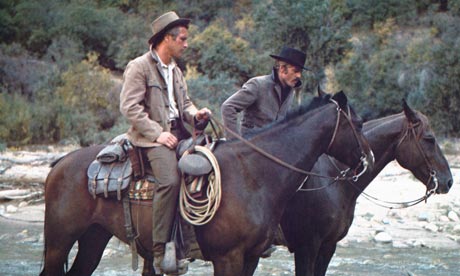
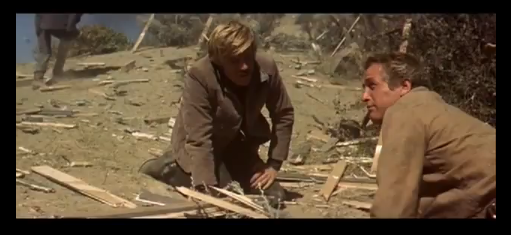
Butch Cassidy and the Sundance Kid(George Roy Hill, 1969) It is probably for certain that Butch and Sundance were not as entertaining (or as well-scrubbed, with feathered hair) as Newman and Redford, nor that they rode bicycles to Burt Bacharach songs. But then the originals didn't have William Goldman writing for them, either, and though the script starts by saying "Most of what follows is true" you can also bet that much more of it isn't. As it is, it's not a history lesson. It's a grittier, more-influenced-by-European-film version of the previous season's Cat Ballou (which had earned Lee Marvinhis Best Actor Oscar).*
And, in point of fact, I have a hard time thinking of it as a Western, despite the desert settings, the horse-chases, the posses, the train robberies, the clapboard houses, the sense of a passing age, all the traditional acoutrements of the classic westerns, but done coyly, cutely, and with an eye towards having a good punch-line (but not much point). It's a Western trying to be modern, but saying it's true to the period.
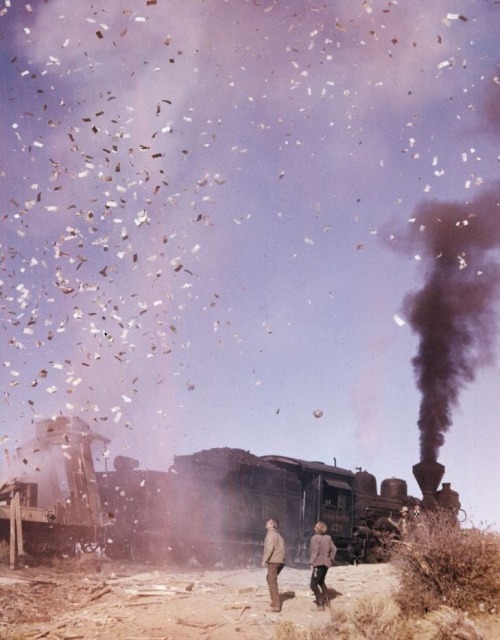
Where it does bear the stamp of a traditional western is its through-line of Butch and the Kid being temporary things, caught in the period between the Civil War and the Industrial Age, where the "old ways," with their easily slipped-through dependence on civilization (and the inherent difficulties achieving it in a frontier environment), are replaced by organization, technology, and machine-like precision that are a threat to outliers, dependent on improvisation and fast getaways. The advancements of the 20th Century—bicycles and streets and (gulp!) dynamite—while all well and good, are an impending threat to scraping out an existence on the land, even if the way you do it is scraping other people's existence.
"Think ya used enough dynamite, there, Butch?"
And as much as Butch and Sundance try to adapt ("Think you used enough dynamite there, Butch?"), it ends up blowing up in their faces. It's why Butch's oft-repeated line (that always falls like a lead balloon and a quizzically raised audience eyebrow) "I've got vision and the rest of the world needs bifocals!" only works in that context, and in a cluelessly ironic way, at that.
No wonder they go to Bolivia. It's still the Wild West down South, while the U.S. becomes gentrified and outgrows outlaws. There's a serious thought in there amongst the yuck-lines and the counter-intuitive Bacharach bubba-bubba choruses glossing over the action sequences. As much as Hill, Goldman and Bacharach try to make it larky and fun, it's still doom-laden, without the inherent triumph of civilization over chaos that provides the spine and invigorates—and makes hopeful—most Western films.
"You crazy? The FALL'll probably KILL you!"
It's never flat-out stated that, though never arrested, the Hole-in-the-Wall gang* are products of arrested development—a better name might be the "Stuck-in-the-Mud" gang—making the whole enterprise an exercise in feeling sorry for the kids who never grew up, or wised up, making the whole show a pitiable "Peter Pan" picture. Maybe it is better to have bifocals. You, at least, see your way clear.
One thing you can't fault is the cinematography of Conrad Hall.
Entertaining? Maybe. And in the short run. But kinda dumb, too.
The Final Shot
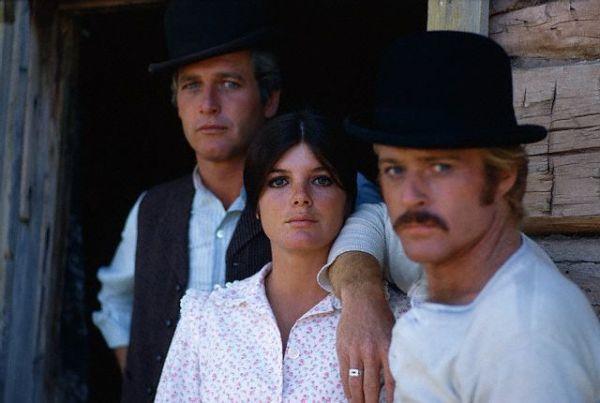
Period photography in the film (above)
and the real Sundance, Etta (Ethel) and Butch at Cholila Ranch (below)
* Just the year before, Sam Peckinpah made another Western about another Hole-in-the-Wall gang with the same arc of old-timers growing too old to see times change and survive. That movie was his masterpiece, The Wild Bunch, which created a revisionist kind of Western, that, along with Sergio Leone's Italian Western series, re-made the Western genre from the form that had become ubiquitous on American television sets in the late 1950's and early 1960's..
Film Without Control
or "A Desperate Venture Shared by Desperate Men"
With their part in the legal untanglement, restoration, editing and post-production of the last Orson Welles film The Other Side of the Wind, Netflix decided that they'd better increase their investment by simultaneously making a documentary on the making of the film—a story that is as fascinating and convoluted as the film itself (how could it not be with Welles as the central figure?). It might also be useful as a as testimony and evidence for a tale that might not be believed. TitledThey'll Love Me When I'm Dead, it documents Welles' idea for the film from its inspiration through the chaotic filming some ten years later, through the complications about rights that prevented Welles from completing it in his lifetime, and ultimately covers the efforts by die-hard associates and completists to make it happen 33 years after the director's death. Documentary filmmaker Morgan Neville (who made 20 Feet from Stardom, Best of Enemies: Buckley vs. Vidal, and the recent Won't You Be My Neighbor?) has done a nearly encyclopedic job of gathering together archive footage, out-takes, interviews with survivors of the project, and bits and pieces to tell a great deal of the story—without some of the more head-scratching intricacies—and keeps it wildly entertaining...and properly melancholy, as well. Just like Welles might have done it.
Cinematographer Gary Gravers' audition—filming Orson
All of that stuff makes it fascinating, and behind it all is Welles, both master of his craft and victim of it. The story is well-documented in Josh Karp's book "Orson Welles' Last Film" in such detail that one can't help but admire Welles the film-maker making a movie with the barest bones of support, but shake your head ruefully at Welles the producer, robbing Peter to pay Paul, constantly over-spending the funds he's able to attract as performer, voice-over actor, and lecturer.
There is also that too many people asked him "what did you do after Citizen Kane?" and he had the hope that, in coming back to Hollywood, after a self-imposed exile during the McCarthy years, he was seeing kids with far less experience making movies and enjoying success—"I've lived too long not to make a successful picture."
He'd been kicking around an idea, partially inspired by an encounter with Hemingway, partially bitterness at his own circumstances, partially autobiographical, partially not, about making a movie about an old time Hollywood director (he chose John Huston to play the part) who is making an artsy movie of the type Antonioni was making at the time and trying to get funding from the studios, who are dubious at his age, dubious that there's no script, and just aren't interested. The movie juxtaposes "found footage" of the director's birthday party by (and for) his sycophants, juxtaposed with sequences from the film. That's a nutshell take on it (there'll be a review next week), but the making of it was chaotic, willfully so, in order to capture the energy and dangerousness of a Maysles Brothers film.
Huston and Little at the beginning of filming
During the course of the movie (which started filming July 4, 1970 and ended...sometime in 1975), actors came and went, ideas were filmed then tossed, then new material added, locations switched—Peter Bogdanovich started off playing one role, then years later was asked to come back and play the role that Rich Little was initially signed to play (one that was vaguely based on Bogdanovich himself). Filming finally moved from Welles' rented locations to Bogdanovich's house, which eventually caused a rift between the two film-makers, exasperated by Bogdanovich's successful directing career, creating a Shakespearean Falstaff-Prince Hal analogue. It wasn't the only one.
Bogdanovich's nebbishy cineaste at the beginning of filming
Welles was tireless when he was creative, and he demanded a tireless loyalty. He rarely got it, but one of the technicians on the film devoted his life to Welles' every whim, just to be a part of an Orson Welles film. Cinematographer Gary Graver heard Welles was in Hollywood and simply called him up at the Beverly Hills Hotel. Welles demanded that he come over immediately with equipment and, there and then, auditioned the cameraman for the Director of Photography job. And Graver never left, devoting his life to filming Welles' many a-borning projects and, after Welles' death in 1985, to trying to resolve the conflicts that prevented completion of The Other Side of the Wind, until his own death in 2006.
Welles' partner, Oja Kodar, and Gary Graver.
Welles, during his last years, tried to negotiate settlements between financiers and holding companies and banks, all to no avail. After his death, there were those who were trying to protect Welles' last film (including his partner during the last years, Oja Kodar, and Beatrice Welles, his daughter by wife Paola Mori—to whom he was still married) and those making false claims that they owned the rights. One of the investors was the brother-in-law of the Shah of Iran, and after the Iranian Revolution, those funds dried up. Two of the original crew-people, Bogdanovich and Producer Frank Marshall were among those who kept the dream alive for decades...companies like Showtime and Netflix started doing their own productions to fill the need for content, and crowd-sourcing raised some funds.
It's a maze of cul-de-sacs, but Neville manages to make a great through-line of the history of the film—now that there IS a film, one that actually has an ending. And the way he weaves in all the archive footage is close to masterful. It's quite the juggling act, even if the star of the piece is killed off mid-way in the story.
Alan Cummings narrates
Now, it will be even more fascinating to see the end product. We'll have a review next week.
Power Ballads, False Notes (Is This the Real Life/Is This Just Fantasy)
or Mercury Rising (Buddy, You're a Boy/Make a Big Noise/Playing in the Street/Gonna Be a Big Man/Some Day...)
They've been working on the story of the pan-sexual rock band "Queen," which is now calledBohemian Rhapsody, for quite a long time now, starting with a treatment by the amazing Peter Morgan (who also wrote THE Queen—maybe that's why they changed the name) and somehow being pureed into the Hollywoodized fairy tale that the movie ultimately becomes—a cautionary tale of all the trouble you can get yourself into by being yourself, no matter how brilliant and talented you might be. Harsh? Maybe. But, there are so many conveniently conventional falsehoods in the telling of the story that one wonders just what the agenda was here. Buttressed by scenes of Queen's appearance at Live-Aid—considered by many the greatest performance by a rock band seen by millions (and I've included it below because it IS amazing—I thought so when I saw it live oh-so-many years ago—but also to show some truth about just how good that band was/is), it tells, rather fictionally, how Farrokh Bulsara (played by a prosthetic-toothed Rami Malik) joined the rock band "Smile" and turned it into "Queen" and himself into Freddie Mercury, rock legend.
Not to disparage Malik—he does a damned good job in the part, despite being much too short and slight to play the part and, frankly, too odd looking, especially in the eyes, to really pull it off—and Bryan Singer's direction is competent, if a bit perfunctory for him (he was fired from the project and the reasons why are conflicting depending on who is asked and the film was completed by Dexter Fletcher*, who was attached to direct until Singer was hired) but, it's the story that's a let-down; it just didn't happen this way.
Really—does this look like Freddie Mercury to you?
Bohemian Rhapsody takes the easy (and dramatically quick) route out every time it comes to explaining any of the highlights in the Queen story, frequently portraying legend rather than fact in order to gin up conflict for a story of the price of fame and unconventionality that is...very conventional in terms of a cautionary Hollywood tale of getting everything you want "except *sob* happiness."
Bulsara did not just happen upon the band "Smile" on the very night their lead singer decided to quit for another band—he'd been following them for quite some time, was a fixture at their performances, and friends with the band-members, even with their turn-coat singer. In the film on the same night, he meets his "love of his life," Mary Austin (Lucy Boynton) at the same venue during a chance meeting (the reality is it was anything but chance, she came into the band's circle when she was dating Brian May, but that is never mentioned). In the film, the fractures within Queen that lead to their break-up (which never happened) is blamed on Paul Prenter (Allen Leech), who, after being rejected by Feddie Mercury, makes himself useful as an assistant to the band, then just the lead singer, isolating him, driving a wedge between him and anyone Prenter sees as a threat, making him the "Iago" of the story.
Prenter is finally let go when Mercury finds out that he's been scuttling any chance of the band reuniting for 1985's Live-Aid concert, necessitating an unhealthy Mercury to clean up his act and get his voice back, risking disaster at the world-broadcast concert; In real life, he didn't need to, as the band had been touring for a year (August 24, 1984 to May 15, 1985) in support of their album "The Works." Then, of course, there is the tragedy of Mercury being diagnosed with AIDS before the concert, making it more like a triumphant swan song (or it would have been, except Mercury was diagnosed in April 1987, two years after the concert—still, it is a tragedy).
They (the film-makers) get the music right—they bloody well better—but the story is all false notes and in the wrong order.
All of this is like making a film about The Beatles and blaming the break-up on Yoko. Sure, it's in the zeitgeist (however trumped up it is), but it ignores the creative differences, the money issues, and just the fact that The Beatles were too talented to stay "The Beatles" after living together in conditions of "display-case isolation" for years. It may be true, but is it entertaining...and fun? Better to make Yoko a shrew.
And that is a shame. Queen should have a celebratory movie. They pushed boundaries across the board in their art and their manner, creating complicated music with ingeniously elemental, contagious hooks—I can't walk along these days without the bass-line of "Another One Bites the Dust" throbbing in my head—and Mercury's pan-sexuality was a bridge, of sorts, to bringing gay matters out of the shadows and into the klieg lights where they belonged and fabulously so. Their concerts were also known for being giant jam sessions between audience and performers, with a rhapsodic call and response that caromed between the two, enervating both.
And their message said "We Will Rock You" while allowing the audience to rock themselves.
The Graduate
or "The Hand That Holds the Pen Writes History"
My name is Claudine, I live in Montigny; I was born there in 1884; I shall probably not die there.
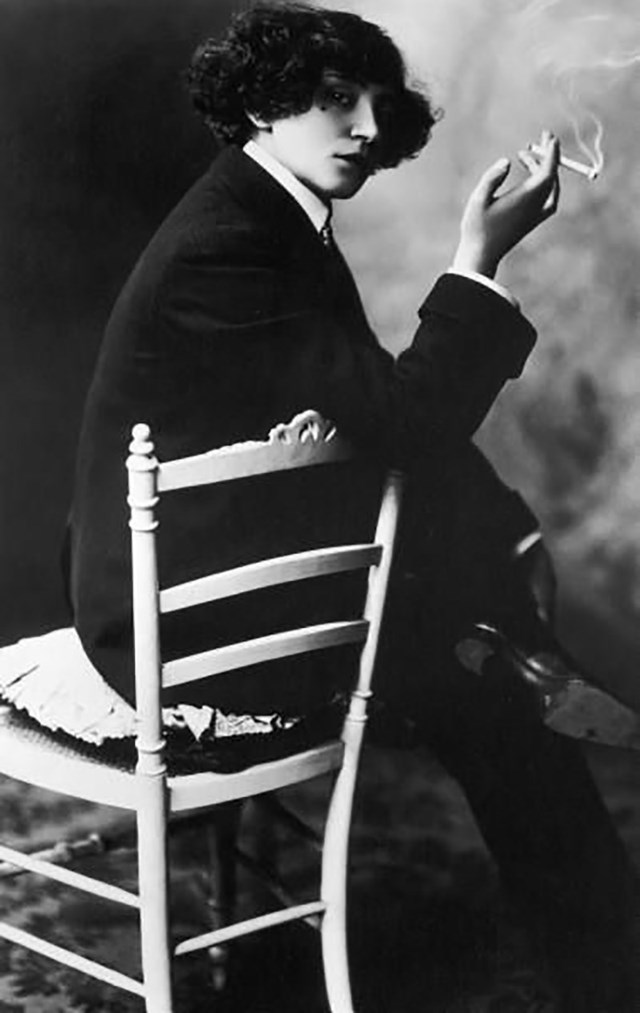
Sidonie-Gabriel Colette's story has been taken off the book-shelf and adapted, and despite covering her years during the turn of the century (20th) from fancifully-romantic young womanhood to a sadder-but-wiser independence, could not be more timely. While being so, Wash Westmoreland's* biography of French writer known simply as Collette manages to rise above the constant threat of the stiffness of a BBC adaptation, which might have been, if they decided to tone down the life and present her as merely a Nobel Prize winning icon. Colette, you have to read between the lines. It couldn't have been easy. Films about writers tend to be either precious when recalling inspirations for their work, or present the creative process as a magical mystery, completely unfathomable (except with voice-over).
Colette falls into the latter category, but at least it shows a side of writing few of these things show: writing is hard work, often born of necessary...and it's not a lot of fun. We meet Gabriel (Keira Knightley) at the age of 19, the daughter of Jules-Joseph Colette (Robert Pugh) and Adele Eugenie Sidonie (Fiona Shaw), living in a small rural town in Burgundy. The family, being once well off, is now in financial straights—they can't even provide Gabriel with a dowry. Good thing a family friend, the well-known author, publisher, critic and bon-vivant Henry-Gauthier Villers (Dominic West)—who writes under the pen-name "Willy"—finds her enchanting...and available. They whisk away to Paris to a cosmopolitan married life and where Gabrielle finds that "Willy" depends on ghost-writers for his output and he can be counted on to be unfaithful to her.
His small stable of writers rebel and finally quit, leaving them in bad consequences, given Willy's exorbitant lifestyle. Gabriel offers to write something—a novel, something that Willy is in no position to turn down. She spends hours on the project, the story of a young girl named Claudine, who, not unlike herself, grew up in Burgundy and her years at an all-girls school. When she's finished, Willy dismisses it as fine writing, but the novel as "plotless" and beneath his standards. he won't publish it. Gabriel is crushed—the writing was hours of hard work and says she'll never do it again.
But, in a moment of frustration, with the bills mounting, Willy relents, after making some small suggestions for tinkering and spicing up...and surprise! "Claudine at School" becomes a publishing phenomenon. Everyone seems to be reading it, and Willy—whose name is on it as author—becomes the toast of the town, as Colette looks on in amazement. Along with the staggering book sales, Claudine even inspires merchandising and a popular play. Everyone assumes that the book is inspired by Gabrielle, but no one suspects—because Willy won't allow them to—that she might actually be the author.
Willy buys her a country estate, away from the city, with the profits for her. But, he has an ulterior motive. While Gabrielle spends time fixing it up and making it "just so," Willy becomes more and more agitated; he'd intended it to be a writer's retreat for Gabrielle—but she isn't writing, a problem he solves in his usual subtle way by locking her in her room until she's produced enough pages to his satisfaction.
As if he wasn't "Svengali" enough, Willy starts to become possessive and jealous if Gabrielle even looks at another man, but she dismisses the idea as absurd—she's more attracted to their lady-friends, if anything. Noting how Gabrielle is charmed by an American heiress from Louisiana, Georgie Raoul-Duval (Eleanor Tomlinson), he encourages an affair between the two, and, because he's a complete cad, decides he'll seduce Georgie, as well.
At this point, the marriage of Willy and Colette, as she begins to call herself, becomes fractious, and some of the invective starts to spill out on the pages of the books. When Colette even includes a fictionalized version of the menage-a-trois with Georgie in her third volume of "Claudine," Willy takes the opportunity to avoid a lawsuit by burning the existing copies, and then having them re-published, anyway. At one point, in discussing sequels she coyly tells him "I'm going to kill [the husband] in the next one."
Colette sets out on her own. Instead of writing, she decides to begin a career on the stage, separating herself from Willy and starting an intense friendship with Mathilde de Morny,(Denise Gough), the cross-dressing Marquis de Belbeuf. She very publicly rebels, recreating herself to her own satisfaction if to the bewilderment of the public-at-large. What's lovely about Colette is that there is no shame in it, merely the story of a woman who's been boxed in and revels in seeing just how free she can become, and on her own terms.
Everybody's great in it, but it is Knightley that shines. She has always been an actress of intense daring, presenting her roles in mercurial flashes that hint at the conflicting emotions roiling within her. At times in the past, she has been so good, she's been scary, but in Colette, she presents a relaxed strength that finally snaps when she realizes that the nice little life she's made for herself has also become a prison...and a raw deal. After a success has been stolen from her, merely because anyone can claim words on a page, she makes herself the art, and no one can lay claim to that, good or bad.
Perhaps now, that Colette is out (although it hasn't done extremely well at the box office) we could supplant the endless adaptations of Jane Austen and maybe do the "Claudine" series as films, so that the author, so well regarded, can be most well known for something other than Gigi. Thank heavens.
* Westmoreland made the well-acted, but soft-pedaled and blunted Alzheimer's drama, Still Alice.
The Last Ride of the Sundance Kid
or "Brother, I'm Not Talkin' 'Bout Making a Living"
It's the smile you notice. Forrest Tucker (Robert Redford) walks into a bank and if there's no women behind the teller-stations, he'll ask to see the manager. Then, invited to the manager's office, he'll sit down, smile, and open his coat showing the manager that he has a gun, and (very reasonably) ask for an emergency withdrawal of some weight to keep him from using that seen gun in a way injurious to that manager. He never says that the gun is loaded—psychologically, that is irrelevant—it achieves its purpose without getting into details. And he never has to demonstrate. It rarely doesn't work, and he'll leave the banking institution several thousand dollars richer. Detective John Hunt (Casey Affleck) interviews employees post-robbery and when he gets to motivation, he strives to keep incredulity out of his voice when he re-states what he's been told: "So, you did what you did because he said he had a gun..." "Yes. And also, he was sort of a gentleman."
Robert Redford doesn't directThe Old Man and the Gun, but he does some producing chores on it, and it is David Lowery (who worked with Redford on his miraculous un-tuned version of Disney's worst musical, Pete's Dragon) who is calling the shots, making a breezy film based on David Grann's*New Yorker article on Tucker**, who became known as "The Gentleman Bandit" cutting a swath through Southern banks in the 1980's. Tucker usually worked alone, and on tougher jobs that needed more co-ordination and a fast getaway, with two long-in-the-tooth associates Teddy (Danny Glover) and Waller (Tom Waits), who became known in law-enforcement circles as "The Over-the-Hill Gang."
When we first meet Tucker, he does a job ("Belmont Texas, July 26, 1991" we're told to give the film some authenticity by place/time-stamps as well as a first title that states "The story, also, is mostly true."***), a hearing aid in his ear (which is tuned to police frequencies), and as he makes his escape, he passes a motorist, Jewel (Sissy Spacek), who has broken down on the highway. He stops to help, and as, after police cruisers have raced by, he pulls his head out from under the hood. "Do you know anything about cars?" Jewel asks. "No," he replies. "Not really."
A tow truck is called, as he knows nothing about cars. They're a means to an end, just like lunch at a diner with Jewel while the police are running around outside, looking for this "gentleman bandit." She's trying to figure him out. He introduces himself as "Bob...Bob Kelly." "I like that truck of yours," she mentions. "Yeah," he says casually. "I stole it." But his eyes twinkle when he says it. "Hey, I'm just pullin' your leg." When he's a little vague about what he does, she presses, and he asks for her phone number. She writes it down and slides it across the table. He writes down what he does and slides it back. She looks at him in shock. "What's worse—if I'm lyin' or telling you the truth?" More talk, and he talks about his list of "things I want to do, but haven't done yet." "Better hurry up," she smirks.
It's probably as good as time as any to talk about Robert Redford's face. There's no longer a hint of the smooth, angelic planes that made his initial days of acting so problematic—finding roles that would play against type than as "the nice boy"—that he finally roughed it up with various facial hair until folks could look past...his looks. His face, now, is a complicated map of wrinkles that crinkle with every expression, going beyond the weathered look he's had in the last couple decades and becoming more expressive and more open in conveying what his character is feeling. It's like Redford's movie-star mask has dropped. And we're starting to see him in his own skin. More on that at the end.
Hunt actually has contact with Tucker, when he's inside a bank that gets robbed by him right under the detective's nose. The bank goes into lock-down and all he can think of is his kids in the car, who are probably wondering that's going on with daddy in the bank; they'll be panicking when they see the police cars showing up. Try as he might, he can't convince the bank officials that he IS a police officer and he doesn't NEED to wait for the police to show up. Somewhere in there, he must be frustrated that he's less convincing to the bank officials than the robber.
Hunt had been frustrated with police work, maybe even quitting, but Tucker's spree energizes him (despite the ribbing his fellow officers give him for chasing a senior citizen bank robber). He WANTS to catch this guy, even goes on television saying that he WILL catch him—a broadcast that Tucker sees, and when the next job happens, the Gentleman Bandit leaves a present of a $100 bill saying "Detective John Hunt: Good Luck! 'The Over-the-Hill Gang'." Oh. It's on.
Meanwhile, Jewel and "Bob" start seeing more of each other. She invites him out to her farm, introduces him to her horses, tells him she's keeping the place, despite her kid's protestations that she should get herself a condo with little up-keep. "Now's the time to be a little selfish." "Bob" likes the idea of her keeping the place, being independent, but he's not smiling when he looks out at the place. At a mall, they look at a bracelet Jewel likes, and Bob grabs her by the arm and they walk out without paying for it. He's all smiles. She looks at him...and stops in her tracks. She turns to go back to the store, and he, sheepishly, follows her.."sorry, we totally forgot..he's paying for it."
The FBI steps in when the Gang pull a job across state lines, leaving Hunt to merely look on in frustration, while somebody else handles the leads. Then, he gets a letter: a young woman named Dorothy (Elizabeth Moss) writes him a letter, saying that the robber, from his description and from stories her mother told her about her absent father makes her suspect that the two might be one and the same. Her father's name: Forrest Tucker. Background work on Tucker shows a lifelong criminal history, with a penchant for escaping whatever prison thought might hold him. A chance encounter between the two men in the bathroom of the local diner just confirms what Hunt has begun to suspect—and the two men now know each other—by sight.
"Lookin' sharp makes you look like you know what you're doin' ...even if you don't."
Lowery's direction is low-key and efficient, less concerned for the striking image (as he has in the past), but keeping an eye for the magic that his cast can deliver at the drop of a smile, and the energy transference between a scene between an old pro like Redford and a "bury-it-deep" performer like Affleck manages to bring out sparks in both actors. Working with Redford seems to invigorate Affleck with just that much more wattage, as Spacek does the same for Redford. The story lends itself to making one wonder what makes a character like Tucker tick, and the answer lies in the very longevity that belies a high-risk occupation. This is some of Redford's more subtle work in his career and it's helped by the etching carved into his face that allows the slightest of smiles shine through with satisfaction. It is a melancholy acknowledgment of damage along the way, which might be apparent to those around Tucker, but he wouldn't be aware at all. One can't help but smile, albeit sadly, in return. If this is Redford's last film performance (I'm highly skeptical of that), it's a great one to go out on.
** January 23, 2003, if you're checking or looking for it at the old magazine store.
*** One should remember that Butch Cassidy and the Sundance Kid started with the title "Most of what follows is true." The "also" of The Old Man and the Gun hearkens back to it. The film is a sly little tribute to Redford in places; at one point there's a clip of the young Redford from The Chase(1966), and there's a sweet little nod to The Sting, that I won't spoil by pointing it out.
 Butch Cassidy and the Sundance Kid (George Roy Hill, 1969) It is probably for certain that Butch and Sundance were not as entertaining (or as well-scrubbed, with feathered hair) as Newman and Redford, nor that they rode bicycles to Burt Bacharach songs. But then the originals didn't have William Goldman writing for them, either, and though the script starts by saying "Most of what follows is true" you can also bet that much more of it isn't. As it is, it's not a history lesson. It's a grittier, more-influenced-by-European-film version of the previous season's Cat Ballou (which had earned Lee Marvin his Best Actor Oscar).*