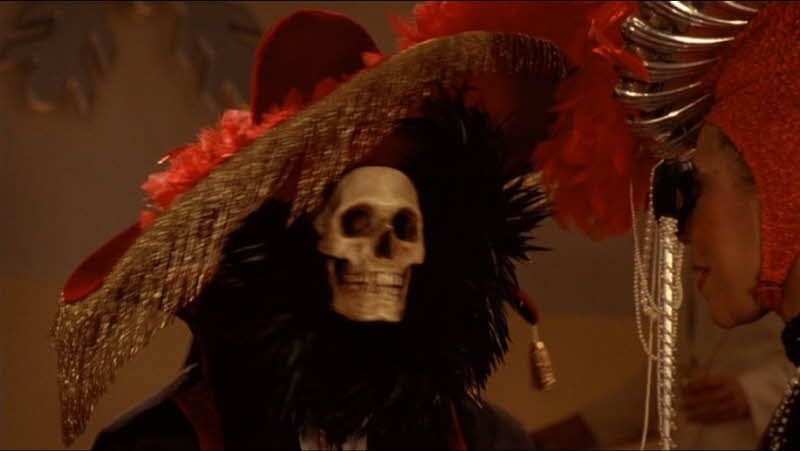
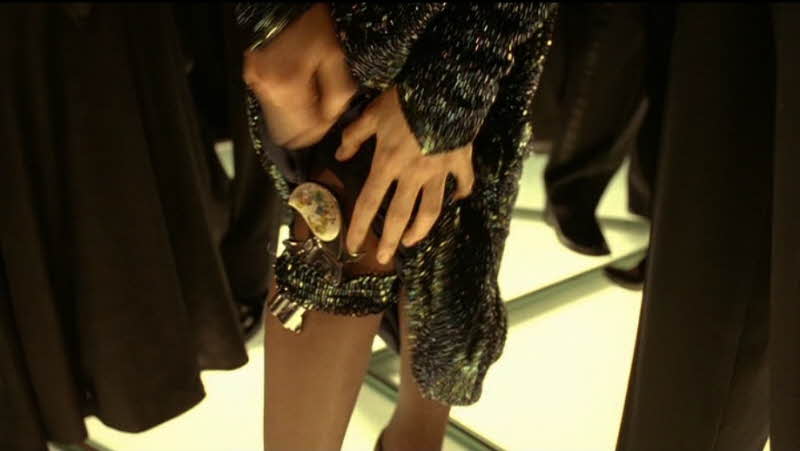
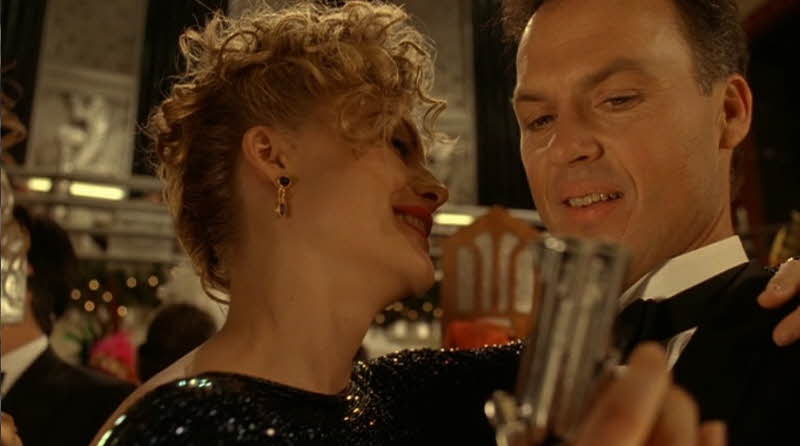
The Story: Two different eras. Two different Bat-men. Two different Cat-women. Two different directors. Two different approaches. But the two are so similar, it is eerie. This is the first of two "Dances with Catwomen," the second being next week in our regular "Don't Make a Scene" Sunday feature. Next week, there'll be more to say as I compare and contrast. This week, just some random comments on Tim Burton's version of this waltz. First, both Selina Kyle and Bruce Wayne show up at a costume ball with no costumes, merely dressed up. They spend enough time masked and concealed, why would they? But, then there's the psychological thing. They show up at a costume ball as themselves because...Batman and Catwoman are their real identities, how they perceive themselves, but Bruce and Selina, they're the disguises, the masks they present to the outside world. As is pointed out numerous times in the script, (even here, in a deleted (and unnecessary) scene-capper voiced by Commissioner Gordon and Wayne's butler Alfred), with so much in common, they're meant for each other—two people split down the middle between who they are and what they let people see. And, during the dance, when the "masks" drop...that budding relationship becomes a lot more complicated. "It's so much easier when you've got people who are on the edge of crazy" says Burton in the DVD commentary. And both Keaton and Pfeiffer are mercurial performers who can morph through emotions very quickly, changing on a dime, Keaton in his eyes, Pfeiffer, her whole face. She whip-saws through so many—lust, irony, giddiness, grief, murderous anger—it's hard to keep track, making Keaton's Wayne look more stable by comparison, a tough trick. But, he's been at this costume ball longer, knows the pit-falls of a dual-identity. Maybe, now that they've figured out who each other is, they can find themselves. Hey, it's a comic book movie. It doesn't "do" to take it too seriously. Better to just hit the dance floor. The Set-Up: It's not the merriest of Christmases in Gotham City: The Batman (Michael Keaton) is in the midst of a power struggle on a criminal/political front. Toy entrepreneur Max Schreck (Christopher Walken) is using the Holiday Season to wrest control of the city, to foist an empire-building power plant. He's set up freakish tabloid sensation Oswald Cobblepot (Danny DeVito) to run for Mayor, and killed his secretary Selina Kyle (Michelle Pfeiffer) who learned too much of his plans. But Selina survived, and started to toy with those involved as Catwoman. Now, with Cobblepot's campaign in ruins (thanks to Batman), Schreck is holding a Christmas costume party attended by Gotham's elite. Action.
Various people are in Batman and Catwoman outfits, including an undulating couple on the dance floor, Josh and Jen. Josh is Catwoman. Jen is Batman.
JOSH Jen, look over there, but don't stare.JEN (staring) My god. How rude.
They are revealed to be looking at Bruce Wayne strutting down the main aisle, dressed dramatically as......BRUCE WAYNE.
The only one without a costume, Bruce catches some glares from the hedonists. He and Max shake hands, trading chilly smiles.
MAX Ingenious costume. Let me guess... Trust-fund goody-goody?
BRUCE Course you're feeling fine ... You almost made a monster the Mayor of Gotham City.
MAX I am the light of this city. And I am its mean, twisted soul. Does it really matter who's the "mayor"?
BRUCE It does to me.
MAX Yawn. He drifts off.
Bruce considers having the last word, when his attention is diverted to a new guest, entering. It's:
Selina Kyle, dramatically dressed as ... Selina Kyle.
She draws the same sour looks as Bruce did.
And ignores them, as Bruce did.
Gives Bruce a lovely, world-weary smile.
INT. STORE DANCE FLOOR--NIGHT
Chip Shreck is dressed as an old-time football hero, in knickers, etc. He moves, warily, across the floor ...CHIP Selina ... Ms. Kyle... May I have this -- Bruce cuts in and Selina lets him: The band does a ballad as Selina flows into Bruce's arms. They nakedly dance amid the swathed-in-artifice revelers.
BRUCE Sorry about yesterday ... Some big deal came through,
BRUCE ...no, fell through, and --
SELINA 'S'okay, I had to go home, feed my cat.
BRUCE No hard feelings?Selina presses against her partner. Smiles.
SELINA Actually ... semi-hard, I'd say.
Bruce blushes, steps back. Selina does a sultry pirouette.
SELINA There's a big, comfy California King over in Bedding. What say we ...
BRUCE (ironic) Y'mean take off our costumes?
SELINA (sad laugh) Guess I'm sick of wearing masks ...
BRUCE Same here. So why'd you come tonight?
SELINA You first.
Bruce presses close to her again.
BRUCE To see you.
He waits for a response. Selina pauses, then:
SELINA That's lovely...
SELINA ...and I really wish I could say the same, but ... I came for Max. At first, Bruce doesn't understand.
BRUCE You don't mean ... you and Max ..?
Selina gives a harsh laugh, shakes her head.
She discreetly pulls a little derringer from her evening bag.
SELINA This and Max.
Shocked, Bruce pushes it back in her bag.
INT. THE SEWER BELOW THE STORE--EVENING
The spooky ballad wafts into a sewer below the Store. The lights of the party radiate through the grate of a ventilator shaft. Rising into this strange mix of music, light, and slime is Penguin's Rubber Duck. On its scissor-lift, it continues to climb, at first revealing Four Penguin Shock Troops, in bizarre headgear, missiles- pointed straight up.INT. STORE--DANCE FLOOR--NIGHT
Bruce and Selina continue to dance, emotions rising.
SELINA Now don't give me a killing-Max-won't-solve-anything speech, because it will.
SELINA Aren't you tired of this sanctimonious robber baron always coming out on top?
SELINA When he should be six feet under?
BRUCE Jesus, Selina, you're not the judge or the jury... I mean, just who do you think you are?
SELINA I don't know anymore, Bruce ...
They glide together beneath a piece of hanging mistletoe, and she gives a soft, almost regretful kiss. And laughs.
SELINA A kiss under the mistletoe.
SELINAMistletoe can be deadly, if you eat it ...
BRUCE But a kiss can be even deadlier, if you mean ... it.
And suddenly it hits them -- what? No! Can it be?
BRUCE SELINA You're ... her? You're ... him?
Bruce tenderly, carefully undoes the cuff of Selina's blouse and pulls back her sleeve. Feels:
BRUCE The burn I gave you.
Meanwhile Selina's hand explores under Bruce's shirt, finds: SELINA The puncture wounds I gave you.
SELINA(wearily)Oh god ...
SELINA ...does this mean we have to start fighting now?
Bruce's answer is to hold her tight. He's scared, so is she. SELINA ... What do we do?
BRUCE I don't know. Till we figure it out, let's ... let's keep dancing.
BRUCE Let's get out of here...
That works for Selina. They sway on, to the haunting song.
Alfred is standing next to Commissioner Gordon, watching.
GORDON A darling couple.
ALFRED Yes, made for each other ...
Black Sunday(John Frankenheimer, 1977) From the twisted mind of Thomas Harris (who would later write "Red Dragon" and "The Silence of the Lambs") comes this entry in the "disaster movie" cycle of the 1970's. Only this one seemed entirely credible. Harris' first novel (and the only one that doesn't have Hannibal Lecter in it) conceived of a terrorist plot by a cell of the PLO called Black September (the group behind the Israeli athlete massacre in Munich in 1972) to kill everyone in the stadium hosting the Super Bowl. The film had the promotional tagline "It could be tomorrow!" Robert Evans bought the movie rights in his independent production deal with Paramount after leaving the studio, Ernest Lehman was contracted to write the screenplay (it would prove to be his last, with additions by Ivan Moffat and Kenneth Ross) and John Frankenheimer hired to direct—he had just finished a sequel to The French Connection and was starting to be noticed (again) as a gifted film-maker, especially when it came to thrillers. From the beginning, Frankenheimer wanted to set Black Sunday apart from the normal string of disaster movies in vogue during the 70's*by making it seem as true-to-life as possible, giving it an almost documentary feel.
The movie begins with a night-time raid on a September cell by a ruthless Mossad squad (led by Robert Shaw's agent David Kabakov) that is brutally efficient in taking out the terrorists, with one notable exception: catching September agent Dahlia Iyad (Marthe Keller) in the shower, he lets her go with only an appraising gaze.
Big mistake. Dahlia has a plan...and a means to carry it out. She has been "grooming" the aid of a court-martialed Vietnam vet, Michael Lander (Bruce Dern), who is on the psychological edge—suffering from PTSD as a Vietnamese POW, and by the resulting collapse of his marriage upon his return, he is chronically suicidal. Curiously, that hasn't stopped him from getting a job driving the promotional blimp for the Goodyear Tire company. Bad for them. Good for Dahlia. She convinces Lander that if he is going to commit suicide, he should do it in the most spectacular way possible, striking back at the country he's convinced has betrayed him, taking out as many Americans as possible in a terrorist attack on the Orange Bowl during that year's Super Bowl.
Meanwhile, the Mossad has brought in the FBI—in the form of agent Sam Corley (Fritz Weaver) on the results of the raid. Kabakov is starting to realize his error; Iyad is a former Baader Meinhoff member now offering her services to the PLO...and he had her dead to rights. She's now dropped off the intelligence radar and the Israeli's want the assassination mission completed, something Kabakov takes on as his personal responsibility. A recording that was found at the compound leads the investigators to suspect some sort of action is imminent and that the tape was meant to be discovered after the attack...but where and when the recording isn't specific.
The movie begins to take two parallel paths, following both the terrorists in their preparations and the FBI/Mossad investigation about what they might be doing. Their first idea that something is about to happen comes from a report from the Coast Guard to the FBI—twelve crates have been unloaded from a freighter to a man and woman wearing masks, but when the CG tried to intervene they were outrun. Kabakov travels to Long Beach and sneaks aboard the freighter under cover of darkness to interrogate the captain who needs a little persuasion to talk. But, when the captain answers a telephone, he is killed in an explosion and Kabakov is injured by the blast.
Those smuggled crates contain statues of the Madonna—made out of plastique that will be shaped into a large bomb to be brought into the Orange Bowl by the blimp and detonated, releasing thousands of steel flechettes, enough to kill everyone in the stadium. An initial test in the desert convinces Lander that the explosion will be uniform enough to cause the most devastation within the bowl-shaped stadium. With the plot proven in theory, Lander and Dahlia start work on the details to be ready for the next Super Bowl, while Kabakov and Corley are delayed by the Mossad agent's hospitalization. But, an aborted attempt by Dahlia to kill Kabakov in his room, convinces them that what could have been a few unrelated clues is a very real plot, one that their suspects are trying to see to completion by eliminating the investigators.
Upon Kabakov's release from the hospital, the investigation becomes more intense: Kabakov threatens a Los Angeles based importer to tell him that the shipment was for explosives to be delivered to a woman named "Kaza," then meets with an Egyptian intelligence official (Walter Gotell) who eventually tells him that this "Kaza" is actually Dahlia Iyad; when she is seen on January first in the Miami vicinity, the team start concentrating their efforts there and their suspicions begin to point to one target—the Orange Bowl, the Super Bowl.
The film then becomes a race against time and a fight against obstacles for both sides—the path is smooth for neither the terrorists or the security forces and one is kept guessing along the way whether the plot will come apart at the seams due to its own dicey nature or whether it will succeed in spite of it because the game authorities just choose to "bureaucracy" themselves into suicide. Both sides are firmly dedicated to a fanatical extreme and by the time Frankenheimer has ramped up the tension of the final denouement, you're just about willing to believe anything can happen.
And that's where director Frankenheimer is the biggest co-conspirator in the whole plot; he knows how to set things up to make the audience put the framework together, and by game-time, he has the audience both wanting to see the plot come together at the Super-Bowl, but also to see it quashed in as viscerally satisfying a way as possible. His editing has been moving at an ever-quickening pace culminating with a shootout on a Miami Beach, but, the realization of the target becomes known, the film settles into a complicated rhythm due to all the pieces coming together. And at that point, he pulls out every visual trick in the book to try to convince you that there is a goddamn blimp flying into the middle of the freakin' Super-Bowl and using every suspense trope right down to a sputtering, burning fuse.
It's pretty amazing what the film-makers got away with back in the innocent days of 1977: First off, yes, Frankenheimer did film at the genuine Super-Bowl game—Super-Bowl X (Steelers/Cowboys), to be exact—with permissions from the NFL and the two vying teams to use their logo's**—and the shots of the blimp hovering into the stadium were filmed the days before and after, with a lot of crowd cooperation going on for the scenes of panic. In fact, at one point, there's a shot of Robert Shaw sprinting along the side-lines where he is nearly strong-armed by a very real stadium security guard who didn't recognize Shaw and maybe didn't realize the movie was being filmed (the many film camera's were disguised to look like CBS-television cameras to ensure that one wasn't caught inadvertently due to all the footage being shot).
One or two effects shots are a bit dodgy amidst the hundreds it took to construct the sequence and some of the process work stretches credulity—as if the methods used to subdue a runaway blimp weren't incredulous enough—but, that last half an hour of the film does have one on the oft-cited "edge of one's seat." When I see a film of this nature (and it's successful in its purpose) my left leg has a tendency to bounce in a nervous response that would resist any amount of sticky gum on the theater-floor and Black Sunday had that effect (and it had nothing to do with matching John Williams' "thrummy" tension music at that point in the proceedings).
At the time of the film's release (it's opening was basically swamped by the juggernaut of the first Star Wars movie), the film and story was a competent, if fanciful, thriller of the paranoid variety on the cusp of the "disaster" cycle of films. Now, it's a cautionary tale, a blueprint for terrorists to some—it and Tom Clancy's "Debt of Honor" are regularly brought up in terrorism discussions—a call for vigilance by others, but, unfortunately, no longer fanciful. We've seen worse, for real. And it's tagline—"It could be tomorrow"—rather than a come-on, now sounds like a threat.
* After the heady rush of Irwin Allen hits ofThe Poseidon Adventure and The Towering Inferno, they were starting to ebb in popularity and ideas—another entry of that year was the rather ridiculous Rollercoaster (rather than a disaster movie, it might have been a "bad accident" movie) and a previous terror-in-the-football-stadium was the previous year's Two Minute Warning, which was "legacied" into the genre for the fact that it starred Charlton Heston. ** And, if we are trying to keep it in the real world, Frankenheimer used his clout with Goodyear Tire Company (he'd worked with them in filming 1966's Grand Prix) to get the actual Goodyear blimp—with the company's actual logo—to make it feel more like a credible event. Now, that is truly amazing. And a step above Harris' novel; the author sidestepped the issue by calling it "the Aldrich blimp," creating a fictitious and non-litigious company to sponsor the air-ship.