Watching the Oscars last week, with its "Heroes" theme, I noticed that they included John Wayne in one of the montages. Not just John Wayne, but specifically Wayne in the character of Ethan Edwards from The Searchers (no, really, folks, you can tell John Wayne characters from other John Wayne characters—you watch enough films, or even if you have a brain in your head other than a prejudice, you can tell the so-called "one trick pony" Wayne from one movie to another). To use the oft-quoted lazy writer's stand-by: "You just don't get it, do you?" There is no way—NO. way.—that Ethan Edwards can be considered a hero. To do so would indicate that one has not seen The Searchers, and is only going by Wayne's top-billing in the film and the tradition that Wayne, no matter what kind of complicated character he was playing, was always going to be just one thing: the "Good Guy." This is not lazy acting on Wayne's part. This is lazy thinking on the part of the viewer, writer or critic (who should know better) ...and the twerp who put that montage together. "The John Wayne character" (for those who insist on using that term) in The Searchers is (and was intended to be) a racist, murderous blowhard former Confederate soldier, who has one non-saving grace—the love of his brother's wife, and even that fuels his years-long obsessive search for her last surviving child...and (if that should sound all warm and fuzzy) with the express intent to kill her, rather than have her live as an "injun squaw." He has one moment of redemption in the film (so powerful that Jean-Luc Godard who loathed Wayne, wrote in Cahiers Du Cinema: "How can I hate John Wayne upholding Goldwater and yet love him tenderly...in the last reel of The Searchers?" But, even director John Ford doesn't allow that moment to re-define the man, or redeem him, leaving him shut out ('til the end of the movie, anyway) from the welcoming arms of family. Maybe it was just sloppy vetting that they chose THAT character (when they were probably looking for "a youngish Wayne as a cowboy" image), or maybe they've never seen the film. Who knows? But, in a year when 12 Years a Slave wins Best Picture, they chose to include as a "hero" one of the few Wayne characters who might actually wield the lash. But, then The Searchers has always had this problem: Ford cast his biggest star and an American icon as the "heavy," and for whatever reason, nobody can equate the two. Wayne was careful to avoid any such complications for the rest of his career. But, this was the best acting of his career—a tight-rope where he had to balance the Wayne persona and the dictates of a script that required a tough character arc. Maybe someone should alert the Academy about this?*
The Set-up: A lot of "First People" died in John Ford "westerns." That's a fact. Obsessed as he was with telling stories of the building of America, and the conquering of the West, it was inevitable that the Native race was going to get ground up in the gears of the inexorable wagon trains invading their country, and they made for cinematic chases and shoot-em-up's—the kind of excitement that was the bread and butter of the silent B-westerns where Ford learned his craft. But Ford was a Roosevelt Democrat, and he saw things in the Photographic Unit of the Navy during World War II that changed him, just as it did Capra and Huston and Zanuck and Stevens. It was hard to drum up boyish enthusiasm for the necessary action scenes anymore when you saw the damage real bullets did. The movie stuff began to look like a lie.
So the tenor of Ford's movies began to change--an undercurrent that ran through them as the black-and-white blossomed into color. Sure, the Cavalry was the Good Guys, the Cowboys the heroes, the Whites came out on top, but the white hats they wore were not so white anymore. You began to see the dirt. The corruption. The greed. The cost. By the time Ford made The Searchers in 1955 with his old pal, the box office champ John Wayne, they returned to one of Ford's favorite locations despite the haul out to the Four Corners from Los Angeles and the baleful glare of the Studio muckety-muck's that Ford despised, but needed. They'd set up camp in Monument Valley on the Navajo Reservation, for which the tribe would be compensated, the residents made extra's, the chief given a speaking part, maybe (if he could get it past the Suits and the part was minor enough), the young men did stunts and with that influx of cash the tribe would make it through another miserable winter in the hard-scrabble of the desert--and Ford would get a little authenticity in his story.
And he'd get Monument Valley, the biggest movie set in the World, as desolate as the moon. One look at its wind-seared escarpments that jut out of the ground like pre-historic high rises told you that life out there was hard, the distances vast and the chances slim. The Valley told you as much about the grit of the characters as the dialog did, more for the isolation that vast floor of dirt provided. Look at the painterly love Ford used in those long shots.
Look at The Searchers today and all you might see is an archaic "John Wayne Western" from the '50's, with the cute antics of the settlers, and the rapacious villainy of the Commanche, and melodramatic hysterics and low comedy. But you're not seeing John Ford's journey, the one that would lead him in the next decade to tell the story of the Trail of Tears, and make the Natives the almost saintly heroes of his Cheyenne Autumn(and they aren't, if one has taken the time to watch the film). You're not even seeing how Ford is starting to see the Native side of the story, and of the racism and genocide inherent in the "conquering of the West." Because this is "the White's" story, it is one of fear and hysterics, of race-hate and savage contempt, but the Destiny is not Manifest, and at one point one of the leads can look at a Native woman killed by the Cavalry (John Ford's beloved Cavalry) and say "What'd they kill her for, she never hurt anybody!" You didn't hear that much in the complacent westerns of the 50's. Nor the sex-hysteria over miscegenation.
But you might recognize the searing race-hatred of Ethan Edwards, embodied by an unreigned-in John Wayne. Wayne's the star of the picture, but he's not the hero. In many ways, he's the villain, the Other, the Outsider. In the gentility of trying to bring civilization to the West, he's as much an anomaly as the Natives, and his time as limited. The movie begins and ends with Edwards on the other side of the closed door of home and hearth. One would like that to mean that his type of hatred is something to be left out of Society, left to wander on the winds and shunned. One would like that.
That'll be the day.
The Story: Almost as soon as Ethan Edwards (John Wayne), a bitter veteran of the Civil War, visits his brother and sister-in-law, tragedy strikes the Edwards stake: a Commanche raid leaves the parents and son dead, and Lucy (Lana and, eventually, Natalie Wood) and Debbie Edwards (Pippa Scott) kidnapped. Now a vengeful Edwards leads Martin Pawley (Jeffrey Hunter)—the Edwards' adopted son—and Brad Jorgenson (Harry Carey, Jr.), Lucy's fiancee, on a search for the two girls. Mount up!
BRAD JORGENSON: They gotta stop sometime! If they're human men at all, they've gotta stop! ETHAN EDWARDS: No, a human rides a horse until it dies, then he goes afoot. Commanche comes along and gets that horse up, rides him 20 more miles, then eats him. (watches Martin Pawley drinking from a canteen) Easy on that. MARTIN PAWLEY: Sorry. We don't even know if Debby and Lucy's in this bunch. Maybe they split up. EDWARDS:They're with 'em, alright--if they're still alive. JORGENSON:You said that enough! Maybe Lucy's dead! Maybe they're both dead! But if I hear that from you again, I'll fight ya, Mr. Edwards! EDWARDS:That'll be the day!
EDWARDS:(gets on his horse) Spread out! (Fade to later in the day)PAWLEY:Found a main trail, but four of 'em cut out right here, and they rode on up through the pass there. JORGENSON:How come they do that, Mr. Edwards? EDWARDS:I'll take a look. Keep after the others.
PAWLEY:You want us to fire a shot just in case... EDWARDS (cuts him off):No, nor build bonfires, nor beat drums! I'll meet you on the far side. Move! He rides off.
Later, they wait for him on the other side, and Ethan rides hurriedly up and jumps unsteadily off his horse, throwing his rifle to the ground.
Agitated and silent, he sits and starts digging in the sand with his knife.PAWLEY:You want some water, Ethan?
Edwards grabs the canteen and drinks greedily,
Pawley and Jorgenson stare at him. EDWARDS:Oh. The trail leads over there.
JORGENSON:Why'd they break off? Was there water in that canyon?
EDWARDS:Huh?
EDWARDS:No water.
PAWLEY:You all right, Ethan?
EDWARDS:I'm all right.
PAWLEY:Hey, what happened to your Johnny Reb coat? You lose it?
EDWARDS:Must have.
EDWARDS:But I'm not goin' back for it.
They mount up and ride on. Transition to night. Pawley and Edwards are lying on the ground, keeping watch, when Jorgenson runs up to them.
JORGENSON:I found 'em! JORGENSON:I found Lucy!
JORGENSON:They're camped about a half mile over. I was just swinging back, and I seen their smoke. Bellied up a ridge, and there they was, right below me.
PAWLEY:Did you see Debbie?
JORGENSON:No, no. But I saw Lucy, all right. She was wearin' that blue dress that she--
EDWARDS:What you saw wasn't Lucy. JORGENSON:Oh, but it was, I tell you. EDWARDS:What you saw was a buck...wearin' Lucy's dress. I found Lucy back in the canyon. Wrapped her in my coat. Buried her with my own hands. Thought it...best to keep it from you. JORGENSON:Well, did they...w-w-was she--
EDWARDS(furiously): What do you want me to do, draw you a picture?! Spell it out?!
EDWARDS:Don't ever ask me! As long as you live, don't ever ask me more!
Jorgenson stares at him in disbelief and shock, then, hysterical...
...runs to his horse .
PAWLEY:I'm awful sorry, Brad.
PAWLEY:Hey, Brad!
PAWLEY:Brad!... Jorgenson rears his horse and starts to ride furiously towards the Commanche camp. Pawley tries to grab his reins and runs after him. PAWLEY:..wait a minute!! Brad!! Come back here! Edwards trips up Pawley, and grabs him, keeping him from going after Jorgenson.
PAWLEY:Brad!! Come back here! Brad! In the distance, wild gun-shots are heard...
...then a final rifle-shot.
Edwards lets go of Pawley, and the men stare off into the distance, into the dark.
Fade out.
Fade in to the two men continuing their search. Time has passed.
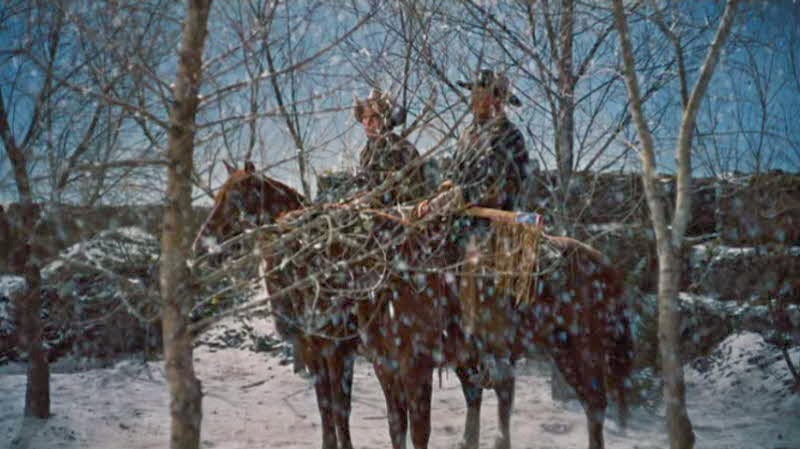
It is now snowing. They stop.
PAWLEY:Well, why don't you say it?
PAWLEY:We're beat and you know it.
EDWARDS:Nope. Our turning back don't mean nothin.' Not in the long run. If she's alive, she's safe. For awhile, they'll keep her to raise as one of their own, until--'til she's of an age to...
PAWLEY:Look, do you think maybe there's a chance we still might find her?
EDWARDS:Indian will chase a thing 'til he thinks he's chased it enough. Then he quits. Same way when he runs.
EDWARDS:Seems like he never learns there's such a thing as a critter who'll just keep comin' on. So we'll find 'em in the end, I promise you. We'll find 'em...
EDWARDS:...just as sure as the turnin' of the Earth.
The Searchers is available on DVD and Blu-Ray from Warner Brothers Home Video.
...for Jon
Post-Script: Doing research for this I found a marvelous article by Richard Franklin (writer/director in his own right) that cautioned that The Searchers should not be one's first foray into the life-work of John Ford. The Searchers is, above all else, a "pot-boiler" in all senses of the term. He recommends starting out with The Grapes of Wrath, They Were Expendable, How Green Was My Valley, Fort Apache, She Wore a Yellow Ribbon, The Man Who Shot Liberty Valance, and The Quiet Man. I would add Stagecoach (essential!), Young Mr. Lincoln, My Darling Clementine, and...aw, hell, I'd watch anything by Ford. In fact, I've got a full week of reviews of some "between the cracks" Ford films that are not considered classics, but you can tell come from a classic film-maker. But I'd agree that The Searchers is a pump that needs to be primed. Such is its power. * Of course, I'm not serious.
Every year, the United States Library of Congress puts up to a vote the 25 films that will be included in the National Film Registry for their significance, “culturally, historically or aesthetically.” Those twenty-five are then given over to the National Film Preservation Foundation, an independent, non-profit charity, to make sure those films are preserved and kept in top-notch condition, so they can be seen by the public in all their glory. The films run the gamut of feature films, documentaries, shorts, even student films and significant "home movies." A list of films already chosen (since 1989) can be found here. This year's list is no less eclectic, no less broad-based; the earliest, made in 1919, and the latest, assembled in 2002. They are listed here, with the Board's comments for inclusion, written in white (Arial), with samples of the work (when they can be found on the web). My comments, where applicable, are in the customary gray Verdana.
Part of the vibrant New Wave of independent African-American filmmakers to emerge in the 1970s and 1980s, Billy Woodberry became a key figure in the movement known as the L.A. Rebellion. Woodberry crafted his UCLA thesis film, "Bless Their Little Hearts," which was theatrically released in 1984. The film features a script and cinematography by Charles Burnett. This spare, emotionally resonant portrait of family life during times of struggle blends grinding, daily-life sadness with scenes of deft humor. Jim Ridley of the "Village Voice" aptly summed up the film’s understated-but-real virtues: "Its poetry lies in the exaltation of ordinary detail."
This introspective "contrived diary" film by Stanton Kaye features vignettes from the relationship of a real-life couple, in this case the director and his girlfriend. An evocative 1960s time capsule—reminiscent of Jim McBride’s "David Holzman’s Diary"—this simulated autobiography, as in many experimental films, often blurs the lines between reality and illusion, moving in non-linear arcs through the ever-evolving and unpredictable interactions of relationships, time and place. As Paul Schrader notes, "it is probably quite impossible (and useless) to make a distinction between the point at which the film reflects their lives, and the point at which their lives reflect the film." "Brandy in the Wilderness" remains a little-known yet key work of American indie film-making.
Cicero March (1966)During the summer of 1966, the Chicago Freedom Movement, led by Dr. Martin Luther King, Jr., targeted Chicago in a drive to end de facto segregation in northern cities and ensure better housing, education and job opportunities for African Americans. After violent rioting and a month of demonstrations, the city reached an agreement with King, in part to avoid a threatened march for open housing in the neighboring all-white town of Cicero, Ill., the scene of a riot 15 years earlier when a black couple tried to move into an apartment there. King called off further demonstrations, but other activists marched in Cicero on Sept. 4, an event preserved on film in this eight-minute, cinema-vérité-styled documentary. Using lightweight, handheld equipment, the Chicago-based Film Group, Inc. filmmakers situated themselves in the midst of confrontations and captured for posterity the viciousness of northern reactions to civil-rights reforms.
(The) Daughter of Dawn (1920)A fascinating example of the daringly unexpected topics and scope showcased by the best regional, independent filmmaking during the silent era, "Daughter of Dawn" features an all-Native-American cast of Comanches and Kiowas. Although it offers a fictional love-story narrative, the film presents a priceless record of Native-American customs, traditions and artifacts of the time. The Oklahoma Historical Society recently rediscovered and restored this film with a grant from the National Film Preservation Foundation.
Decasia (2002)Errol Morris, the director of such highly acclaimed documentary features as "The Thin Blue Line," "Fast, Cheap and Out of Control" and "Mr. Death," is noted to have sat drop-jawed watching "Decasia" and stammering, "This may be the greatest movie ever made." Created from scraps of decades-old decomposing "found film," "Decasia" hypnotizes and teases with images that fade and transform themselves right before the viewer’s eyes. Culling footage from archives across the country, filmmaker Bill Morrison collected nitrate film stock on the very brink of disappearance and distilled it into a new art form capable of provoking "transports of sublime reverie amid pangs of wistful sorrow," according to New York Times writer Lawrence Weschler. Morrison wedded images to the discordant music of composer Michael Gordon—a founding member of the Bang on a Can Collective—into a fusion of sight and sound that Weschler called "ravishingly, achingly beautiful."
Decasia is a trip and one could see that it wouldn't be everybody's cup of burning nitrate. The music by Michael Gordon is enough to drive you to a psychiatrist's couch. But, nonetheless, it's fascinating to watch, as if David Lynch was working in the silent era of film-making. But, it's ordinary film, shot on the high volatile nitrate stock, which after years of wear, and sticking and fading has had its emulsion so deteriorated that the ordinary scenes of fiction and non-fiction films take on the look of a surreal nightmare. It's an extraordinarily good advertisement for film preservation.
Ella Cinders (1926)With her trendsetting Dutch bob haircut and short skirts, Colleen Moore brought insouciance and innocence to the flapper image, character and aesthetic. By 1926, however, when she appeared in "Ella Cinders," Moore’s interpretation of the flapper had been eclipsed by the more overtly sexual version popularized by Clara Bow or Joan Crawford. In "Ella Cinders," Ella (Colleen Moore) wins a beauty contest sponsored by a movie magazine and is awarded a studio contract. New York Times reviewer Mordaunt Hall observed that the film was "filled with those wild incidents which are seldom heard of in ordinary society," and noted "Miss Moore is energetic and vivacious." The film is an archetype of 1920s comedy, featuring a star whose air of emancipation inspired her generation.
Yes, sure it's based on the "Cinderella" story, but Ella Cinders's more direct inspiration is the United Features comic strip written by William Conselman and drawn by Charles Plumb that was started in June, 1925 and ran until (get this!) 1961.
It follows the strip (and fairy tale) quite closely, and, yes, Moore is a delight, although fully half of her films are now considered lost. Sje made a lot of money in the stock market, though, becoming a full partner at Merrill Lynch. F. Scott Fitzgerald called her "the torch" of the Jazz Age.
Forbidden Planet (1956)Directed by Fred M. Wilcox, MGM’s "Forbidden Planet" is one of the seminal science-fiction films of the 1950s, a genre that found itself revitalized and empowered after World War II and within America’s newly created post-nuclear age. Loosely based upon William Shakespeare’s "The Tempest," "Forbidden Planet" is both sci-fi saga and allegory, a timely parable about the dangers of unlimited power and unrestrained technology. Since its production, the movie has proved inspirational to generations of speculative fiction visionaries, including Gene Roddenberry. Along with its literary influence, highly influential special effects and visual style, the film also pushed the boundaries of cinematic science fiction. For the first time, all action happened intergalatically (not on Earth) and humans are depicted as space travelers, regularly jetting off to the far reaches of the cosmos. Additionally, "Forbidden Planet" is remembered for its innovative score—or lack thereof. No music exists on the film’s soundtrack; instead, all ambient sounds are "electronic tonalities" created by Louis and Bebe Barren. Walter Pidgeon, Leslie Nielsen, Anne Francis and, in his debut, Robbie the Robot make up the film’s cast. The film seems a little dated viewing it now, in the decades post-Stars Trek and Wars (you can certainly see where it influenced the '60's TV series, especially in its pilot episode, "The Cage")—the costumes are a little "Flash Gordon", the humor a bit puerile—but the sophistication of the story (Shakespeare is so malleable) and the effects (out of the Disney studio) are still wonder-inducing. It is not (what Stanley Kubrick called) "the proverbial really good science-fiction movie," but for the genre, at the time, it was as sophisticated as it could get without falling into the metaphorical territories of philosophy or propaganda. And, as much as I like Leslie Nielsen's later comedic career, it's always fun to see him play "straight" drama.
Gilda (1946)With the end of World War II came a dark edge in the American psyche and a change in the films it produced. Film noir defined the 1940s and "Gilda" defined the Hollywood glamorization of film noir—long on sex appeal but short on substance. Director Charles Vidor capitalizes on the voyeuristic and sadomasochistic angles of film noir—and who better to fetishize than Rita Hayworth, poured into a strapless black satin evening gown and elbow-length gloves, sashaying to "Put the Blame on Mame." George Macready and Glenn Ford round out the tempestuous triangle, but "Gilda" was and, more than 65 years later, still is all about Hayworth. "Disaster to the wench who did wrong by our Johnny," toasts club owner Ballin Munson (Macready) when he wonders at the dour nature of his newly-acquired right-hand man Johnny Farrell (Ford). Trouble is, it's more than implied that the wench is Munson's wife (also newly-acquired) Gilda (Hayworth). This one is, no doubt, the most sizzling, almost-giddy love-hate relationship in films, with clever writing and two smoldering performances from Hayworth and Ford (both of whom were rarely better), where you can practically see daggers flying from their eyes. It's a "noir" love story without the gats, but there's a lot of danger in the air, and an unspoken back-story that would probably get in the way, anyway. It's nasty fun. My favorite moment: Munson brings Fallon up to meet his new wife and, entering their bedroom, calls: "Gilda, are you decent?" There's a waterfall-rush of tawny hair across the screen, then Hayworth's face pops up and smiles in mock surprise: "Me?"
The Hole(1962)With "The Hole," legendary animators John and Faith Hubley created an "observation," as the opening title credits state, a chilling Academy Award-winning meditation on the possibility of an accidental nuclear catastrophe. Jazz great Dizzy Gillespie and actor George Mathews improvised a lively dialogue that the Hubleys and their animators used as the voices of two New York construction workers laboring under Third Avenue. Earlier in his career, while he worked as an animator in the Disney studios, John Hubley viewed a highly stylized Russian animated film—brought to his attention by Frank Lloyd Wright—that radically influenced his ideas about the possibilities of animation. With his new vision realized in this film, the Hubleys ominously, yet humorously, commented on the fears of nuclear devastation ever-present in cold war American culture during the year that the Cuban Missile crisis unfolded.
Judgment at Nuremberg(1961)Selecting as its focus the "Justices Trial" of the post-World War II Nuremberg war crimes tribunal, rather than the more publicized trials of major Nazi war criminals, "Judgment at Nuremberg" broadened its scope beyond the condemnation of German perpetrators to interrogate the concept of justice within any modern society. Conceived by screenwriter Abby Mann during the period of McCarthyism, the film argues passionately that those responsible for administering justice also have the duty to ensure that human-rights norms are preserved even if they conflict with national imperatives. Mann’s screenplay, originally produced as a Playhouse 90 teleplay, makes "the value of a single human being" the defining societal value that legal systems must respect. "Judgment at Nuremberg" startled audiences by including in the midst of its narrative seven minutes of film footage documenting concentration camp victims, thus using motion-picture evidence to make its point both in the courtroom and in movie theaters. Mann and actor Maximilian Schell received Academy Awards and the film boasted fine performances from its all-star cast. Director Stanley Kramer had a certain stodgy quality to his directing that seemed to work best in courtroom films, and Judgment at Nuremberg is one of his better ones. Claude Rains had played the Spencer Tracy role on television (directed by George Roy Hill), and the late Maximilian Shell played the impassioned German defense attorney in both versions (although Marlon Brando actively pursued the role—rare for him). The cast is one of those Kramer assemblages that is legendary (his next completed film—probably as a result of the intense subject matter of this one—was the all-star comedic romp It's a Mad, Mad, Mad, Mad World), including Burt Lancaster, Judy Garland, Montgomery Clift, and Marlene Dietrich, and the performances are eclectic in manner, with Garland and Clift's being noted for their shattered emotionalism, Lancaster and Tracy's for their subtlety, and Schell and Richard Widmark providing the courtroom fireworks. The film makes extensive use of the city of Nuremberg, where many of the Nazi landmarks were still standing.
It's certainly one of Kramer's best films, and his extensive use of war footage in the film is a good example of the director breaking style for maximum effect.
King of Jazz (1930)A sparkling example of a musical in the earliest days of two-color Technicolor, "The King of Jazz" is a fanciful revue of short skits, sight gags and musical numbers, all with orchestra leader Paul Whiteman—the self-proclaimed "King of Jazz" — at the center. Directed by John Murray Anderson and an uncredited Paul Fejos, it attempted to deliver "something for everyone" from a Walter Lantz cartoon for children to scantily-clad leggy dancers and contortionists for the male audience to the crooning of heartthrob Bing Crosby in his earliest screen appearance. "King of Jazz" also featured an opulent production number of George Gershwin's "Rhapsody in Blue." A lot of "firsts" in this jamboree, demonstrating the power of "jazz" to its audience, The King of Jazz is one of those examples of the now-extinct film genre of "revues," a sort of filmic variety show. Even though the film offered "something for everyone," audiences stayed away, making the film a financial failure for Universal.
The Lunch Date (1989)Adam Davidson’s 10-minute Columbia University student film examines the partial erosion of haughty self-confidence when stranded outside one’s personal comfort zone. A woman has a slice-of-life, train-station chance encounter with a homeless man, and stumbles through several off-key reactions when they share a salad she believes is hers. Winner of a 1990 Student Academy Award, "The Lunch Date" stands out as a simple, yet effective, parable on the vicissitudes and pervasiveness of perception, race and stereotypes. Quite lovely, really.
The Magnificent Seven (1960)The popularity of this Western, based on Akira Kurosawa’s "Seven Samurai" (1954), has continued to grow since its release due in part to its role as a springboard for several young actors on the verge of successful careers: Steve McQueen, Charles Bronson, James Coburn, Robert Vaughn and Horst Buchholz. The film also gave a new twist to the career of Yul Brynner. Brynner bought the rights to Kurosawa’s original story and hand-picked John Sturges as its director. Sturges had earned a reputation as a solid director of Westerns such as "Bad Day at Black Rock" (1955) and "Gunfight at the O.K. Corral" (1957). Transporting the action from Japan to Mexico, where it was filmed on location, the story portrays a gang of paid gunslingers hired by farmers to rout the bandits pillaging their town. Contributing to the film’s popular appeal through the decades is Elmer Bernstein’s vibrant score, which would go on to become the theme music for Marlboro cigarette commercials from 1962 until cigarette advertising on television was banned in 1971.
When one looks at the entire career of director John Sturges, you see a learning process honing his craft and then a fifteen year "bump" where he started to make some really fine films that benefited from his take-a-chance casting, his eye for wide-frame composition, and his gravitation to mature themes with just a bit of a wink to them. This "translation" of Kurosawa's film (which, itself, was influenced by American Western films) takes the basic framework of the samurai film and moves it South of the Border. Sturges benefited greatly from a cast of young turks out to prove themselves (McQueen was always trying to upstage Brynner who countered with "All I have to do is take off my hat...") and a Coplandesque score by Elmer Bernstein that gave so much verve to the film that you barely notice Sturges' directorial pace is going considerably slower than the score's. Kurosawa's is clearly the better film, but this one sure is a lot of fun.
Martha Graham Early Dance Films (1931-1944)
("Heretic," 1931; "Frontier," 1936; "Lamentation," 1943; "Appalachian Spring," 1944)
Universally acknowledged as the preeminent figure in the development of modern dance and one of the most important artists of the 20th century, Martha Graham formed her own dance company in 1926. It became the longest continuously operating school of dance in America. With her company’s creation, Graham codified her revolutionary new dance language soon to be dubbed the "Graham Technique." Her innovations would go on to influence generations of future dancers and choreographers, including Twyla Tharp and Merce Cunningham. This quartet of films, all silent and all starring Graham herself, document four of the artist’s most important early works. They are "Heretic," with Graham as an outcast denounced by Puritans; "Frontier," a solo piece celebrating western expansion and the American spirit; "Lamentation," a solo piece about death and mourning; and "Appalachian Spring," a multi-character dance drama, the lyrical beauty of which is retained even without the aid of Aaron Copland’s famous and beloved music.
Mary Poppins (1964)Alleged to be Walt Disney’s personal favorite from all of his many classic films, "Mary Poppins" is based upon a book by P.L. Travers. With Travers’ original tale as a framework, screenwriters Bill Walsh and Don DaGradi, with the aid of songwriters the Sherman Brothers (Richard M. and Robert B.), fashioned an original movie musical about a most unusual nanny. Weaving together a witty script, an inventive visual style and a slate of classic songs (including "A Spoonful of Sugar" and "Chim Chim Cher-ee"), "Mary Poppins" is a film that has enchanted generations. Equal parts innocent fun and savvy sophistication, the artistic and commercial success of the film solidified Disney’s knack for big-screen, non-cartoon storytelling and invention. With its seamless integration of animation with live action, the film prefigured thousands of later digital and CGI-aided effects. With its pitch-perfect cast, including Julie Andrews, Dick Van Dyke, Jane Darwell, Glynis Johns and Ed Wynn, "Mary Poppins" has remained a "supercalifragilisticexpialidocious" achievement. Last year's Saving Mr. Banks seemed to want to cast a pall over Disney's film of the children's book—a personal favorite of his daughters'—but the fact is that Mary Poppins, perhaps because of the conflicts with its author (and perhaps not), is a great film of vintage Disney operating on all of its creative cylinders, pushing its boundaries as far as technique, special effects and underlying philosophy. It was the last film that Walt Disney personally supervised, and afterwards, with his death in 1966, his company coasted, resting on its laurels and theme parks, and becoming...rather "mickey mouse." But, this was a fresh, European-evoking, tart and sweet film, with eye-popping sequences and a child-memorable song every few minutes or so. Yeah, the hipsters might knock Mary Poppins, but then they haven't seen it in awhile, if at all. Their loss. This was the very definition of "magical" for a child in the 60's, and to overlook its value is like...re-appraising Star Wars because you didn't like the prequels. Oooh....
Men and Dust (1940)Produced and directed by Lee Dick—a woman pioneer in the field of documentary filmmaking—and written and shot by her husband Sheldon, this labor advocacy film is about diseases plaguing miners in Kansas, Missouri and Oklahoma. Sponsored by the Tri-State Survey Committee, "Men and Dust" is a stylistically innovative documentary and a valuable ecological record of landscapes radically transformed by extractive industry.
Midnight (1939)Claudette Colbert, Don Ameche and John Barrymore light up the screen in this Mitchell Leisen romantic comedy. Liesen is often described as a "studio contract" director—a craftsman with no particular aesthetic vision or social agenda who is efficient, consistent, controlled, with occasional flashes of panache. Leisen’s strength lay in his timing. He claimed he established the pace of a scene by varying the tone and cadence of his voice as he called "ready…right…action!" This technique served to give the actors a proper "beat" for the individual shot. In addition to Leisen’s timing, "Midnight" also boasts a screenplay by the dynamic duo of Billy Wilder and Charles Brackett. Hilarity ensues when penniless showgirl Colbert impersonates a Hungarian countess, aided by the aristocratic Barrymore, until, despite her best efforts, she falls for a lowly taxi driver (Ameche) —all this amidst a Continental sumptuousness abundant in Paramount pictures of that era. The staggering number of exceptional films released in 1939 has caused this little gem to be overlooked. However, in its day, the New York Times called "Midnight" "one of the liveliest, gayest, wittiest and naughtiest comedies of a long hard season." Reportedly unhappy with Leisen’s script changes, Wilder found the motivation to assert more creative control by becoming a director himself. Good Lord, a second movie based on Cinderella! The same year Brackett and Wilder wrote Midnight, they wrote the more popular Ninotchka. Wilder, who had directed one film in his native Germany, before he emigrated to escape the Nazi's, stayed on set watching Howard Hawks direct his script of Ball of Fire in 1941, and got his chance to direct with his next script with Brackett, The Major and the Minor.
Notes on the Port of St. Francis (1951)When Frank Stauffacher introduced the Art in Cinema film series at the San Francisco Museum of Art in 1947, he was on his way to becoming a significant influence on a generation of West Coast filmmakers. Through the series, he cultivated his knowledge of San Francisco surrealist films of the 1940s as well as the "city symphonies" produced by European filmmakers in the 1920s and 1930s. "Notes on the Port of St. Francis" is the natural progression of Stauffacher’s appreciation for the abstract synthesis of film and place. Impressionistic and evocative, the film is shaped by the director’s organization of iconic imagery, such as seascapes and city scenes, and by the juxtaposition of these visuals and the soundtrack comprised both of music and narration by Vincent Price of excerpts from Robert Louis Stevenson's 1882 essay on San Francisco. Independent film scholar Scott MacDonald speculated that the "notes" in the film’s title may refer to "both the informality of his visuals and his care with sound that may have been a subtle way of connecting his film with the European city symphonies of the twenties." Throughout the film, Macdonald observed, Stauffacher echoes Stevenson’s theme of the "City of Contrasts" by shooting from both San Francisco Bay and from the hills. You can watch it here.
Pulp Fiction (1994)By turns utterly derivative and audaciously original, Quentin Tarantino’s mordantly wicked Möbius strip of a movie influenced a generation of filmmakers and stands as a milestone in the evolution of independent cinema in the United States, making it one of the few films on the National Film Registry as notable for its lasting impact on the film industry as its considerable artistic merits. Directed by Tarantino from his profane and poetic script, "Pulp Fiction" is a beautifully composed tour-de-force, combining narrative elements of hardboiled crime novels and film noir with the bright widescreen visuals of Sergio Leone. The impact is profound and unforgettable. Funny how they say "utterly derivative" like it's a GOOD thing. The one film of the features selected I'm not altogether enamored with. Oh, parts are great—the segments with Bruce Willis, Samuel L. Jackson's philosophical hit-man—but there's a lot of crap, too. We never find out what's in "that" box (probably because it was cribbed from Kiss Me Deadly without any thought other than cribbing it), why the bullets go through the hit-men at one point, and the whole "Date with Uma Thurman" is so precious it just leaves me cold (still the "popular" dance sequence is below). The film is helped immeasurably by its unconventional sequencing, which manufactures resonance that might not be there "in sequence." Tarantino was already a critical darling with this film. I didn't come on-board until his next film, Jackie Brown, and I still find Tarantino's parabolic learning curve a little hit and miss. It's still up in the air whether, looking back, his career will resemble Sergio Leone's or Ed Wood's.
The dance scene—even though it kinda narrowly recalls Hawks' singing collaborations, it's still just a chance for Tarantino to go through his record collection.
Surprised he didn't have more shots of their feet.
The Quiet Man (1952)Never one to shy away from sentiment, director John Ford used "The Quiet Man" with unadulterated adulation to pay tribute to his Irish heritage and the grandeur of the Emerald Isle. With her red hair ablaze against the enveloping lush green landscapes, Maureen O’Hara embodies the mystique of Ireland, as John Wayne personifies the indefatigable American searching for his ancestral roots, with Victor Young’s jovial score punctuating their escapades. The film and the locale are populated with characters bordering on caricature. Sly, whiskey-loving matchmaker Michaleen O’Flynn (Barry Fitzgerald), the burly town bully Will Danaher (Victor McLaglen) and the put-upon but patient Widow Tillane (Mildred Natwick) are the most vivid. Beautifully photographed in rich, saturated Technicolor by Winton C. Hoch, with picturesque art direction by Frank Hotaling, "The Quiet Man" has become a perennial St. Patrick’s Day television favorite. Gee, what would happen if you couldn't use the word "sentimental" in a review of a John Ford film? You'd have to use words like "unpretentious" and "folksy" and "heart-warming," I guess. But, then the hoi-polloi couldn't damn with faint praise.
It's a great film made with love and quite a bit of blarney. Ford managed to convince Republic Pictures, a C-movie studio ("C" for "Cheap"), to fund this Ireland-based film, in return for making a couple westerns. Republic got a nice return on them, as well as The Quiet Man, the story of a boxer, Sean Thornton (Wayne), who comes to Ireland to get out of America for awhile, only to find that the fighting comes without a paycheck, but wedding rituals generally do. He is hit like a lightning bolt by the sight of Mary Kate Danaher (Maureen O'Hara), and the rest of the film involves the highlands and lowlands of their tempestuous love...and her tempestuous brother. There is a longish boxing brawl between Thornton and the elder Danaher, but I can guarantee that is far more interesting and more fun than your standard duke-em-out in theaters these days.
The Right Stuff (1983)At three hours and 13 minutes, Philip Kaufman’s adaptation of Tom Wolfe’s novel is an epic right out of the Golden Age of Hollywood, but thanks to its assortment of characters and human drama, it rarely drags. Director/screenwriter Kaufman ambitiously attempts to boldly go where few epics had gone before as he recounts the nascent Space Age. He takes elements of the traditional Western, mashes them up with sophisticated satire and peppers the concoction with the occasional subversive joke. As a result, Kaufman (inspired by Wolfe) creates his own history, debunking a few myths as he creates new ones. At its heart, "The Right Stuff" is a tribute to the space program’s role in generating national pride and an indictment of media-fed hero worship. Remarkable aerial sequences (created before the advent of CGI) and spot-on editing team up to deliver a movie that pushes the envelope.
A 3 hour box-office bomb, The Right Stuff finally found its audience in the burgeoning home video market. Thank God. Because the film is a fascinating homage/myth-buster to test-pilots and the Cold War-inspired space race of the 1960's. It's a crowd-pleaser, but not a fawning one, showing the warts-and-all process behind the gleaming suits and reputations of the media-darling astronauts, while at the same time, talking about the Wild West days of post-WWII jet-testing and military attempts to break the sound barrier. Director Kaufman (who wrote the screenplay) manages to tell the story of the space race, and in some weird alchemy (as the above description so aptly puts it) "creates his own history, debunking a few myths as he creates new ones," doing so in a fascinating amalgamation of archive footage, live action and special effects model work, that blends seamlessly. The result if a very cynical movie that still manages to be "rah-rahing" at the end. "The Right Stuff," indeed.
Sam Shepard's Col. Chuck Yeager breaks the sound barrier for the first time.
Roger & Me (1989)After decades of product ascendancy, American automakers began facing stiff commercial and design challenges in the late 1970s and 1980s from foreign automakers, especially the Japanese. Michael Moore’s controversial documentary chronicles the human toll and hemorrhaging of jobs caused by these upheavals, in this case the firing of 30,000 autoworkers by General Motors in Moore’s hometown of Flint, Michigan. As a narrative structure, Moore uses a comic device sometimes found in political campaign commercials, weaving a message around trying to find the person responsible for a wrong, in this case General Motors Chairman Roger Smith. "Roger & Me" is take-no-prisoners, advocacy documentary film-making, and Moore makes no apologies for his brazen, in-your-face style—he would argue the situation demands it. The themes of unfairness, inequality and the unrealized attainment of the American Dream resonate to this day, while the consequences of ferocious auto-sector competition continue, playing a key long-term role in the city of Detroit’s recent filing for bankruptcy protection.
Michael Moore's first movie, and the first example of his combination documentary and comedy lecture style of film-making. It takes a certain kind of personality to do that, and Moore's pugnaciousness and chutzpah are entertaining, but also a bit distracting from the subject at hand. He may be the master of the humiliating juxtaposing image, and he's a master manipulator (What? Documentaries aren't supposed to be manipulative? Then who edits them?). As a result, Moore's ideological opponents spend more time attacking him then they do addressing what he's talking about, and that's not an effective tool for change (other than educational).
A Virtuous Vamp (1919)Employing a title suggested by Irving Berlin, screenwriter Anita Loos, working with husband John Emerson, crafted this charming spoof on romance in the workplace that catapulted Constance Talmadge, the object of Berlin’s unrequited affection, into stardom. During the silent era, women screenwriters, directors and producers often modified and poked fun at stereotypes of women that male filmmakers had drawn in harsher tones. The smiles of Loos’ "virtuous vamp"—as embodied by Talmadge—lead to havoc in the office, but are not life-threatening, as were the hypnotizing stares of Theda Bara’s iconic caricature that defined an earlier era. In this satire of male frailties, the knowing innocence of Loos’ character captured the imagination of poet Vachel Lindsay, who deemed the film "a gem" and called Talmadge "a new sweetheart for America."
Who’s Afraid of Virginia Woolf? (1966)
Edward Albee’s 1962 stage triumph made a successful transfer to the screen in this adaption written by Ernest Lehman. The story of two warring couples and their alcohol-soaked evening of anger and exposed resentments stunned audiences with its frank, code-busting language and depictions of middle-class malaise-cum-rage. Elizabeth Taylor and Richard Burton—who were both Academy Award nominees for their work (with Taylor winning)—each achieved career high-points in their respective roles as Martha and George, an older couple who share their explosive evening opposite a younger husband and wife, portrayed by George Segal and Sandy Dennis. "Woolf’s" claustrophobic staging and stark black-and-white cinematography, created by Haskell Wexler, echoed its characters’ rawness and emotionalism. Mike Nichols began his auspicious screen directing career with this film, in which he was already examining the absurdities and brutality of modern life, themes that would become two of his career hallmarks. While working on an adaptation of Charles Webb's "The Graduate," comedian and Broadway director-extraordinaire Mike Nichols took on the daunting task of directing Edward Albee's controversial, acidic play about well-liquored domestic academia...as his first film. He may have been stunt-casting to hire "Lizn'Dick" (the most famous Hollywood couple at the time) to portray the antagonistic husband and wife (Jack Warner had wanted Bette Davis and James Mason, while Uta Hagen and Arthur Hill premiered the roles on Broadway), but their energy galvanizes the film, and certainly brought in the crowds. Their celebrity brought them in, but audiences got a master-class on how good the two could be, especially when sparking off each other, something you couldn't miss with Nichols' boozily up-front camera work, and a spareness of anything else but the words, the actors, and capturing the take. It was a red-hot warm-up for what was to come.
Wild Boys of the Road(1933)Historians estimate that more than 250,000 American teens were living on the road at the height of the Great Depression, criss-crossing the country risking life, limb and incarceration while hopping freight trains. William Wellman’s "Wild Boys of the Road" portrays these young adults as determined kids matching wits and strength in numbers with railroad detectives as they shuttle from city to city unable to find work. Wellman’s "Wild Bill" persona is most evident in the action-packed train sequences. Strong performances by the young actors, particularly Frankie Darrow, round out this exemplary model of the gritty "social conscience" dramas popularized by Warner Bros. in the early 1930s. Sad to say I haven't seen this one, despite my fondness for the films of Wellman—this one came five years after Wings and two years after The Public Enemy, and four years before his one-two punch of Nothing Sacred and A Star is Born. But, the clips are interesting, sort of a junior version of a gangster film, but without the bootlegging and tommy-guns.
Actually, now, I have seen it and it's rather astonishing what Wellman got away with on this picture (it was pre-Code), a Warner—sorry, "First National" pot-boiler with the veneer of social reform.
And I Only Am Escaped Alone to Tell Thee or I Died With My Brothers—With a Full F**king Heart
Lone Survivoris "based on a true story"—that of the Navy Seal team involved in Operation Red Wings to capture Taliban leader Ahmad Shah, which ended disastrously for the participants—but it feels more like a testament. It's directed by Peter Berg, who is at his best in the realm of psuedo-documentary, his roving camera acting as a fly-on-the-wall, catching the telling detail, the private moment, the feeling of a collective, like his 2004 film (and to a certain extent, subsequent TV-series) Friday Night Lights, or The Kingdom. His recent forays into A-list projects (like Hancock and the "film-of-the-board-game" Battleship) have been less successful, despite using his same camera-scheme to give them a lived-in feeling. Lone Survivor, however, is a return to his strengths. Not burdened with a sprawling story-line or too many characters, Berg has focused his story-telling abilities and stays on the four men on the mission and their commitment to each other and their task. He's helped immeasurably by the four actors playing the small scouting task force: Taylor Kitsch (Gambit from X-Men Origins: Wolverine, the TV version of "Friday Night Lights," the lead in John Carter); Emile Hersch (Into the Wild, Milk, Speed Racer); Ben Foster (3:10 to Yuma, The Messenger, Ain't Them Bodies Saints); and Mark Wahlberg.Each one of these actors has carried movies—big movies—on their shoulders, and each one treats their roles, supporting or not, as a starring role. Wahlberg (who, as he's moved from actor to actor-producer and gotten astoundingly better as the former in the last few years) is top-lined, but fades into the mix with an understated performance that gives the film a great ensemble balance.
Kitsch as Lt. Murphy, Wahlberg as Luttrell, Foster as Axelson, and Hirsch as Dietz
"Ensemble" is the point. Berg starts Lone Survivor with "found footage" of Navy seal training—brutal, berating, limit-pushing—training that shows the individual what they're capable of, shows the squad what they can expect from each other, building the "trench camaraderie" without the deployment. The seals are pushed to the edge, brought back, and their very existence and presence is testament to their abilities to survive in extreme situations. The fact they're going through it together bonds them, as Wahlberg's opening narration states firmly. The film ends with footage of the real men who were lost—home movies and the like—showing the individuals now that we know them apart from the squad, and it's poignant, stirring, and heart-breaking. In between is the story of the mission and how an act of conscience in extreme conditions can cost. There's been some fabrication of the story—the Taliban were not in a numbers position to attack the village, as shown—but the facts are basically there. On a reconnaissance mission, four Navy Seals are having difficulty contacting their base. They're found out by passing shepherds whom they tie and discuss what's to be done; it's not a democracy but everybody weighs in—kill the villagers and continue then mission, or let them go and try and contact the base, as the mission has been "compromised." "Rules of engagement" figure heavily in the discussion, but it comes down to rather than kill the villagers, let them go and scrub the mission, and get the hell out of there.
That would be in a perfect world, but it's Afghanistan. Soon the hills are alive with Taliban fighters and the four must engage and get out, while constantly being pushed down the terrain. Berg shoots this close-quartered and fast with the stuttered lens/editing that's been so effective since Saving Private Ryan. And it's here that the sound department kicks in with heightened effects, as well. It never feels like a video-game depiction, but with an overall perspective that lets you know where the four are in relation to each other, and fleeting glimpses of enemy positions. It's harrowing. And then, things go up a notch when the four have to desperately drop off mountain terrain with no forethought to what awaits below...not once, but twice. The imagery and especially the sounds of those sequence are painful—Lone Survivor received one Oscar nomination (for sound) and it is truly deserving of it (but, it was a little disappointing to not see a clip from this film in any of the broadcast's "heroes" montages). The sequences are visceral, painful to watch, and gut-wrenching. And that's where Berg's strength lies as a director in a film like this—he keeps the work centered on the soldiers—this is not effect for effect's sake, it's part of character, woven throughout the film. By the end you wonder at the dedication and gut-level heroism of the people we, as a nation, throw into battle, and one can't help leaving the film, admiring..and mourning.
Matthew Axelson (far left); Danny Deitz (center left); Marcus Luttrell (center right); Lt. Michael Murphy (far right)

 BRAD JORGENSON: They gotta stop sometime! If they're human men at all, they've gotta stop!
 JORGENSON: You said that enough! Maybe Lucy's dead! Maybe they're both dead! But if I hear that from you again, I'll fight ya, Mr. Edwards!

 PAWLEY: Found a main trail, but four of 'em cut out right here, and they rode on up through the pass there.
 EDWARDS: I'll take a look. Keep after the others.
 EDWARDS (cuts him off): No, nor build bonfires, nor beat drums! I'll meet you on the far side. Move!
 He rides off.


 Agitated and silent, he sits and starts digging in the sand with his knife.

 PAWLEY: You want some water, Ethan?


 EDWARDS: Oh. The trail leads over there.


 Transition to night.
 JORGENSON: I found Lucy!


 EDWARDS: What you saw was a buck...wearin' Lucy's dress. I found Lucy back in the canyon. Wrapped her in my coat. Buried her with my own hands. Thought it...best to keep it from you.
 JORGENSON: Well, did they...w-w-was she--

 EDWARDS: Don't ever ask me! As long as you live, don't ever ask me more!


 Edwards trips up Pawley, and grabs him, keeping him from going after Jorgenson.


 In the distance, wild gun-shots are heard...


 Fade in to the two men continuing their search. Time has passed.