And it's a bit dated. We all know what happened with the pandemic, and it gave an extra push-start to streaming services, with indications that it might have pushed the market to far. Services are consolidating. But director Steve Soderbergh was pushing the red envelope way before anybody, looking for a way to unlock the stranglehold the main studios had with distribution. The situation is still in flux...and theaters are back in business again. We'll see what the market bears.
Bubble(Steven Soderbergh, 2005) Billed as "AnotherSteven SoderberghExperience," this low-budget, shot on video, story of a love-triangle at a doll-making factory is more experimental than experiencial.
The business-end of the film is that it was released simultaneously in theaters, on Pay-per-View, and DVD...just to see what would happen. With the theater-life of films to DVD approaching four months and closing, business analysts were interested in what this new paradigm would look like. The costs on Bubblebeing reasonable, they had nothing to lose, allowing them the freedom to experiment. Bubble, however, was probably not the best film to do it with, as the entire film is unconventional, with no stars, no pyrotechnics, and the innovations behind the scenes for the most part.
Soderbergh had executive-produced (with George Clooney, his "Section Eight Productions" partner) a cable series called "K Street", centered around Washington D.C. politics that mixed real actors with politicians, and Soderbergh became fascinated with the split-dynamics in the performances of thespians and politico's—sometimes preferring the latter. Bubble was then designed to accommodate non-professionals before the camera: there was no formal script, taking memorization out of the equation, and the film was designed as a series of "Tableuax," freeing performers and crew from having to "hit their mark" (and it should be noted —here in 2024—that this was the same approach used by Jonathan Glazer in the recent The Zone of Interest—although Glazer went so far as to hide the cameras and merely "allowed" his actors to interact in their field of view, almost as if they were security cameras).
Filmed locally in the twin-cities of Belpre, Ohio and Parkersburg, West Virginia with locals culled from an interview process, Soderbergh made great picks for the principles with contrasting personalities and body-types and histories, informing their performances with the DNA of their lives. Line-readings are out of the equation, so the acting is reduced to reactions, flat-toned conversation, and tamped-down emotions.
And their eyes. "It's all in the eyes, really," said Laurence Olivier, and this trio's "windows to the soul" are doing 80% of the work with fascinating results. Pretty soon, story is reduced to reaction and eyes that sparkle, harden, and hide...and betray inner thoughts, even un-scripted ones. It may not be the most dynamic film in the world, but for taking the mystery out of the film-making, and film-acting process, it makes for a very interesting watch.
Written at the time of the film's release...(although, here, outdated links have been deleted and more relevant ones have been inserted...and then, I'll post the thing on "Facebook"...which is so "Meta")
"Saving Facebook" ("Every Creation-Myth Needs a Devil") or "There's Somethin' Happenin' Here (What It Is Ain't Exactly Clear)"
"O wonder!
How many goodly creatures are there here!
How beautious mankind is!
O brave new world,
That has such people in't!" (The Tempest, Act V, Scene 1)
Maybe it is too early to make a movie about Facebook (out of MySpace and Friendster) and the ramifications of our Brave New World of cyber-relationships.Maybe it is a little too "street-corner sage" to predict The End of the World As We are Sorta Familiar With it (But Not Really...More Acquaintances, Really). But, it is interesting to see a story about the Frankenstein behind the Monster, if only to see how each reflects the other. And even though we're secretly rooting for The Monster.
And, at this point in time, there isn't a better team to makeThe Social Networkthan Aaron Sorkin and David Fincher. Sorkin, the mad savant behind some of the better TV shows of the past decade and a half, has always written about people and their "issues," and how personality impacts policy. Fincher has matured from an ILM tech (who was happy to fly cameras through coffee-maker grips**) to an intricate observer of societal pressures on the psyche. For the two of them to make this particular story is a Friend Invitation made in Hollywood Heaven. "Accept" it. But, you can't "Ignore" it.
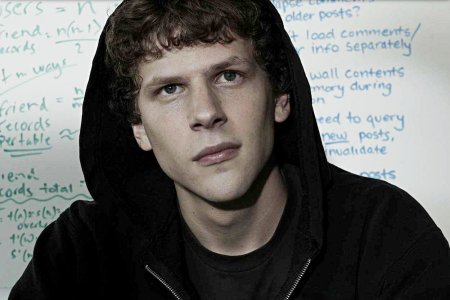
The movie begins with a date going badly between Mark Zuckerberg (Jesse Eisenberg, late of many movies with "...land" in the title) Harvard wall-flower, and Erica Albright (Rooney Mara—she'll play Lisbeth Salander opposite Daniel Craig in Fincher's big-budget version of The Girl with the Dragon Tattoo), an acquaintance. Anyone familiar with the machine-gun dialogue that writer Sorkin is known for, had better duck for cover—or wait for this on DVD so you can...play...it...slooooowly—for he now has an automatic weapon for a word-processor, and a co-conspirator in Eisenberg who can milk every nuance out of a line, despite hyperventilating it at debate-competition speed. His Zuckerberg is a "no Dolby/no squelch" type of unreadable conscience, and Eisenberg plays it with a deadness behind the eyesthat interprets the world as a problem, if not necessarily a challenge. He's a bit too candid for a first date, and she stomps off, which sends him on a mission, simultaneously trashing her on his blog (LiveJournal) and culling the pictures of every woman on campus to create a "Who's Hotter" web-competitionthat becomes so popular so instantly that it crashes Harvard's web-infrastructure.
He becomes both famous and infamous for the stunt, guaranteeing he'll never get a date in college, and attracting the wrath of the college's board, and the interest of two preppies attempting to create an exclusionary social network on the web. He goes them several steps better, making a system open to everyone on campus that trumps their attempts, and as it gains "friends," expands throughout the college system.
Hindsight is 20/20, and Sorkin constructs the film as a series of depositions after the fact (of Facebook's success) as everyone who thinks they've been burned by Zuckerberg testifies to his vague promises and dealings under the table.***Of course, they have every right to sue—but they'd only sue if "The Facebook" was a success—and the underpinnings and double-dealings don't resemble a fight for satisfaction, or a Noble Quest, so much as resembling a snake eating its own tail.****
Which brings us back to Frankenstein and his Monster. The film itself is expertly done—it is a complicated story of hidden motivations and the presentation of masks before public faces—and Sorkin and Fincher manage to navigate us through the maze of the story, even though one feels there is no cheese at the end. The experience is a bit hollow, which may be a part of the point.
Because the Facebook experience is hollow, as well. As hollow as Zuckerberg, as portrayed in this film, is. While it is nice that one has the opportunity to "re-connect" with old friends in a virtual environment and satisfy everyone's need to (as one friend commented on blogging) "talk about what you had for lunch," one wonders why one has to re-connect at all...especially if the relationship wasn't maintained in the first place. Not enough time in the world to meet? Because a "real" relationship takes time, takes effort, "gets messy?" Facebook provides the illusion of "staying in touch," without actually touching. Like Zuckerberg's abortive "date," a lot of time is spent broadcasting, but not interacting.
There are, of course, exceptions. But the fact of the matter is Facebook's cyber-community is not a "Brave New World" at all. Just the opposite. It provides a substitute in lieu of commitment. A panacea in a life thought to be full to bursting and without risk. The most precious commodity we can give is time—slices of our lives and our selves. Facebook is a pacifier—a mass-Hallmark card that we can spend a few heart-beats picking out, and send away without a thought and not even sweat the cost of a stamp.
It soon becomes a numbers game—a collection, like the celebration of the 1,000,000th friend portrayed in the film. But who are those million people? Facebook doesn't know or care. It's just a number. A number of casual relationships, that may lead to something else, but probably won't. A collection, nice to look at, but more often, ignored. Trophies, and ones that don't need to be polished or buffed up.
It's a new world of blithely arrested development, in the image of its creator, where love and commitment do not compute, and the only thing close to it is "hope"—translatable as keystroke F5.
* Except for some dodgy freezing breath-work, the biggest special effect will be invisible to you until the closing credits. Nice.
** Personally, I'd like to get back all those hours spent on "ZooWorld."
*** An image that kept coming to mind every time I thought of writing this review, where it would subsequently be published...on B/C-L's's Facebook page.
The Story: In the DVD commentary track of In the Heat of the Night (with director Norman Jewison, cinematographer Haskell Wexler, Lee Grant and Rod Steiger), Jewison can't remember who came up with it, but it wasn't initially in the script (although it was put in a revised script at the time of filming).
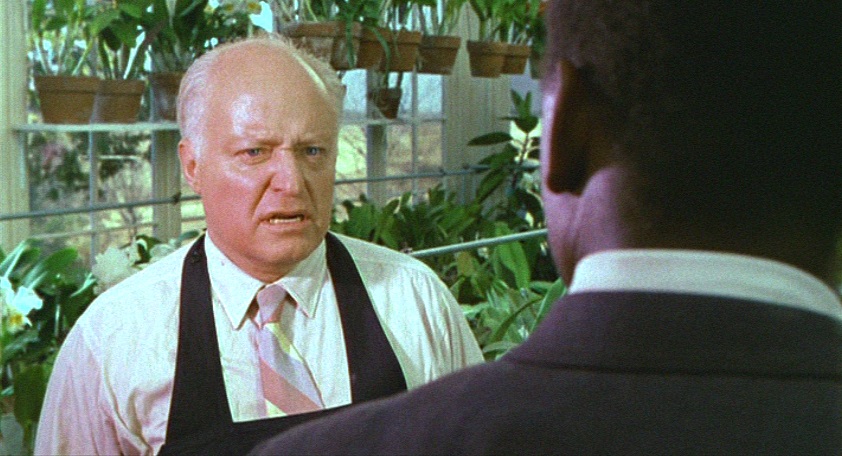
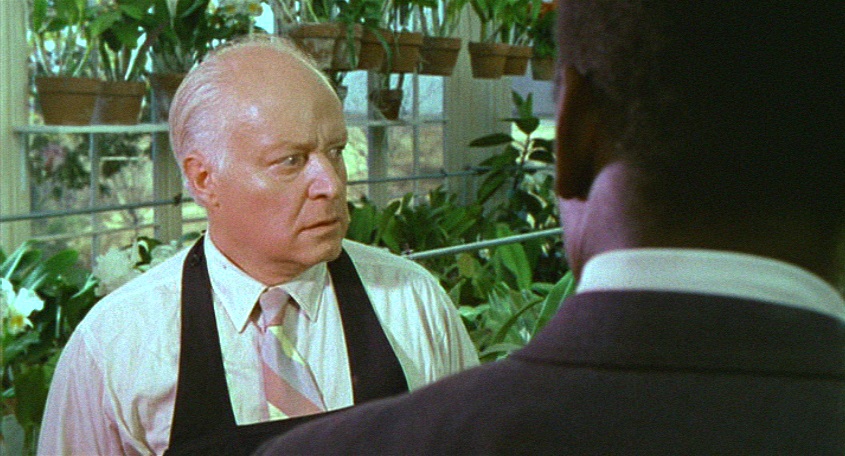
It was the slap. The first time a black man slapped a white man in a motion picture. Although it had been long past due.
At the first screening in San Francisco, Jewison was aggrieved to hear laughter in the audience at two dramatic points—specifically, the line "They call me Mister Tibbs!" and this slap—and was considering removing both, when his editor (and future director) Hal Ashby—a cooler, hipper head—advised him that the crowd, rather than thinking it was funny, was actually enjoying it. Jewison thought those moments would certainly shock an audience...but he hadn't quite made the leap that they'd approve. Both stayed. The film went on to do well at the box office and won the the Best Picture Oscar that year, over Bonnie and Clyde, The Graduate, Guess Who's Coming to Dinner (also featuring Poitier) and...Dr. Dolittle (which...believe it or not...almost featured Poitier).
If there was a King of Cool in the 60's, I wouldn't go with the usual answer of Steve McQueen, I'd go with Sidney Poitier. Yes, he could be a bit of a poser, but, he was also quietly subversive, especially here. Coming up from playing angry juveniles and token roles, Poitier rather quickly rose up the cast-lists to be become a featured player and then, starring roles in, co-starring in The Defiant Ones, then starring in Porgy and Bess, A Raisin in the Sun, Pressure Point, until he became the clear name-above-the-title with Lillies of the Field, for which he won the Best Actor Oscar becoming the first African-American actor to do so. Perhaps more significantly, Poitier, had the clout that, rather than taking a higher salary, he opted to take a percentage of the film's profits. He had become a box-office draw, no longer dependent on the property he was in or his co-stars. It became obvious that audiences were coming to see him.
That brings power. And Poitier carefully began to pick and choose projects where he could push boundaries to become more that "that nice black man" on-screen, to bring edgier textures, broad subject matter and better opportunities, going on to produce and direct. He knew he had an audience. He was going to use it.
It's always great to watch him work. Jewison and Poitier knew they were treading dangerous ground with the slap, but, after some (I think) unnecessary screen-time waiting for a reaction from the Gillespie and Endicott characters, Poitier's Tibbs answers Endicott's impotent threat "There was a time I could have had you shot" with the slightest of smiles, and straightens the lay of his suit before marching out the door, not even watching his back. Nice. Little details like that always makes Poitier fun to watch...and the King of Cool.
The Set-Up: Wealthy industrialist and contractor Philip Colbert has been found dead in an alley-way of Sparta, Mississippi. That doesn't happen much in small-town Sparta, and Police Chief Bill Gillespie (Rod Steiger) is under some pressure to find out who the killer is. He's grasping at straws and jailing anyone—even one of his officers (Warren Oates) on just a suspicion. The first person he suspects is the stranger waiting for a train at a bus station; he turns out to be Detective Virgil Tibbs (Sidney Poitier) from Philadelphia visiting his mother in Sparta. After talking to Tibbs' superior, Gillespie recruits him to help solve the murder and the two begin a mutually-suspicious inquiry of suspects, given Tibbs' lines of inquiry. He knows the killer bludgeoned Colbert, that he moved the body to the alley-way, that he's right-handed, and that—driving the victim's car after the murder—there were traces of osmunda—fern root—on the car's brake. Tibbs and Gillespie go to speak to Eric Endicott (Larry Gates)—of Endicott Cotton—a prominent Sparta resident, and who opposed Colbert's factory, fearing an influx of new African-American workers to the area.
Action.
Gillespie and Tibbs
GILLESPIE You going to come right out and ask him where he was last night?
TIBBS (a put-down) Let's just—sniff around a bit first. All right?
Before Gillespie can react, Tibbs starts for the front door, Gillespie going after him.
CLOSE MOVIING SHOT - The two men
GILLESPIE (accusative) Is there anything you know you haven't told me?
Gillespie draws abreast of Tibbs as they arrive at the front door.
TIBBS AND GILLESPIE
TIBBS I found a piece of osmunda in Colbert's car.
He rings the bell.
GILLESPIE You found what?
TIBBS (cool) On the brake pedal. Osmunda?
(a beat)
TIBBS Fern root?
Gillespie remains baffled.The door opens. Inside an elderly Negro butler with white hair looks out, past Gillespie towards Tibbs.
GILLESPIEChief Gillespie. Oh, is Mr. Endicott here?
BUTLERPlease come in, Yes, suh. He's out in the greenhouse.
Gillespie enters, Tibbs following.
BUTLER Would you follow me, please?
INT. RECEPTION HALL - MED. FULL SHOT - DAY
The butler shows the two men to the parlor, but the butler's eyes reproach Tibbs, seeming to be a warning and a scolding simultaneously.
INT. THE PARLOR - GILLESPIE AND TIBBS - DAY
move into the mid-room as the butler vanishes.
Gillespie looks around the tastefully-furnished room.
He seems tense and out-of-place. Tibbs, on the contrary, seems at ease.
They hear footfalls, see Endicott appear through the french doors leading to the adjoining greenhouse.
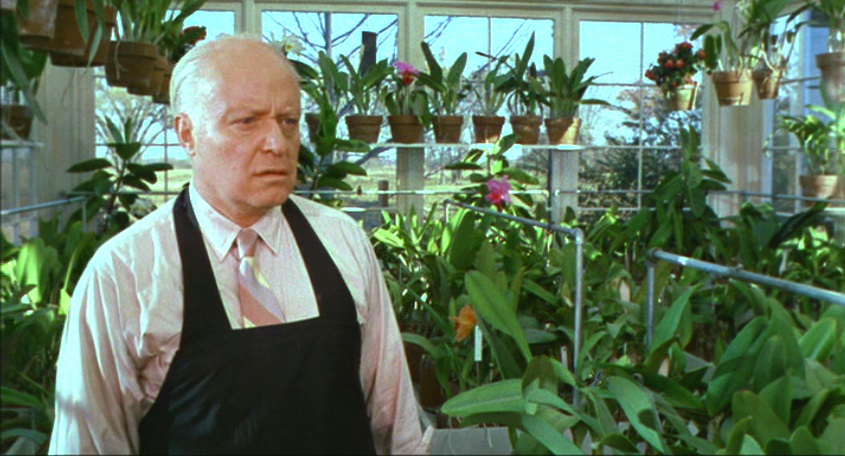
He is wearing an apron and carrying a tiny instrument used by orchid-fanciers for cross-pollination. He looks rich, secure, cultured, and affable, King of the Haves.
ERIC ENDICOTT: Gillespie.
-
CHIEF BILL GILLESPIE: Mr. Endicott.
GILLESPIE:This here's Virgil.
-
ENDICOTT:Mr. Tibbs.
DETECTIVE VIRGIL TIBBS: How do you do, sir?
ENDICOTT:Oh, may I have Henry fetch you
somethin'? Some light refreshment?
-
GILLESPIE:No, thank you. We're all right (the way we are)...
-
TIBBS (interrupting):Well,
TIBBS:I'll have something cold, something soft. Anything.
ENDICOTT:Henry, bring in a pitcher of lemonade. I'll have one, too.
HENRY: Yes, sir.
ENDICOTT: Investigating any crime of violence has got to be a most unpleasant occupation. Is there any way that I can be of help?
Endicott notices how Gillespie glances over at Tibbs, as though for counsel. Gillespie seems to be at a loss for words. Tibbs seems to be appreciating the Civil War portrait of Endicott's great grandfather which hangs above the fire-place.
GILLESPIE (finally) Virgil here is—trying to set me up a—sort of—timetable.
ENDICOTT Sounds intelligent.
(to Tibbs)
ENDICOTT I was told you had some trouble this morning at the hotel.
Gillespie gives Tibbs a sharp look of reproof.
TIBBS Nothing important.
ENDICOTT I apologize for that particular clerk. He's suffering, I fear, from the white man's historical guilt. He can't seem to adjust to—the changing times.
Tibbs...then moves a few steps to an orchid plant.
TIBBS (To Endicott) May I compliment you, sir...
TIBBS:I didn't know it was possible
to grow this species locally.
-
ENDICOTT:Oh, you like flowers?
-
TIBBS:I do.
ENDICOTT:Well, Mr. Tibbs, do you know
anything about orchids?
-
In the Heat of the Night is available on DVD and Blu-Ray from MGM Home Entertainment.
* The first draft has this appear after Endicott's slap: "Tibbs has all he can do to restrain himself. The butler drops his head, starts to pray. 'For him, Uncle Tom', Tibbs says furiously, 'not for me!'" That doesn't feel playable to me...certainly not by Poitier...yeah, better and more efficient to just back-hand the guy.
The Viviene Sanders' book "Civil Rights and Race Relations in the U.S." cites Poitier as the inspiration quoting him: "I said, 'I'll tell you what, I'll make this movie for you if you give
me your absolute guarantee when he slaps me I slap him right back and
you guarantee that it will play in every version of this movie. I try
not to do things that are against nature."
 Bubble (Steven Soderbergh, 2005) Billed as "Another Steven Soderbergh Experience," this low-budget, shot on video, story of a love-triangle at a doll-making factory is more experimental than experiencial.