Saturday, October 30, 2021

Last Night in Soho

Killing Two Birds with One Stone
or
Who Are you Wearing?
 
Edgar Wright's new film, Last Night in Soho, is his first horror/thriller film where the purpose isn't to make fun of them, where the emphasis is on the disorientation and not the whimsy (but don't worry, there are a lot of cheeky touches to it).
 
In it, a mousy fashion-design student, Eloise (Thomasin McKenzie—from Jojo Rabbit) moves to the big city of London to attend classes and achieve her goals of becoming au courant. But, as her grandmother (Rita Tushingham !!) warns her "London can be a lot." 
 
That it can be. Even in one time-line. Eloise has a rough first day, what with meeting her room-mate and a coven of snarky "mean girls" who occupy her dorm. It's tough on Eloise, who misses her Mum (she'd committed suicide when Eloise was a girl, but kept seeing images of her in the mirror back home). Finally, she decides to rent a room in Soho from Mrs. Collins (Diana Rigg !!) who's been there forever and wouldn't think of selling the place—"Too many memories".  That should have been put in the advert.
Eloise loves the place, seeing as she's obsessed with the 1960's. She's constantly spinning the old EP's—traveling, she takes an over-loaded suitcase and a record-player—and her fashion-sense runs to the eye-popping 60's. It's the place she'd most like to go-go. But be careful what you're wishin' and hopin' for. She goes to sleep with the neon buzz of the "Soho" sign right outside her window, and with the R.E.M blink of an eye, she finds herself back there, to find a world still fruging and twisting and swinging.
There's one little hitch, though. When she looks in the mirror—or any reflective surface—she sees somebody else's reflection, a woman who turns out to be named Alexandra (Anya Taylor-Joy)—"Call me Sandy"—an aspiring singer-dancer who wants to be the "next Cilla Black." Eloise and Sandy are tied to each other as they roam around the "Cafe de Paris" separated only by a silvered plate of glass, as Eloise watches her make her way through the club, fending off would-be suitors until finally latching on to Jack (Matt Smith), the loungiest of lounge-lizards, who promises to get her into "the business."
But, as Eloise witnesses whenever she goes to sleep, the path of success is littered with slimy, handsy men making promises and repeated pick-up lines that end up in disappointment and being used. As the old saying goes "nostalgia isn't what it used to be" and Eloise finds these visions only adding to her "outsider" stress and fears about life in the big city. Could Alexandra's cautionary tale be something that Eloise is inextricably tied to? And when that tale leads to murder is there anything she can do from being drawn into that fate?
Wright's ability to use effects and imagery are magical here—at times, in a moment's flash, Alexandra becomes Eloise and vice versa—so, one has to keep on one's toes, and the soundtrack is filled with a British Invasion of hits commenting slyly on the action going on-screen. The relationship between the two women is the strongest of the ones on-screen and Wright's tricks to achieve the doppel-ganging leave you utterly convinced, as things get darker and darker and darker.
One wishes the ingenuity required to pull it off extended to the screenplay. Oh, there are clever touches in the details throughout, and one sits on the edge of one's seat, anticipating the next twist. But, the longer the film goes, the more one realizes that time is slipping away, and Last Night in Soho feels longer than it's less than 2 hour running time would suggest—lately I've been seeing things with much longer lengths that seemed to zip by far more quickly. Perhaps there are one or two too many red herrings crowding the narrative—at one point, I was losing any sympathy for Eloise when a "what is she concentrating on them for" question crept in and lodged in my skull. Ultimately, it's merely a diversion, although it's rather short-lived (but then what do you expect in a thriller/horror film?).
But, it put enough doubt in my mind to make me question exactly what Wright was trying to say in this movie. Horror films, have—at their slimy core—some caution, some elemental lesson, that they're preaching in the most ghastly way. Is Last Night in Soho a plea to live in the moment? That seeking revenge against one's oppressors is a fool-hardy act? That victims can be just as dangerous as the ones who attack? Lord, I hope not. I just wish the intellect that kept the threads of who's who had been used to clearly say what's what. I was disappointed and somewhat appalled.

Friday, October 29, 2021

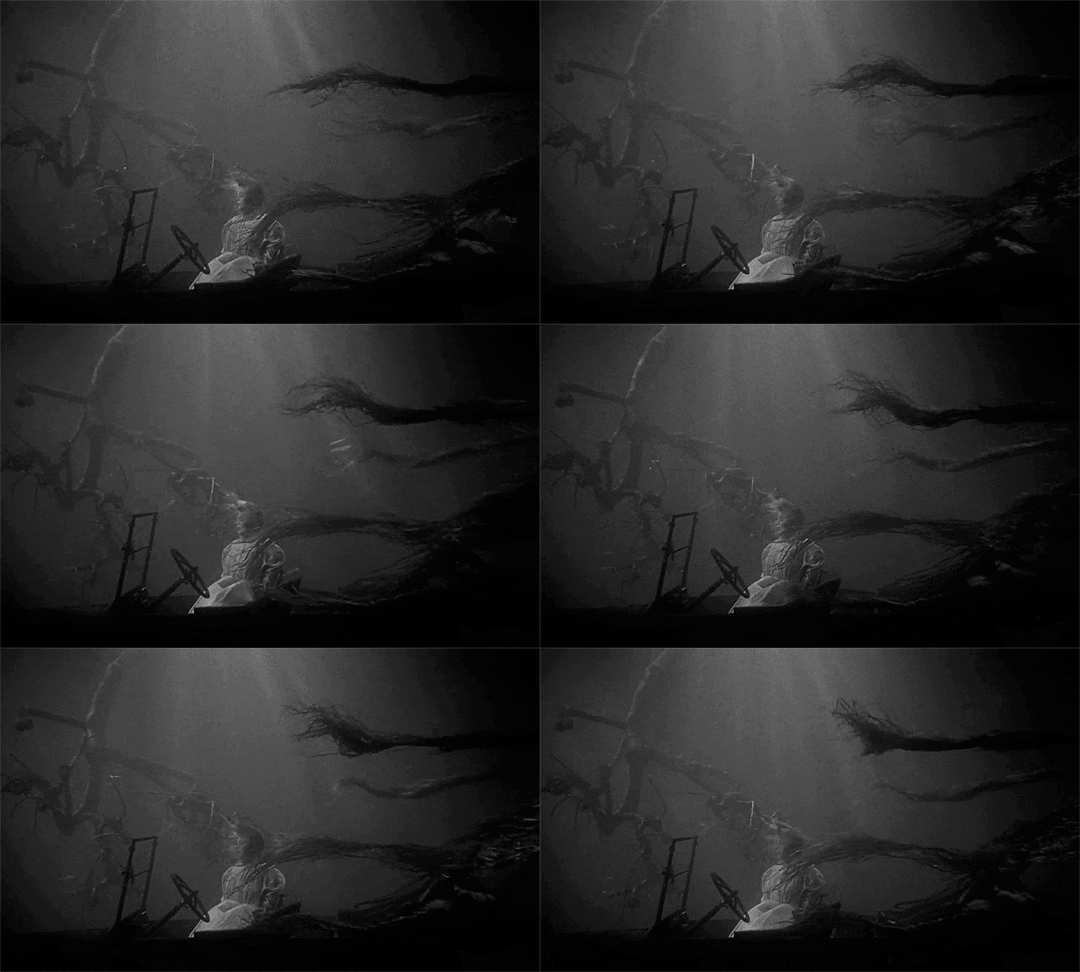
The Night of the Hunter

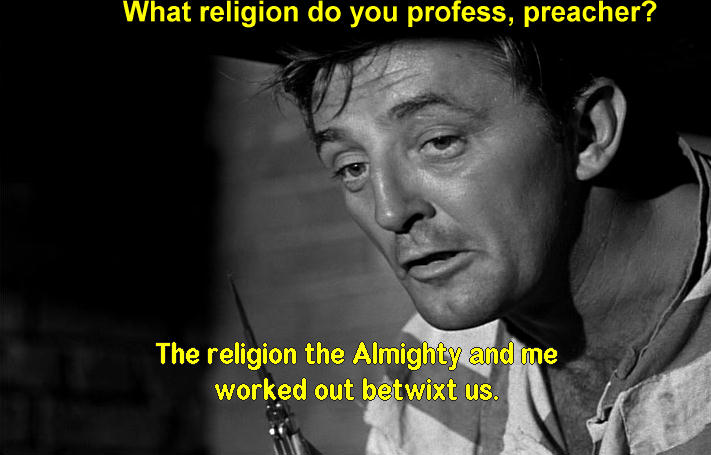
Ah, little lad, you're staring at my fingers. Would you like me to tell you the little story of right-hand/left-hand? The story of good and evil? H-A-T-E! It was with this left hand that old brother Cain struck the blow that laid his brother low. L-O-V-E! You see these fingers, dear hearts? These fingers has veins that run straight to the soul of man. The right hand, friends, the hand of love. Now watch, and I'll show you the story of life. Those fingers, dear hearts, is always a-warring and a-tugging, one agin t'other. Now watch 'em! Old brother left hand, left hand he's a fighting, and it looks like love's a goner. But wait a minute! Hot dog, love's a winning! Yessirree! It's love that's won, and old left hand hate is down for the count!

The above quote is a distillation of the conflicts in The Night of the Hunter—a failure at the time of the film's release in 1955, but has become a cult classic among fans of the Gothic, the film-noir, the atmospheric, the poetic, and amongst film-makers—Spike Lee famously recalled it in Do the Right Thing—as what one is capable of when "making pictures". The movie veers from day-blasted scenes in the sunlight, to an artificially encroaching studio-night of terrors and claustrophobic angles.

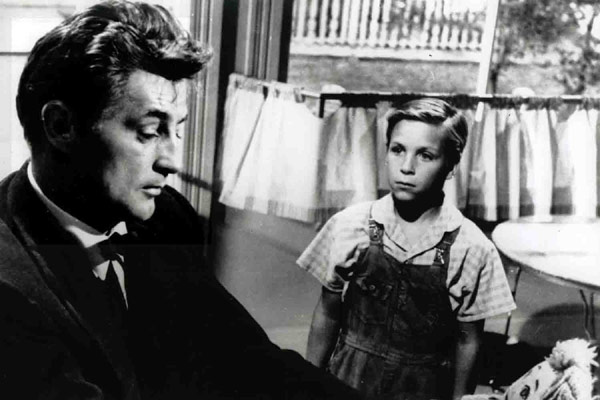
One of the most stylized, creepiest movies ever made--the only one ever directed by actor Charles Laughton--The Night of the Hunter tells the story of an almost-elementally corrupt minister who comes to town seeking fortune by seducing and murdering the wife and terrifying the children of his old cell-mate, and tells it in the manner of a magical fairy tale. As two of the targets of the Rev.'s obsessions are the impressionable children of Willa Harper (Shelley Winters), the film becomes a battle between Good and Evil as seen through their eyes.
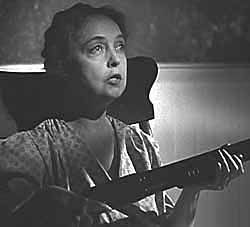
The Good is represented by the Grandmother
, played forthrightly by silent film star Lillian Gish. The Evil is the right Rev. Harry Powell, who strides into town with the conflicts in his soul tattooed on his fists. It's a bravura performance by Robert Mitchum, who wasn't known for bravura performances, usually satisfied maintaining a laconic air to get by. Here he brays and exhorts like a bull and it's an amazing thing to see so theatrical a performance come out of him--in fact, it's the role he's best remembered for. The film itself is a creepy blend of reality and fantasy, of realism and theatricality and the clashes of those sensibilities jar one's attention, while burrowing into the soft places of one's skull. Despite poor box-office and critical pans when it opened in 1955, The Night of the Hunter abides. 
 
It abides and it endures.


Thursday, October 28, 2021

American Psycho

American Psycho (Mary Harron, 2000) 
[Bateman] was crazy the same way [I was]. He did not come out of me sitting down and wanting to write a grand sweeping indictment of yuppie culture. It initiated because of my own isolation and alienation at a point in my life. I was living like Patrick Bateman. I was slipping into a consumerist kind of void that was supposed to give me confidence and make me feel good about myself but just made me feel worse and worse and worse about myself. That is where the tension of American Psycho came from. It wasn't that I was going to make up this serial killer on Wall Street. High concept. Fantastic. It came from a much more personal place, and that's something that I've only been admitting in the last year or so. I was so on the defensive because of the reaction to that book that I wasn't able to talk about it on that level.
Bret Easton Ellis' controversial 1991 novel "American Psycho" received damning reviews and protests, even boycotts. It's depictions of violence against women— and violence against anybody—was condemned left, right and center, while its look at toxic masculinity, and toxic consumerism was pretty much dismissed as trying to apply a sociological band-aid for what was essentially slasher-porn. The violence in the book buried any consideration of what the book might be saying about a personality so self-involved that it surpassed pathology. 
But, why should this be surprising? Anthony Burgess' "A Clockwork Orange" and Stanley Kubrick's film of it are more talked about for its violent aspects and cruelty rather than the very real—and extreme—considerations about free will and attempts to dampen it, even if for the greater good. The message gets lost in the illustration of the worst case scenario.
The thing is Patrick Bateman, Ellis' "Psycho" protagonist (played by Christian Bale in the film version by Mary Harron), is a misanthrope, much like that other "Psycho," Norman Bates—it's just he's better dressed, more stylish, has a better job, and is on an upward track to being what is considered successful in America. Sure, the surface-flash may be attractive...to some...but the festering pit of soullessness and heartlessness that serve as competitive spirit in his career as an investment banker is only somewhat more lethal than the motivations of Jordan Belfort, Leonardo DeCaprio's character in Wolf of Wall Streetsociopath or psychopath, they're just two paths to getting what you want, without regard to others, and the destruction, seen or unseen, left in the wake of success.
At about the same time as Ellis' novel, there was another, Chuck Palahniuk's "Fight Club," that also examined the American path to success where the protagonist's hollow consumerism started to so weigh on him that he started beating himself up over it and, when that movie was made in 1999, nobody missed the point...even when it led him to an act of terrorism that resembled the 9/11 attacks two years later. Everybody cherry-picks when they have a point to prove. "Fight Club" was also seen by some as a model for males to return to a form of rugged primacy to avoid consumerist emasculation. And yet he doesn't live in a cave, but a luxury condo, and not independent in any form. One can see this in AP's use of extreme grooming and high-fashion one-upmanship. The guy gets upset when someone has a better designed calling card than he does. He merely wants to win by any means necessary.
Now, I'm not going to get political here (as I was when I first started writing this thing LAST Hallowe'en season), but one can see where this is going. Let's just say I've always rejected the sentiment that "Winning isn't everything; it's the only thing"—attributed to Vince Lombardi (who would hedge on it), but actually coined by Red Sanders (I guess "winning" depends on your press agent). You can win AND lose, it's just depends on what goals you're looking at. Ellis was making a philosophical point and has said of the film version that it "doesn't really work as a movie." Perhaps it's all just a vision in his head, rather than committing actual acts. But, the impulse is there. We've seen it. It happens. Some righteous synapse gets snapped, or diverted, turning an American Dream into an American Nightmare.
 
The question is: of what use is a "cautionary tale" when it's already here?

Wednesday, October 27, 2021

M (1931)

M
(aka M-Eine Stadt sucht einen Mördor, Fritz Lang, 1931) A rash of child-murderers in the Weimar Republic led Fritz Lang and his then-wife Thea von Harbou to use it for what Lang wished to be a film about "the ugliest, most utterly loathsome crime."

He could only have topped it if he'd stayed in Germany and waited a few years. Indeed, when he was attempting to arrange the start of filming, he was refused the use of Staaken Studios, as the head of production was a Nazi and thought the working title—"Murderers Among Us"—would be critical of the up-and-coming political movement. One wonders why, if he thought that was the case, he wanted to be a Nazi Party member in the first place. Actually, given History and given people, one no longer wonders.
 
But, Lang's M had more things on its mind than just a film about a child murderer. Lang's films usually did.
Lang presents the emotional issue in one shot.
 
The film begins with an ironic sequence—children in a circle out on a street playing a counting-out game (where when a child is pointed at, they drop out, or disappear from the game) with a rhyme that has to do with a "man in black" who makes "mincemeat" out of children with a "cleaver's blade." One by one, children get eliminated. How's that for foreshadowing? The song is an annoyance to one of the women at the tenement who is taking her laundry up to be washed, and when she complains about the kids, the washer-woman says "At least if we hear them, we know they're safe."
Then, it's a good thing this is Lang's first film utilizing sound. And a cacophonous world it is, with street-noises, off-screen alarms and sirens...even the passage of time when her little girl doesn't arrive for her regular lunch is emphasized mockingly with a cuckoo clock. In fact, after the titles, the first thing we hear is that children's on-the-nose game-chant. When the little girl is late, the woman no longer depends on sound and goes looking, asking the other kids coming up the stairs if they'd seen her. Then, as if to emphasize that she's not coming, Lang shows her empty place at the table, the yawning empty staircase to her flat, the still basement—then, outside, telephone wires to which gets stuck a balloon that we had seen a man buying for her, then the girl's ball as it rolls...and becomes still.
Horrible things are done in this film, but Lang shows them off-screen, suggestively, and lets the audience do the dirty work, making us culpable. But, we're not alone in this. As fear grips the city, everyone becomes suspicious of each other. Talking to a kid on the street? You could be the murderer! The accusations are made directly to the camera, as if we're the guilty ones. Suspicions turn into accusations, and the police, under considerable political pressure starts to ramp up their investigation, looking in all those empty spaces for victims, rousting criminal hang-outs for clues, making the city sweat, especially those dens of iniquity where aberrant behavior are ever-present.
While the populace looks over their shoulders, buying up the hysterical headlines in the newspaper, squinting at any suspicious activity (or even not suspicious!), the criminal element begins to feel the heat and they determine to catch the pedophile by the means the police don't have at their disposal—their own spider's web of a network utilizing beggars on the street to keep an eye on every child. The police, meanwhile, are narrowing down their suspects and starting to close in. It's just a matter of who catches him first, the authorities or the outlaws.
We already know who it is: we've watched him (Peter Lorre) work, watched him write taunting letters to the paper, watched at how close he gets to getting caught and slip away. But, it's the investigations that take him out of the shadows and provide him with a name and a familiarity. We've listened as he whistled "In the Hall of the Mountain King" and fretted, even if we haven't seen him, but felt the tension increase. Then, when he's been marked, we watch as he struggles to avoid detection only to realize that it's not the police he has to fear, but everyone around him. The tables have been turned. The populace are no longer potential victims, but potential threats.
Murderers as victims. Criminals as detectives. The audience as co-conspirator. Lang's film—his favorite of his career—subverts so many elements to such devastating effect that's it's no wonder anyone who wants to make a thriller—at least a smart, cynical one—has borrowed from Lang's playbook for many years. And his parlaying of a black and white world into one where the colors are switched was so alarming to the Nazi's that once they seized power, they banned the film in July of 1934 (although they did use clips of it in their anti-Semitic propaganda). Seems they didn't want any moral complexity for the masses. Black is black and White is right and they got to choose what was good and evil in the Universe (they chose wrong). Lang saw child murderers as vermin. But, he also saw vigilantism and mob-think as dangerous, as well. The message he said he wanted to convey was "watch your children" not only to keep them from harm, but prevent them from becoming monsters, as well.

Tuesday, October 26, 2021

Dune (Part 1)

As the Worm Turns
or
"So, It's Done?" "It Is Done." (No, It's Not)
 
There have been two previous versions of Frank Herbert's classic novel "Dune"—the 1984 David Lynch version* which tried to be trippy and kinky and ended up looking like any other Dino DeLaurentiis sci-fi movie and the Syfy Channel did a mini-series in 2000, which had a bit more of a bead on Herbert's novel, but looked cheap and seemed mis-cast. And there's the legendary Alexandro Jonorowsky version that cost two million dollars while never getting out of the design phase. "Dune" has a considerable history in both the science-fiction and literary circles (which don't intersect too deeply) and has passed through the minds of many directors and scenarists who have considered cracking it, distilling it, trying to fold it into a manageable narrative. No one's been able to do it, especially the folks who made the ones that exist. 
 
The problem with both of them is those versions were so...white! I'm not being a Social Warrior saying this, because "Dune" was not concerned about race in the story, so much as it was with the politics of imperialism and the pivotal moment when indigenous people rise up against their occupiers. It's also concerned with taking back the resources for which that tribe's land is plundered. And it's about the pressures of a charismatic leader, especially when there is a zealotry aspect to it. And it's about evolution. And ecology. And power. And religion. And myth. And a few other things all mixed into the big sandbox. There is too much of Planet Earth in "Dune" for the cast to be solely Aryan. For it to work, there has to be a clash of textures...and I'm not talking about in the production design.
Paul Atreides (Timothée Chalamet) has been having bad dreams. He is the scion of the House of Atreides, led by Duke Leto (Oscar Isaac) and his concubine (Rebecca Ferguson), a priestess of the secretive and influential Bene Gesserit sect, which has been tasked by the Galactic Emperor to take over the fiefdom of the planet Arrakis, the source of the spice "melange", which has made its way throughout the societies as an essential mineral, allowing faster than light space-travel, hyper-sensitive senses, and higher cognitive abilities. Without melange, the gears of humans among the stars grinds to a halt. The spice must be mined, and the House of Atreides has been given the planet's charge to increase production.
Actually, the whole thing is a manipulation by the Galactic Emperor to destabilize the most powerful houses, the Atreides' and the Harkonnen's who have been the previous exploiters of Arrakis, a role they have undertaken brutally. With both houses fighting to the death, wasting their resources while doing so, the only winner would be the Emperor, who would be that much more powerful with no threats to his primacy. But, for Duke Leto it is an opportunity too tantalizing to resist—melange is the oil by which so much of the infrastructure of the Galaxy depends, and if he can successfully increase its harvest, his House will become very powerful, indeed. Possibly bigger than the powers of the Emperor to interfere with. Duke Leto is trying to buy his House's future, but even he doesn't know—couldn't fathom—that it has already been determined, pre-destined, as long as the will to sacrifice to achieve it is followed through. But, that is out of his control.
This version of Dune concentrates on the political manipulation that sets these events in motion, and it is the only failure of the movie that it decides to keep the run-time down to a hefty feature length (although one never feels it's too long). But, it is also the film's strength in that it doesn't scrimp on the detail that makes the story-telling so rich. One feels that this is the first true adaptation of Frank Herbert's vision of things (it has "'thopters"!—he said geekily) with a genuine-looking epic scale. Spaces are vast and the functionally-designed ships seem like they have weight.** At the same time, it manages to convey the vulnerability of little objects—like people—caught up in those expanses.
The cast is top-notch, putting more emphasis on the characters who will disappear (temporarily) like Josh Brolin's Gurney Halleck and Jason Momoa's Duncan Idaho, and focusing on the character of Paul (Timothée Chalamet—I've never seen him less than interesting), at first a callow youth unsure of his place in things, then becoming more of the "man of the house" when they get dicey. And for his limited time on-screen, Javier Bardem makes the most of his role as Stilgar, the leader of the indigenous Fremen (the film ends during a pivotal moment when Paul meets the tribe—a scene that wasn't even IN Lynch's theatrical cut). These flashes of characters will (hopefully) be expanded in any continuation, making one want to cross fingers in anticipation. It's a frustrating business not knowing the future.
That the actors stand out in the epic-ness of Villeneuve's frames (with the masterly expertise of DP Greig Fraser) and don't get lost in it all is a testament to their abilities. You have to be on your "A"-game to compete when Villeneuve gets caught up in his production design, leaving you strolling for minutes enjoying the sumptuousness of the scenery and lighting. He has overplayed that hand in the past, but, here, it all works and works well. No crippling exposition. No favoring the scenery over the characters. The people are figures in the director's landscape, a part of it, and not just walking through it.
And what a landscape it is. This is a beautiful film, whether it's the glittering of "spice" wafting among the grits of the Arrakis sand, or the alligator grills on the sand-worms, or the insectoid nature of some of the tools, the snap of the uniforms, or the vast horizons that bisect the screen, this is world-building and story-telling at its best and most compelling (for a nice sampler of shots check out the video below from the "Amazing Shots" channel at YouTube). 
 
This is the adaptation of "Dune" has been waiting for.


* Lynch turned down directing Return of the Jedi to make this film. Can you even imagine what that might have looked like?
 
** And if I can add an "anti-advertisement" here for HBOMax. I don't care how big your home-screen is, this film deserves to be seen in a theater! 

Sunday, October 24, 2021

Don't Make a Scene: The Player (1992)

The Story: Here's another of those Premier magazine "Classic Scene" features, one from Michael Tolkin and Robert Altman's poison pen letter to corporate Hollywood, The Player.

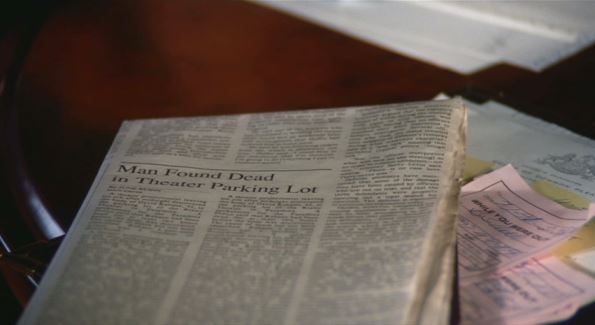
Two things are going on here: pitch-filter Griffin Mill has a board meeting, the first one including a recent acquisition from Fox studios, Larry Levy, who, even before he arrives, starts angling to eliminate Mill's job—both men detest each other as is apparent from their coolness towards each other; the second is that Mill had killed a man the previous night and notices at the board meeting that the newspapers are already reporting the murder. The scene subtly shifts from boardroom politics to Mill's growing paranoia about being caught for the crime.

And yet, the big-wigs go on nattering about the prospect of dispensing with writers and sharing headlines for movie ideas when Mill notices the little item about the writer killed in Pasadena. Subtly, the sound lowers as Thomas Newman's minimalist score starts to herald alarm bells and he maneuvers to retrieve the paper and take it off the table.

It's subtle film-making, it draws you in, and highlights the subtle and off-kilter way Altman shoots and cuts to build suspense.

The Set-Up: Studio Exec Griffin Mill (Tim Robbins) takes pitches for upcoming projects, but the one he's living right now, he'd probably reject. Receiving threatening post-cards from a disgruntled writer, Mill agrees to meet with the writer in Pasadena, and the writer ends up deader than a script in turnaround. The next morning, he's unusually late for a meeting and—oh, joy!—there's a new hire (Peter Gallagher) who's angling for his job. He's probably considering a sequel to last night's action, but something stops him in pre-production.

Action!
 
GRIFFIN MILL: Excuse me...
GRIFFIN:
Hello. Sorry I'm late. 
CELIA—(Levison's assistant):
You certainly are. 
CELIA:
A few minutes in the office would be fine. 
JOEL LEVISON (Studio Chief): Griffin, you missed the formal welcoming ceremony. 
LEVISON:
You know Larry Levy. 
GRIFFIN: Of course. 
GRIFFIN:
Hi, Larry. 
LARRY LEVY: Hi, Griffin. 
LEVISON:
Larry was... 
LEVISON:
...
able to leave Fox a week earlier than he thought...and has come aboard as of this morning. - 
GRIFFIN:
Great. Let's...let's start. 
LEVISON: Larry was in the middle of something. 
LEVY: Ah, no, I wasn't. 
LEVY:
I was just killing time waiting for Griffin. 
LEVISON:
Well, no, finish. What were you saying? 
LEVY: I was saying I've yet to meet a writer who could change water into wine...and we have a tendency to treat them like that. 
LEVISON: Not at this studio. 

LEVY: A million, million and a half for these scripts. It's-it's nuts. 
LEVY:
And, I think, avoidable. 
LEVY: Let me ask you something. 
LEVY:
When was the last time you bought a ticket to see a movie? 
LEVY:
You actually paid(your own money?)
GRIFFIN
(interrupts):
Last night. 
GRIFFIN: Pasadena. The Bicycle Thief
BONNIE SHEROW (Mill's associate): You went...
BONNIE:
...to see The Bicycle Thief
WHITNEY GERSH (Sherow's assistant):
I love that film. It's a great film. 
LEVY:
It's an art movie. It doesn't count. We're talking about movie movies. 
LEVISON:
Jesus, people. 
LEVY: I'm just saying... 
LEVY:
...there's time and money to be saved if we came up with these stories on our own
SHEROW:
Where are these stories coming from, Larry? 
LEVY:
Anywhere. Anywhere. It doesn't matter. Anywhere. Uh.
LEVY:
The newspaper. 
LEVY:
Pick a story, any story. 
STEVE REEVES (marketing):
All right. 
REEVES:
'Immigrants protest budget cuts in literacy program.' 
LEVY:
Human spirit overcoming human adversity. Sounds like Horatio Alger in the barrio. 
LEVY:
Put Jimmy Smits in it and you've got a sexy Stand and Deliver.
LEVY:
Next. Come on. 
MARTY GROSSMAN (accountant):
Larry, this isn't my field. 
LEVY:
Marty, it doesn't matter. Just give it a shot. You can't lose here. 
GROSSMAN:
Okay...
GROSSMAN:
How about 'Mud slide kills 60 in slums of Chile'? 
LEVY:
That's good. Triumph over tragedy. Sounds like a John Boorman picture. 
LEVY:
You slap a happy ending on it, the script will write itself. -
LEVY:
Bonnie, here. Give me the paper. 
SHEROW:
Gee, I don't know, Larry. 
LEVY: Give it a shot. 
SHEROW:
'Further bond losses...
SHEROW:
...push Dow down 7.15' - 
SHEROW:
I see Connery as Bond. 
LEVY:
That's funny. It's a good thing... 
LEVY:
...Oliver Stone wasn't listening to you. Where would we have been? 
SHEROW:
Well, we would have been spared sitting through Wall Street, for one thing. 
LEVY:
Marty,
what did Wall Street do worldwide? 
GROSSMAN:
Seventy, seventy-five, maybe eighty. 
LEVY:
$80 million, a couple Oscars, is nothing to sneeze at. 
LEVISON: Okay...
LEVISON:
I think Larry's point is well taken. 
LEVISON:
Let's move on now. Griffin...
LEVISON:
...can you give us an update on the Taylor Hackford project? 
LEVISON:
Griffin? 
GRIFFIN:
Yeah. 
GRIFFIN:
I was thinking what an interesting concept it is to eliminate... 

GRIFFIN: ...the writer from the artistic process. 
GRIFFIN: If we can get rid of the actors and directors, maybe we've got something here.


The Player is available on DVD and Blu-Ray from The Criterion Collection.