Saturday, August 22, 2015

The Man From U.N.C.L.E. (2015)

Cry U.N.C.L.E.! and Let Slip the Dogs of Summer!
or
The Better Luck Next Time Affair

Those of us "of an age" remember the 1960's (if what we did in the 70's and 80's didn't completely wipe it out) as a time burgeoning from eclectic influences in pop culture. Colors were bold, music had influences from around the world (mostly British, French, Italian, and Spanish with a smattering of Appalachian folk), literature disobeyed rules and fashion skimped on material and was mightily chromatic. Things began to go "pop" and the notion of "long-hair music" forever changed. In the era of the Beatles and Bond, things began to be taken less seriously until it fell into "camp." On TV, the transition went from black-and-white into "living color" and the shows went from filmed radio plays to bigger-budgeted escapism.  

One of those was an hour long spy-mock-drama that endeavored to bring a James Bond type of thriller to the small screen (Bond's creator, Ian Fleming, contributed the name of its hero-agent) with a touch of intercontinentalism (on a small budget) and a running nod towards Hitchcock. "The Man From U.N.C.L.E." (which stood for The United Network Command for Law and Enforcement.*) premiered on the NBC TV network in September of 1964 (a few months shy of the movie premiere of Goldfinger) and featured Robert Vaughn as American agent Napoleon Solo (Fleming's contribution) and David McCallum as Russian agent Ilya Kuryakin. Leo G. Carroll played their boss, Alexander Waverly (he played a similar head of a spy agency in Hitchcock's North By Northwest). The plots generally revolved a plot by the criminal organization T.H.R.U.S.H.** which Solo and Kuryakin would quell with the assist of an innocent civilian (usually that week's lead guest star) who would prove invaluable and then return to their ordinary lives never to be heard from again. The show ran for 4 seasons on NBC and frequently bits of episodes were joined together to form theatrical films which were most prominently shown in foreign markets. There was a spin-off: "The Girl From U.N.C.L.E." starring Stephanie Powers (as agent April Dancer—another Fleming name) and Noel Harrison, but it lasted one season.
That was then; this is now.  An "UNCLE" film has been in development for years with various enticing elements attached, but when the chips fell, Guy Ritchie was in the director chair, and re-united with his Sherlock Holmes co-screenwriter Lionel Wigram to make an updated version of the film. Just as with that film, the two tinker with expectations while trying to remain somewhat true to the spirit of the thing.
So, how is it?  Pretty luke-warm for a Cold War film.  It is an origin story of sorts, set in 1963 with a threat of such high seriousness and nuclear repercussions that the CIA and KGB must unite to try and stop it. The recruits are Napoleon Solo (Henry Cavill—who doesn't have Vaughn's lizard-like charm, but replaces it with a winsome mean streak) and Ilya Kuryakin (Armie Hammer, just fine, thank you), just like the series. But not like the series. Solo has a history of theft, smuggling and black marketeering from his days at the end of World War II (although Solo looks a bit young to have been serving at the time) and Kuryakin is humorless, abnormally strong (he yanks the boot off a car at one point in the film) and is reported to be slightly psychotic from childhood traumas. Well, that's no fun, but it does set up the sort of bitchy, bickering banter that the Holmes films are known for, some of which works and some of which feels like filler.
The collaboration does not start off well.
The matter at hand is an Italian industrialist couple, the Vinciguerras's (Luca Calvani, Elizabeth Debicki) with ties to former Nazis who—for whatever reason—are trying to develop a nuclear bomb. Not nice. The reason Solo and Kuryakin are collaborating is that both agents were trying to get their hands on one Gabby Teller (Alicia Vikander), whose father is working with the Vinciguerra's to develop the bomb. Solo manages to smuggle her out of East Berlin, much to the consternation of Kuryakin, who is trying to prevent it. This forces the two sides to cooperate, although both agents are privately advised to steal the back-ups of the bomb plans even if they have to kill the other to do so. Not the most viable of partnerships.
And if their rivalry doesn't put the kibosh on the operation, Gabby's loose cannonry certainly might. She trusts Solo a bit (he did, after all, get her out of East Berlin), Kuryakin, not at all—and he's the one tasked with posing as her fiancĂ© in the hopes that she can contact her long-missing Daddy working for the enemy. It is the flimsiest of spy-schemes but it beats a high-stakes poker game or most of the other UNCLE strategies on the TV show. While Solo turns on the charming roguishness with the Vinciguerra's (particularly the Mrs.)...
...Kuryakin and Teller try to pose as a happy couple in love, something the Russian has to be constantly coached at by both Solo and Teller, as he is not very good at staying in character. He also has a nasty habit of losing his temper and using his martial arts training, even though he's supposed to be posing as an architect. Considering he's being watched constantly by Vinceguerrian hoods, you would think he'd have a little more control over himself. How long has Kuryakin been an undercover agent, anyway? 
The character arcs of the two agents are rather obvious—they start out as the best of enemies and after some softening up, whether by feminine charm or by Nazi-inspired torture, they become the worst of friends. Each has more than enough opportunity to irritate the other—they both manage to "bug" the other metaphorically and technologically—but stray instances of rescuing the other, even if deliberately delayed after initial second thoughts, makes them realize that they have each others' backs, even if secretly imagining a target over-layed there. It's a wonder with all the bickering they get any work done and it becomes apparent fairly early on who the prime movers of the opposite camps are.
For the best thing about The Man From U.C.L.E. is, contrarily, The Women: Vikander's Gabby Teller is presented as an innocent—the Hitchcock innocent in over their head (which was a much used trope of the original TV series)—but she quickly displays a better understanding of her role than the uptight Kuryakin does, and her adaptability and her quick judgment in rolling with changes in strategy makes her a better insurgent than Solo, who always manages to stick out like a superbly tailored sore thumb. And the actress has more fun with her role than either of the two leads, frequently being more engaging and entertaining—there's a lovely moment where she boogies to vintage rock in the background while Kuryakin tries to concentrate on a focusing chess game despite the irritation of his lively room-mate.
Then there's the villainess, played by Debicki. Tightly coiffed and haute coutured to maximum advantage, she resembles nothing so much as a blonde Audrey Hepburn morphed into a cutthroat assassin. She's gorgeous, but that's not the main reason you wouldn't want to turn your back on her, and Debicki invisibly sashays between cooing hostess and sociopathic evil without breaking stride. Her screen-time is not much, but she manages to be always one step ahead of her co-players, both in dominating a scene and the story.  The actor playing her husband barely registers—it's clear she's in charge even if she wouldn't be caught dead wearing a pant-suit.
That the women in U.N.C.L.E. are far more interesting that the titular males seems a little surprising and a bit vexing—maybe we've seen the back-biting, bitching male co-workers too much in Ritchie's "Sherlock Holmes" movies. And like those, the movie has an over-abundance of style—the period details are fun and distracting, the fashion is really well-done—if only the central roles were as nicely tailored—and the soundtrack is a bold blend of brash Italian stylings with glimmers of other pop fads from the 60's—there's even a barely discernible nod to Jerry Goldsmith's theme from the TV show. It's the one hint of subtlety to the score which is refreshingly free from being the musical paste that has become more of the norm these days and is more of an accompaniment than trying to "blend."

But, there should be more to a movie than some good elements. However fresh some things are, it can not keep the whole thing from feeling a little stale. One wishes for a little more fun, a bit more wink, which, even in its earliest days, the series managed to pull off.  

Open Channel D (or, at Best, C-)
Mr. Waverly (Hugh Grant) gets the very predictable last word.


* The series had a nice joke at the end of the weekly credits: "We wish to thank the United Network Command for Law and Enforcement without whose assistance this program would not be possible."

** It was never really established what the "THRUSH" acronym stood for but it has been widely accepted as The Technological Hierarchy for the Removal of Undesirables and the Subjugation of Humanity—a name that probably wouldn't qualify it for 501(c)(3) status.

Wednesday, August 19, 2015

Trainwreck

Doing the Old Soft-Schumer
or
"Behind every silver lining...there's a dark cloud"  
George Carlin

I'm a big fan of Amy Schumer.  I just love her (kinda...when I'm in a good mood and now that Jon Stewart's quit). There is some real pain there that is channeled through the most deliciously wicked sense of humor that is simultaneously wise, self-deprecating, fierce and fearless. She's also a comedian who is a natural actor with a basic persona that is unique that starts with a strong joke-line, then is followed up an after-thought that one-up's and builds the joke, even as the energy behind it drops. Her edgy Comedy Central show "Inside Amy Schumer" has a nicely absurdist satirical edge when it comes to feminism, relationship issues and just about...everything. She's a potty mouth with a brain and says everything so sweetly, you might not even take offense.  

Unless you're a male. Or at least, onene of those male's who think women can't be funny. Which is so absurd, it might even be funny of its own accord. Except that the "guys" who say this are block-of-stone deadly serious...which is always a good starting point to judge comedy.
"It's FUNNY!"
Trainwreck IS funny, and funny in the way that Schumer's comedy is funny. She wrote the thing, after all, under the patronage of director Judd Apatow who wanted to do a project with her. 

That's good. In the way that all first projects are good. You gotta get your foot in the door, and for Schumer to get out of basic cable, a movie is a good bet—there are only so many talk-shows you can go on to spread "the word" and become more well-known and build "the brand."
Just be careful what you wish for.  Because, sometimes, getting that first deal struck means compromise...and compromise on some pretty basic level. Like the material. Sometimes, you have to do some re-writes to "take the edge off," appeal to a wider audience. Dumb it down.

Before I go any further, a quick capsulizing for Trainwreck: Young Amy and her sister Kim are given a "talking-to" by their father (Colin Quinn) about why he and Mom are getting a divorce: "Monogamy-isn't-realistic." His girl-children dutifully repeat the mantra as its a life-lesson that is obviously important. But the results are different. Younger sister Kim (Brie Larson) is settled down with a husband and a kid on the way. But Amy has gone a different path. A writer for a "trend" magazine (edited by Tilda Swinton, who plays outrageousness absolutely straight) she manages to maintain her career while not managing anything else.  Her after-hours activity usually involves drinking herself into a blurry stupor and sleeping with the first guy she picks up...at which point, she promptly escorts them out, never to be heard from again, to their chagrin, as she is more than agreeable that they leave—forever.  

This is Amy's secret life. She has a boyfriend—a lunkhead named Steven (played by WWE star Jon Cena) but he has no idea this is going on out of his eye-shot.  And that is fine with Amy. Things start to get "complicated" when her magazine assigns her to write a sports surgeon named Aaron (Bill Hader, in a relatively straight romantic lead that he still manages to pull off despite his ventriloquist dummy looks). Their initial meeting is awkward, prickly. She hates sports. It's his livelihood and he deals with some of the largest lights in the sports dimension—LeBron James has an extended cameo and he's a natural at this acting thing (is there anything he's not good at?), finding a sweet-spot between underplaying and looking amateurish (like most players do). The fact that the star doesn't give a rip about sports makes you wonder why there are so many sports cameo's, and again, we will delay any speculation why.
His work makes her vomit, but he's the nicest guy—at least the least creepy—she's met in a long time. He's also annoyingly normal. And—worst of all—after they sleep together, he has the temerity to actually call her and ask her out again.
"Ya know what? I'm gonna call the police..." That's a funny line. And it's also at the heart of Schumer comedy; the norm is so out of whack in the dating game Amy is in that to be confronted with it, it seems bizarre, even threatening. Something so right must have something wrong with it. And so the closer he and she get, the more she pulls back. Cynicism and sarcasm are the comfort zone. Anything positive, in such a world-view, must have a consequence. So why risk happiness?  
That's such a contrarian concept, it can only be either comedy or tragedy—the two are only a reaction shot different from each other. It's a high-wire act that has to be tread very gingerly or it will go in a direction that is not intended and Schumer's comedy strides that line. It's thrilling to watch because you might be blind-sided at any minute by a sudden torque in mood.

Unless, of course, you're watching a Judd Apatow film. Every film of his has the same distinct arc—the square peg getting its corners shaved to fit into the societally-approved round hole. Look at his movies: Apatow has the reputation of being a ground-breaking film-maker, pushing the limits of what can be done on-screen (as far as subject matter is concerned; pictorially, he keeps things in frame and in focus and manages to keep beats as far as emotional focus and that's about it), but there is no director more provincial (even Garry Marshall) in bringing things to a close that would satisfy Focus on the Family. He's a conservative in radicals' clothing and the ending of Trainwreck is another example of how he can bring a challenging idea and completely cut the legs out from it and turn into a bawdy sermon. This ending, in which Schumer's character "turns her life around" (as far as the movie goes) rankled me as much as the ending of Grease in which Olivia Newton-John's character must present herself as a dirt-bag in order to win the heart of John Travolta's namby-pamby bad-boy who's too weak to risk anything in the relationship. As Mad Magazine opined in its parody: "what a wonderful message for the youth of America."

This is the same message although in reverse. No matter how well-meaning the transformation, it still puts its female protagonist in the position of "she who must yield" if the couple is having any future. It flies in the face of what has gone before and feels completely foreign to the Schumer mind-set. But, then we're talking compromise here, compromise to a patron who managed to get the thing made, even if it means finding an easy-cheesy solution to a complex problem and undermining the work in the process. Until then, Trainwreck coasts along smoothly but derails as it pulls into the station, leaving one with the same feeling as the optimistic surgeon: "Well, the operation was a success but the patient died."

'Tis a pity...

Eyes of Hitchcock

Seems so obvious, but here's a "Supercut" of Hitchcock's obsession with eyes.

Sunday, August 16, 2015

Don't Make a Scene: True Grit (1969)

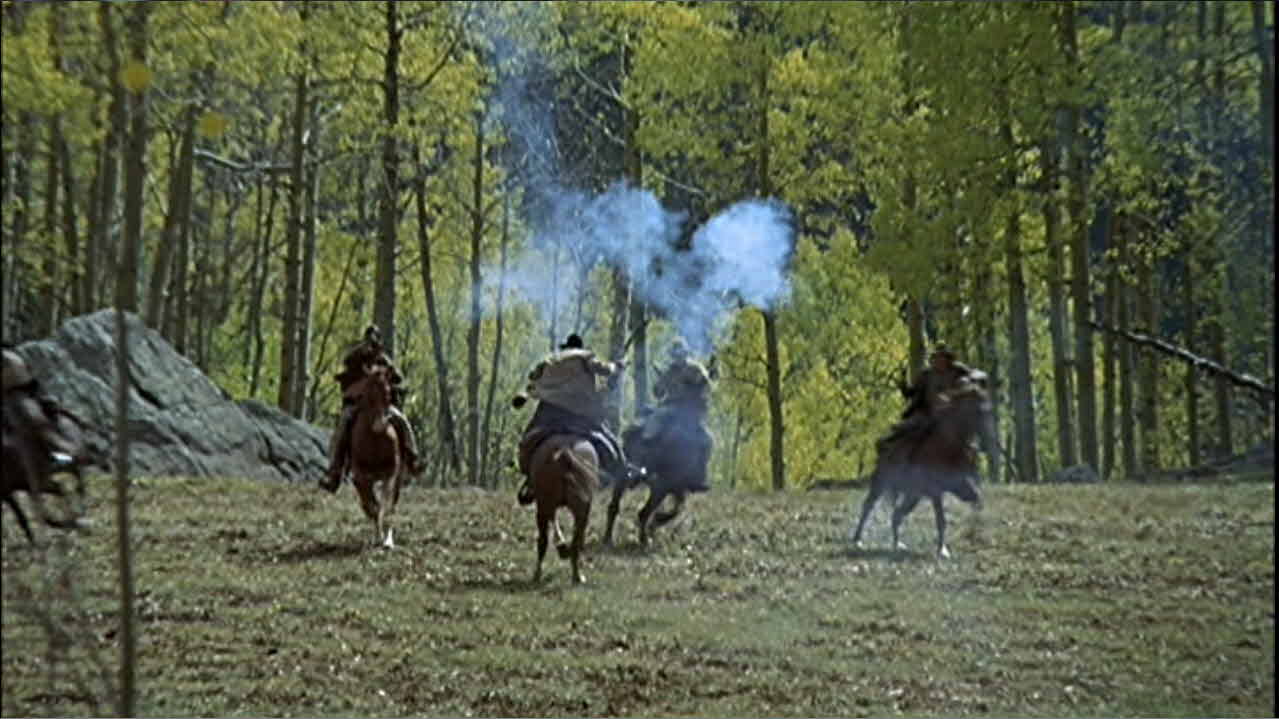
The Set-Up: It's mentioned earlier in the script—how Marshal "Rooster" Cogburn, alone, faced down several gunmen on horse-back, by taking his horse's reins in his teeth and firing on the opponents with both hands. It is assumed it is hyperbole, bold talk from a one-eyed fat man.  But, in this scene, from the original version of True Grit (the Coen Brothers' version, starring Jeff Bridges as Cogburn, will appear next Sunday) it is revealed as truth.

Cogburn really is that crazy.

And that capable. John Wayne won a long-deserved Oscar for the role; he's been better in other movies, but it was always assumed he was just "playing John Wayne." Cogburn was enough of a character, with shades of the Wayne persona mussed up and made sloppy, that the Hollywood crowd could look at this and say "well, that's different." They couldn't deny his comic timing when it was needed, and the still stalwartness when it wasn't. Cogburn's a little arch, the language (from Charles Portis' sepia-toned novel) a bit flowery and precise, but bigger than life—it's entirely appropriate that director Hathaway stages this gladiatorial gun-play in the natural amphitheater of a forest glade, not far removed from the round Spanish ruins that framed the gun-duels of director Sergio Leone's "spaghetti westerns."

This scene also contains one of my favorite Wayne lines—not found in Portis' book, but the rest of the dialogue is his—the relief-expelling laugh line, bordering on camp: "Damn you, Bo" says Wayne's Cogburn to his beloved fallen horse. "First time ya ever gave me reason ta...cuss ya." It's a little precious, but leavened somewhat by Wayne's regret-filled reading. It's the sort of line you'd expect John Wayne to say—the mythical Wayne—if he'd been allowed the vice of cursing.

Love this scene. And I can't wait to see the Coen variation.

The Scene:  The motley posse formed to bring in the killer of a "little" Texas Senator and the father of young Mattie Ross (Kim Darby) is "in a bad way:" Mattie has been captured by the gang the hapless gunman Tom Chaney, nee Chelmsford (Jeff Corey) has partnered with. Texas Ranger LaBoeuf (Glen Campbell) has rescued Mattie, who the two lawman had supposedly abandoned. 

But, it was just a feint.  They've split off, the Ranger tasked to rescue the girl, while Marshall Cogburn (Wayne) confronts his real prize, the gang of "Lucky" Ned Pepper (a pre-Godfather stardom Robert Duvall)

Action!

Dialogue is from the movie; the "descriptions" from the classic book(in the voice of Mattie Ross)© 1968 by Charles Portis.
"No sooner had we taken up our vigil then we were rewarded with the sight of Lucky Ned Pepper and the other three bandits emerging from the trees into the meadow.  There they mounted their horses and headed them west, away from us."
"They had hardly started their ride when a lone horseman came out of the brush at the western end of the field.  The horse was walking and the rider took him out to the middle of the open space and stopped, so as to block the passage of the four desperadoes."
"Yes, it was Rooster Cogburn! The bandits checked up and faced him from seventy or eighty yeards' distance.  Rooster had one of the navy revolvers in his left hand and he held the reins in his right hand."
MARSHAL REUBEN J. "ROOSTER" COGBURN: Where's the girl, Ned?
"LUCKY" NED PEPPER: She was in wonderful health the last I saw her. I can't answer for her now.
ROOSTER: You'll answer for her now. Where is she?
LA BOEUF: Rooster! Make a run for it! I got Mattie. Chaney, too!
"The bandits turned to look up at us and no doubt they were surprised and not a little disconcerted by the interesting development.  Rooster made no reply to us and gave no sign of leaving the place."
"LUCKY" NED: Well, Rooster...
"LUCKY" NED: Will you give us the road? I have business elsewhere.
ROOSTER: Farrell, you and your brother stand clear.
ROOSTER: I got no interest in you today. Stand clear, you won't get hurt.
FARRELL: Cock-a-doodle-doo!
"LUCKY" NED: What's your intention? You think one on four's a dogfall?
ROOSTER: I mean to kill you in one minute, Ned. Or see you hanged in Fort Smith at Judge Parker's convenience.
ROOSTER: Which will it be?
"LUCKY" NED: I call that bold talk for a one-eyed fat man!
ROOSTER: Fill your hand, you son of a bitch!
"...and he took the reins in his teeth and pulled the other saddle revolver and drove his spurs into the flanks of the strong horse Bo and charged directly at the bandits."
"It was a sight to see."
"He held the revolvers wide on either side of the head of the plunging steed."
"The four bandits accepted the challenge and they likewise pulled their arms and charged their ponies ahead."
MATTIE ROSS: Shoot them!
LA BOEUF: It's too far, they're moving too fast.
"It was some daring move on the part of the deputy marshal whose manliness and grit I had doubted."
MATTIE ROSS: No grit? Rooster Cogburn? Not much!
"I believe the bandits began firing their weapons first, although the din and smoke was of such a sudden, general nature that I cannot be sure.  I do know that the marshal rode for them in so determined and unwavering a course that the bandits broke their 'line' ere he reached them and raced through them, his revolvers blazing, and he not aiming with the sights but only pointing the barrels and snapping his head from side to side to bring his good eye into play."
"Harold Parmalee was the first to go down.  He flung his shotgun in the air and clutched at his neck and was thrown backward over the rump of his horse."
"The Original Greaser Bob rode wider than the others and he lay flat on his horse and escaped clear with his winnings." 
"Farrell Parmalee was hit and a moment later his horse went down with a broken leg and Farrel was dashed violently forward to his death."
"We thought that Rooster had come through the ordeal with no injury, but in fact he had caught several shotgun pellets in his face and shoulders, and his horse Bo was mortally struck.  When Rooster attempted to rein up with his teeth and turn to resume the attack, the big horse fell to the side and Rooster under him."
"The field now remained to one ride and that was Lucky Ned Pepper.  He wheeled his horse about.  His left arm hung limp and useless, but he yet held a revolver in his right hand."
"Rooster had lost his big revolvers in the fall and he was struggling to pull his belt gun which was trapped to the ground under the weight of horse and rider."
"Lucky Ned Pepper nudged his pony forward in a trot and he bore down on the helpless officer."
"LUCKY" NED: Well, Rooster...I'm shot to pieces.
"LaBoeuf quickly stirred beside me and assumed a sitting position with the Sharps rifle, his elbows locked against his knees.  He took only a second to draw a bead and fire the powerful gun."
"The ball flew to its mark like a martin to his gourd and Lucky Ned Pepper fell dead in his saddle."
"The horse reared and the body of the bandit was thrown clear and the horse fled in panic.  The distance covered by LaBoeuf's wonderful shot at the moving rider was over six hundred yards.  I am prepared to swear an affadavit to it."
MATTIE ROSS: Hurray for the man from Texas! Some bully shot!
ROOSTER: Damn you, Bo.
ROOSTER: First time you ever give me reason t'... cuss you!

True Grit

Words by Marguerite Roberts (and Charles Portis)

Pictures by Lucien Ballard and Henry Hathaway

True Grit is available on DVD and Blu-Ray from Paramount Home Video.