Sunday, November 23, 2014

Don't Make a Scene: The Graduate

Director Mike Nichols died this week, and we'll be doing a long-in-the-works "Now I've Seen Everything" entry for him in remembrance. Here's one of the most famous scenes from his works.

The Set-Up: It should have been Redford. You read the book and it says blond and Californian. Director Mike Nichols had directed Redford in Neil Simon's "Barefoot in the Park" on Broadway, and supposedly he approached him, but Redford didn't want to play the part at that stage in his career. A bit too "on the nose." And a bit too mature for the role (although Dustin Hoffman is merely 355 days younger).
It could have been Charles Grodin, too, only Grodin looked a bit too "normal" for Nichols' tastes. It went to Hoffman, whose awkwardness and man-boyishness eked through to the camera. You could buy Hoffman as Benjamin.* There's an innate quality of "schlep" to the character that has to be sold, even though he's a swimmer and debater. And he must be uncomfortable because the subject matter is uncomfortable. A few years later, it would be no big deal for a college grad to be seduced by an older woman—Cannon Films would be built on such subject matter—but for 1967, the character needed to be someone who wouldn't jump at the chance, but, rather, take baby steps, hide behind a stanchion, sweat visibly and seem capable of having his voice crack. It had to be comedy, and Hoffman was a natural for that.

He also had to be Hamlet. Most of the movie the question to Benjamin is "What are you gonna do?" There has to be that suspense that Benjamin will actually come out of his cocoon and fly. With Redford, it's a foregone conclusion and "what took you so long?"

With Hoffman, you're never sure. And that's something he's used throughout his entire career. In this scene, where he's desperately trying NOT to make a scene, director Nichols and screenwriter Henry encircle Benjamin in conversational and compositional traps, until Nichols—as he would occasionally do at this stage of his career—makes the point more than obvious, in one of the most iconic shots in 1960's cinema.

Happy Graduation Day. I hope the inspirational speech is better than "plastics."

The Story: Benjamin Braddock (Dustin Hoffman), newly graduated from college, has just survived a welcoming home party put on by his proud, indulgent parents when all he wants to do is sit in his room and worry about his future. He's interrupted in his wallow by family friend Mrs. Robinson (Anne Bancroft), who insists that Benjamin take her home. And once there, insists the nervous young man stay (gulp!). And before you can say "Whoa" three times, things "begin to get a little strange."

Action!

Mrs. Robinson: What do you drink? Bourbon?
Ben: Look, uh, Mrs. Robinson, I drove you home. I was glad to do it, but I have some things on my mind. Can you understand that?
Mrs. Robinson: Yes.
Ben: Alright (starts to leave)
Mrs. Robinson: What do you drink?
Mrs. Robinson: Benjamin, I'm sorry to be this way, but I don't want to be left alone in this house.
Ben: Why not?
Mrs. Robinson: Please wait 'til my husband gets home.
Ben: When is he coming back?
Mrs. Robinson: I don't know. (She pours herself a drink)
Mrs. Robinson: Drink?
Ben: No.
(She hands it to him anyway)
Ben: Are you always this much afraid of being alone?
Mrs. Robinson: Yes.
Ben: Well, why can't you just lock the doors and go to bed?
Mrs. Robinson: I'm very neurotic.
(She turns on music that makes Ben jump)
Mrs. Robinson: May I ask you a question? What do you think of me?
Ben: What do you mean?
Mrs. Robinson: You've known me nearly your entire life. You must have formed some opinion of me.
Ben: Well, I've always though that you were a very...nice...person.
Mrs. Robinson: Did you know I was an alcoholic?
(Benjamin swallows his drink...hard.)
Ben: What?
Mrs. Robinson: Did you know that?
Ben: Look, I think I should be going...
Mrs. Robinson: Sit down, Benjamin.
Ben: Mrs. Robinson, if you don't mind my saying so, this conversation is getting a little strange. Now, I'm sure that Mr. Robinson will be home any minute now and...
Mrs. Robinson: No.
Ben: What?
Mrs. Robinson: My husband will be back quite late. He should be gone for several hours.
Ben: Oh my God.
Mrs. Robinson: Pardon?
Ben: Oh no, Mrs. Robinson, oh no.
Mrs. Robinson: What's wrong?
Ben: Mrs. Robinson, you didn't—I mean, you didn't expect...
Mrs. Robinson: What?
Ben: I mean, you didn't really think that I would do something like that!
Mrs. Robinson: Like what?
Ben: What do you think?
Mrs. Robinson: Well, I don't know.
Ben: For God's sake! Mrs. Robinson, here we are, you've got me into your house. You give me a drink. You put on music, now you start opening up your personal life to me and tell me your husband won't be home for hours?
Mrs. Robinson: So?
Ben: Mrs. Robinson, you're trying to seduce me.
(Mrs. Robinson begins to laugh, delightedly.)
Ben: Aren't you?


The Graduate

Words by Calder Willingham and Buck Henry

Pictures by Robert Surtees and Mike Nichols

The Graduate is available on DVD from M-G-M Home Video.


* Hoffman was set to work in another film and was bought out of that role to play this one. That film was The Producers and the role was Franz Liebkin, Nazi playwright (eventually played by Kenneth Mars). The director was only too happy to accommodate Hoffman, as Mel Brooks was married to Hoffman's Graduate co-star, Anne Bancroft. Small world.

Friday, November 21, 2014

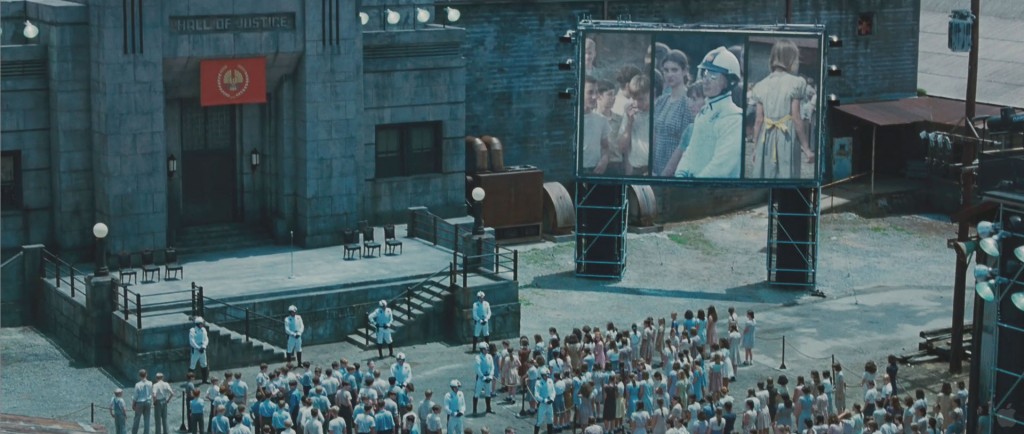
The Hunger Games: Catching Fire

Written at the time of the film's release...

Feeding the Beast
or
To Kill a Mocking-jay

I mocked The Hunger Games rather mercilessly when it came out (as if it would prevent a single sou from entering its coffers) , because even though it was a hot publishing phenom' and a breathlessly anticipated movie, the original concept was a bit derivative without being very divergent (yeah, that's a snark for a future film there).  So now, the second of The Hunger Games films (of four total) Catching Fire has come out (with a new director, Francis Lawrence, of Water for Elephants and I Am Legend as a bit of an improvement over Gary Ross, even with Steve Soderbergh assisting) and this one's a better film.  For one thing. "this time it's political," and the easy targets of reality TV and the excesses of the rich (with an eye towards the Roman Empire and its parallels of bread and circuses) are a bit less strident, although they haven't disappeared. They're just presented a little better this time. And the politico's of the Capitol are being a bit more cagey than they were previously.

Katniss Everdeen (Jennifer Lawrence) now finds herself the most watched human in Panem. Her victory in the 74th Hunger Games along with Peeta Mellark (Josh Hutcherson) has earned her and her family a cushy residence in Victor's Village and the vulture-like scrutiny of Panem's leader, President Snow (Donald Sutherland, as creepily confident as if he were selling you orange juice).  He sees the way that Katniss has reached out to Panem's people and now she's the centerpiece of a swelling revolutionary movement.  A personal presidential visit amounts to a threat that she'd better be convincing in her devotion to the State.  "I'll convince them." assures Katniss.  "No." replies Snow slowly. "Convince me."

And with that, the stakes are raised. A "Victory Tour" is planned for the remaining districts (the ones that haven't been nuked), but at each appearance of Katniss and Peeta something happens that brings out the riot policeAt the suggestion of the Capitol's new gamesmaster (check out this name) Plutarch Heavensbee (Philip Seymour Hoffman, keeping a straight face), who comes up with a plan to put more pressure on Katniss and speeding the inevitable moment when the public turns against her. Then, with the next Hunger Games competition occurring (the 75th), it is decided that, rather than having a "Reaping" lottery among the populace, the competition will be between past Victors, considered by the State now to be potential inspirations and inciters to riot.
So now, the Games are between past champions (including Jeffrey Wright, Jena Malone, and Amanda Plummer), some of whom are just as determined to win, while others are angry at being targeted again, but there will be only one survivor. 
It's a better film with more tricks up its sleeve, and the media manipulation is played by all sides—it may be an illusion but Stanley Tucci's teeth actually look whiter this time—with a terrific set-up for the next films that comes out of left field...if you haven't read the books.  It's an entertaining change-up from the situations of the original, and promises to be even more intersting next time out.

The Hunger Games

Written at the time of the film's release...

Killed in the Ratings
or
Welcome to Another Exciting Edition of Thunderdome!

I know all I need to know about The Hunger Games
So "young a-dult" is The Hunger Games
Like "Potter" before it (The "Twilight" books, too)
Recycling ideas to 'tweens and their peers
Who think that it's "new."

There have been a lot of books before "The Hunger Games"
A lot of "Running Man" in "The Hunger Games"
A "Rollerball" theme and everything seems
Exactly the same.

I know all I need to know about The Hunger Games

(Crooned to the tune of "The Crying Game")

Yeah, yeah. I'm being "Joe Buzzkill" here. The Hunger Games is going to make a kajillion dollars (even in dystopian future-money) in theaters, DVD's, books, magazines and "mockingjay" pins. Nothing I say can stop that (nor should it).

But it's a fact that this is all recycled material* (just as "Harry Potter" was, just as "Twilight" was), just skewed young for the burgeoning youth book market (which is still thankfully strong). The one interesting aspect to it is that this is "The Most Dangerous Game" for a generation having grown up on alleged "reality" TV programming. An entire generation has happened since "Survivor," "Big Brother," "The Bachelor," "The Amazing Race," "Fear Factor," and "American Idol," all game shows rigged from the get-go,** manipulated for false drama in editing suites, ginned up with flashy production values and glitz, and as genuine of enterprise and skill as a WWF wrestling match—think of it, there are people who pay good money to see that junk "live."

There's a sucker born every minute.

Or a saga.
The story is, by now, well-known: In the future, America is now Panem, divided into 12 working districts governed by an all-controlling Capitol, run by President Snow (Donald Sutherland in the film, who might give the second best performance in it, a brutal paternalism, done with economy and implied malice—he's something of a breath of fresh air from some of the other performances, and his reading of the reply to "Everybody likes an underdog"—"I don't"—made me laugh out loud, while putting a chill down my spine).  Every year, two teens from each district are chosen by lottery for "the Hunger Games," a televised death match from which only one can survive. It's The Olympics to the Death, complete with pomp, circumstance, and Roone Arledge style "up-close-and-personal" drama dredging.  It's "bread and circuses" for the Masses with mock sentimentality and district pride provided to cover the slaughterhouse aspects.
From the coal-mining district (12) comes Katniss Everdeen (Jennifer Lawrence, who's the best thing in the film, giving a performance cunning and tremulous) who volunteers for the Games when her 12 year old sister is chosen in the lottery.  Her co-warrior is Peeta Mellark (Josh Hutcherson, in a performance that could best be described as "uneven"), with whom she's had a past.
The two are sent by bullet-train to the Capitol, where they are
prepped, buffed-up, coiffed and positioned for presentation to the national audience, their handlers being Effie Trinket (an unrecognizable Elizabeth Banks in an insufferable performance), past winner Haymitch Abernathy (Woody Harrelson who has his moments—"Nice shooting, sweetheart" gets an appreciative audience response) and Cinna (Lenny Kravitz), their fashion designer. This is easily the worst part of the film, the satire played broad (especially by Toby Jones and Stanley Tucci—both usually fine actors—who play the TV hosts for the broadcast) with a fashion-sense of the privileged Capitol citizens that can best be described as "subtle clown" (or is it "post-modern Gaga?").
I suppose director
Gary Ross (who co-wrote and brought in Steven Soderbergh as second unit director) wanted to make satirical points on Capitol decadence or enhance the futuristic "feel" of the film, but he's a rather dull director and when he "pushes" it, he takes it places that feel false. At 2 hours, 20 minutes, if there are places that needed to be trimmed, it's in this section. But, once the actual contest starts with its electronically domed barriers, constant video surveillance, and game "enhancements" (like fireballs and this movies's version of R.O.U.S.'s***), the film becomes slick, vicious fun. And, appropriately, manipulative as Hell, in the foreground, background and throughout.

Why, after all, should the movie be any different from its inspirations? And if it gets the kids to realize that everything—sports, video games, "reality" shows, fashion, political campaigns, whatever—is just distractions from the struggles of real life, used by government and corporations alike, to keep us satiated with bread and circuses, just like in those "boring" History lessons about Rome, then so much the better.

Of course, it would be nice, if instead of going to the theaters to see it, we might (I dunno) join a protest or something?  Jefferson said "A little revolution now and again is a good thing." But it was never a spectator sport.

* "The buzz" on IMDB is that The Hunger Games is a "rip-off" of Battle Royale (2000).  Sure. Okay. So, what is Battle Royale a rip-off of?

** My favorite comment about "reality" programming was Johnny Carson's about "Survivor:" "I can't feel badly for these people when I know just out of camera range there are 20 Teamsters and a "catering table."

*** For anyone who isn't a fan of The Princess Bride, that would be "Rats Of Unusual Size."