There have been some close calls. The accidents of both the American and Soviet space programs are well-documented, and Apollo 13 came within a cat's whisker of skipping off the atmosphere on its return journey after an explosion disrupted their oxygen and power supply. But, no being—since the days of testing capsules with animals—has ever been stranded in space. Technically, it happened June 2024, when two astronauts, who were supposed to only spend 8 days up at the International Space Station, had to abandon their return, and have been up there ever since. Supposedly, the new "rescue" mission was supposed to launch this week...but it's been postponed. Now, a movie was made in 1969 based on author Caidin's book, but, by the time of its release, the space program had advanced enough that there had already been one manned landing on the Moon with another scheduled days away. So, they looked at future NASA plans—one of which would be called Skylab, a low-tech space station using a spare third stage rocket casing as the orbiter—and based the fictional "Ironman One" mission of Marooned on that. Three astronauts (Richard Crenna, James Franciscus, and Gene Hackman) go up in their capsule to rendezvous, dock and spend seven months on their ersatz, roomy space station, but when Hackman's character gets a little space-woozy after just five months, everybody decides it's time to come home and *pfft* the retro-rockets don't work. Oh, the little green-light that says they're working is on ("We're gonna decorate it for Christmas!" the commander cracks).
  Now, the easiest solution is to get back to their little crude space-station which has plenty of oxygen—their space capsule having a limited supply—but since their big engine won't work, it makes it a little out of reach, space-wise. They have maneuvering thrusters, but they don't have the oomph to do anything but spin the space-craft around. So, NASA has to figure out a way to get their astro-boys back before the air runs out in 42 hours. And that's where the proverbial pooches really get screwed. Oh, NASA's good at schedules, and launch-windows, and prepping enough Tang™, but when it comes to seat-of-your-pants Hail Mary plays, well...let's have a meeting about that.
 Thank God, that Charles Keith (Gregory Peck) is, as he likes to tell everybody "head of Manned Space," and as soon as you say "Houston, we've got a problem" it's his problem, too. The thing is, after looking at all the read-outs and not being able to repeat the problem with a similar retro-rocket on Earth, he's ready to give the "it's a risky business, and we will go on in their name" speech, he's told by Astronaut Lead Ted Dougherty (David Janssen)—who's "head of Space Man," I guess—that they should launch a rescue mission with an unproven booster, an untested vehicle prototype and with a hurricane bearing down on Florida and do it in 42 hours. What could go wrong?
 But, before you can say "hand me those frozen "O"-rings, Keith shoots it down as being too risky and could only make a bad situation worse. That's when he gets a call from the President—it was Nixon, at the time—who says "Make a bad situation worse? I'm all for it!" Daugherty starts training for the mission—it should be the remedial lesson to save time—but, God turns the hurricane towards Florida, delaying the launch, which leads to the decision to launch when the eye of the hurricane is over the cape. That's some precise hurricane. But, the delay will mean that the trapped crew's oxygen supply will run out.
 That is, the oxygen supply for three astronauts. Two might just make it. So, Keith gets to make one of the most cringe-worthy conversations in the history of space movies:


Charles Keith: Jim... how do you uh... how do you evaluate... the oxygen situation?
Jim Pruett:
Um... Well, we have whatever oxygen's left in the spacecraft system.
And, there are only, uh... two bottles of emergency oxygen on board,
five minutes each, that's uh... ten man-minutes. Um... my backpack, and
uh... Lloyd's and Stone's, but um... there's not much oxygen left in
them.
Charles Keith: Well, you'll have to save your backpacks for the EVA transfer.
Jim Pruett: Yeah I know that.
[pause]
Jim Pruett: 55 minutes,
[longer pause]
Jim Pruett: we'll be dead by then.
Charles Keith: Well, only if you... continue to use oxygen at the present rate...
Jim Pruett: Well, uh, we can't cut down.
Charles Keith: Let's... think about that...
Jim Pruett: Do, uh... do you want us to lower the partial pressure again?
Charles Keith: No, we've examined that, it won't work...
Jim Pruett: Well we're lyin' here like corpses now... uh... what else can we do?
Charles Keith: You must... think...
[astronauts exchange glances, realizing the unspoken implication of Keith's statement]
Jim Pruett: Yeah, we're... thinkin'...
Charles Keith: Are we talking about the same thing?
Jim Pruett: Yeah.
Charles Keith: Why don't you... talk it over. If you could... work out something... it would be of great help...
Jim Pruett: Yeah we'll talk it over.
Charles Keith: I must point out Jim, that any *effective* action must be taken immediately...
Jim Pruett: Look, don't tell me what to do! We've been takin' your god damned
orders and where the hell are we? From now on WE'RE gonna make all the
decisions! Whatever we do, you're OUT OF IT!
Charles Keith: Oh I uh... appreciate what you're saying Jim... and I agree with you... You're exactly right...
MAD Magazine (#138, October, 1970) had a field-day with that dialog: As a "space-kid" growing up, eyes glued to the television every time a space mission happened, this seemed absolutely ludicrous (we hadn't had a death in space yet, only during training, and NASA's lucky streak on their space-flights was nothing short of amazing, but you couldn't tell me that). I was already sitting in my seat, arms folded tightly across my chest with a scowl on my face as the depictions of the vehicles in orbit around the Earth wouldn't have passed muster as a "simulation" the networks always used when they didn't have "picture" for what was happening during their coverage (and that was pretty dicey, even though it inspired the movie Capricorn One and hundreds of resultant conspiracy theories).
 Look, I was 14 and that's an age when "fair" is a foreign concept. But, Marooned was released a full year after 2001: a Space Odyssey, with its pristine special effects, and I considered this movie one giant leap backwards. Nothing looked right, or even realistic. The space hardware was pristine, no wads of aluminum foil hanging off the ships (used to reflect sunlight and heat at the time), no wear-and-tear, and they resembled the older Aurora models I used to cement together, in fact, I could have sworn at the time I saw glue on the obvious seams of the Marooned ships. These days, I'm more charitable, but back then, I considered the movie "a travesty"—big word for 14!—but, I told my Dad I liked it...hey, he took me to the movie. I was a punk but I wasn't an ingrate.
 And the thing won an Oscar for special effects. Granted, it's only competition was Krakatoa: East of Java (and, as we all know, Krakatoa was WEST of Java, so those were some pretty special effects!). You think you've got a gripe with your favorite picture not winning an Oscar? I've got you beat. I'm torqued because this one DID win an Oscar.


David Janssen flying out of the eye of a hurricane.
Marooned has one big Legacy feature: it's the most expensive, star-filled movie ever to have been featured on "Mystery Science Theater 3000" (albeit in a truncated form entitled "Space Travelers") as the first episode of their fourth season. This is the version of the movie that I prefer to watch.
Now, that's The Right Stuff.


 Kaufman takes us into the dark-hole of the jet-engine, and inside we hear echoing voices and whistles and the sound of drums, and before we can register the change, we're not in the negative space of the engine anymore, we've transitioned to another channeled tube of energy—we're traveling through a tunnel riding atop a limousine from an astronaut's perspective...
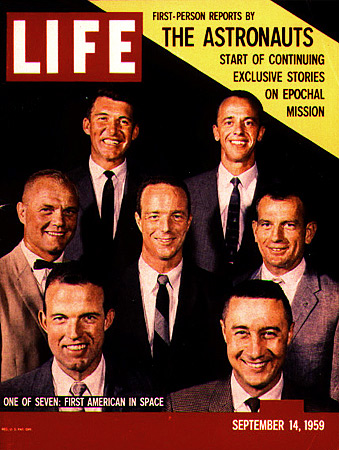
 ...as President Lyndon Johnson stands on a flag-draped stage and welcomes the seven Mercury astronauts to an out-sized barbecue in Houston--the new home for the Manned Space Center, as well as the astronauts and their families. Their homes, their furnishings are all paid for by the Houston developers who are benefiting from Johnson's earmarks. The Mercury 7 are living the good life, while the Man who Broke the Sound Barrier makes a run for space.
 Both these incidents happened and are mentioned in Wolfe's book, but they took place months apart, while Kaufman has them happening simultaneously. To what purpose will become clear later, but in the meantime, we follow Yeager (
 And in one spectacular shot, we see space bend and warp as we approach the feathery layer of a cloud-ceiling, then go through it...
 ...and the picture fades to an incident from that barbecue--an odd detail that Wolfe found funny and sad and a bit pathetic, but Kaufman turns into visual poetry. For some reason, the Houston event organizers chose as one of the entertainers stripper
  But Kaufman takes that incident and marries it with a running theme throughout the film. The Moon has been a beckoning image throughout The Right Stuff, and now, as the clouds that Yeagher is punching through become the delicate feathers of Sally Rand's fans, she dances to an orchestral version of the melancholy "
 Kaufman stays on his images of empty space and feathers and lights, then to shots of the astronauts and their wives reacting to the irrelevance and embarrassment of it all. And then, something strange happens....
 ...and Shepard's not even watching the stage-show. He's lost in thought...
 ...as is
  Glenn turns to look at
  ...who is already looking at him.
 Grissom turns and looks at his buddy,
  ...who is his usual grinning self, but he's subdued. We transition back to Sally Rand...
 ... and a blaze of kleig-lights to Yeager trying to "punch a hole in the sky."
 Yeager reaches top altitude, then his engines give out and he's given one tantalizing glimpse of the stars in space...

 ...before his fighter-jet begins to rapidly tumble back to Earth.
 Unable to bring it under control, Yeager makes a fiery ejection...
 ...and Kaufman holds on him--trailing smoke, because as we'll see his helmet is on fire--and we watch his long, long fall through space as he tumbles through the silence--a modern Icarus...


 ...who disappears into the clouds.
 The clouds fade back to the feathers of Sally Rand.
 ...and to the astronauts, who are somewhere else.

 Glenn, on edge, looks to Grissom and Cooper...
 Grissom is wary...
 Cooper, head bowed, tentatively looks up...
 as does Slayton...
 And Shepard cranes his gaze to the ceiling...
 We transition to Sally Rand, and on the soundtrack we hear a distant boom.
 With a hard cut, we're back in the California desert.
 Reverse angle to an ambulance approaching in the shimmering desert heat.
 The driver points ahead "Sir? Is that a man?"
 Amid the smoke and heat-waves, a silvery shape emerges.
 "Yeah," says Ridley (
 As the music swells, Yeager carrying his parachute, his face burned, but still chewing gum, approaches the ambulance.
 Yeah. You bet it is. It's great film-making, too. And a brilliant sequence by Kaufman that shuffles real time a little, but makes a point about the competitiveness of air-men, giving way to a brotherhood. All of the men in the sequence have competed with each other as well as Yeager to be "at the top of the ol' pyramid," going faster and higher than any person before. The astronauts were test-pilots competing with Yeager, then signed on to become astronauts, "spam in a can" in the test-pilots' jargon, achieving a fame Yeager never would...until Wolfe's book...and this movie