Showing posts with label Rex Ingram. Show all posts

Tuesday, June 19, 2018

Sahara (1943)

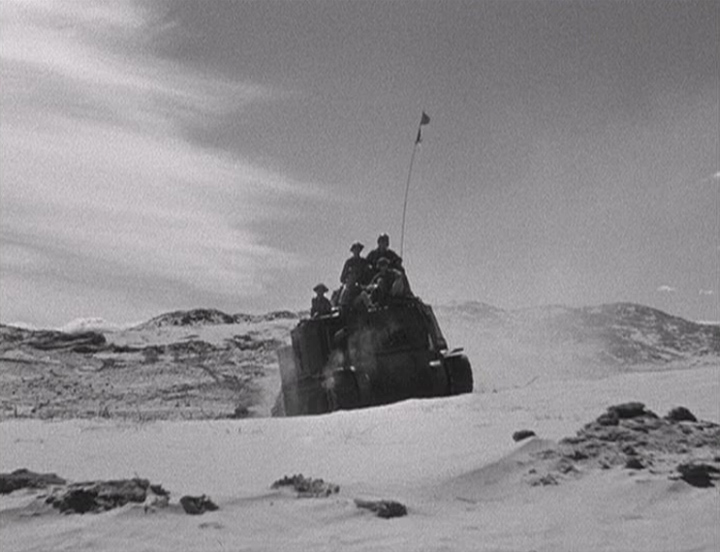
Sahara *(Zoltan Korda, 1943) Columbia Pictures propaganda film (based on "an incident" in a Russian screenplay) disguised as a war-time action picture. Humphrey Bogart stars as Sgt. Joe Gunn,** a cranky old Yank in a clanky old tank, the LuluBelle, who, making his way back to a friendly base, gathers together a rag-tag crew of Allies (French, British, Australian, South African, Italian and Sudanese) in North Africa. Voted in charge of the make-shift troop, he makes priorities—keep LuluBelle running, find water, deal with the Nazi troops nearby, stay alive. Along the way, through the collective effort, manage to sustain a stronghold against a large Nazi desert-troop. Filmed in the California desert, it still feels like rough duty for the actors amid the sand, the flies and the sweat. Director Korda and multiple screenwriters, including John Howard Lawson and Sidney Buchman keep the surprises and the intrigue sustained through the entire picture, while promoting brotherhood and cooperation between the lines.
Bogart really has the least interesting part, but he excels at being the crux of the movie and meriting being the guy to whom all eyes turn. It's an effective, oddball role. Of all the films with people of obvious ethnicity pulling together whether in American or Japanese war films, Sahara succeeds brilliantly, betraying neither the prejudices of the period, nor moving too far into caricature. The movie even takes a stab at trashing the "master race" theories of the Nazi's.
Amidst the water retrieval methods and the tense negotiations and full-on battle scenes featuring big guns and deceiving trench-warfare, the stranded Allies still have time to compare cultures and rememberances of home. "The things you learn in the Army," says a smiling Texan to the Sudanese in conversation.

There's your recruitment headline right there.


* Not to be confused (as if it could be) with the 1983 Brooks Shields vehicle, or the 2005 Clive Cussler adaptation with Matthew McConaughey and Penelope Cruz.

** Presumably Luger being too German, and Beretta to be used in a 70's cop show and Joe Rifle...sounding as dumb as Joe Gunn, frankly.
Tuesday, May 29, 2018

The Thief of Bagdad

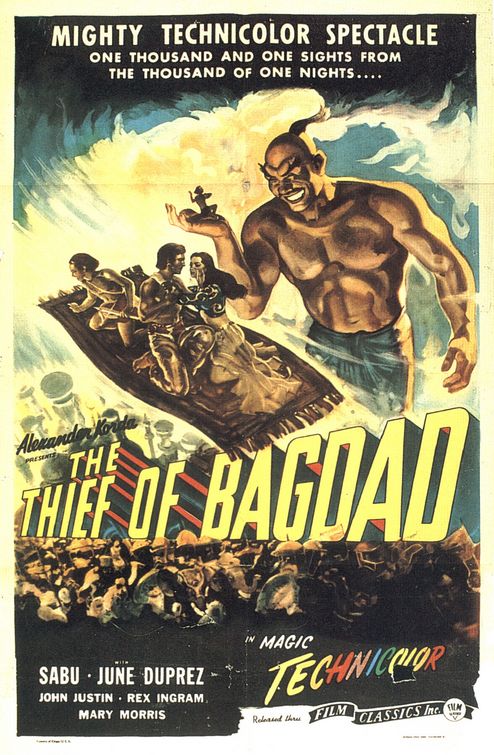
The Thief of Bagdad (Michael Powell, Ludwig Berger, Tim Whelan, etc., 1940) Epic Alexander Korda production, with considerable work from his brothers Vincent and Zoltan, and the grand production designer William Cameron Menzies, that boasted three directors, filming on two continents (interrupted by the Blitz) and became a fantasy favorite.

It's still amazing, even if the two leads are a little leaden (and if we don't get too picky that all of the featured players are extraordinarily ethnically inaccurate—
Sabu was born in Mysore, then a part of British India, and Conrad Veidt...was German!), but if one takes it with a light-heartedness, and a mighty roaring laughter worthy of the Djinn (played by the larger-than-life—even without special effects—Rex Ingram), there are more than enough wonders that would enchant and entice a watcher (as it did with the young Francis Ford Coppola and Martin Scorsese, who both count it as their favorite childhood film).
Because it all comes together, all the disparate elements in eye-popping Technicolor, that somehow manages to make the real world look drab and shabby by comparison. I've had that experience where movies change your outlook:  every new Orson Welles film made me see the world—and its possibilities—differently; a theater screening of the cinematography documentary Visions of Light was followed by an extended parking lot discussion in which the lights of the city (even in that drab corner of Seattle) never looked more beautiful to the eye; a screening of Don't Look Now (in the very same theater, coincidentally) had me walking back to the car, obsessively looking for the color red.
And The Thief of Bagdad has that same effect. Between Menzies' sets (and his insistence on how they be filmed), the vibrant color sense and stylishness of the entire production, one yearns that movies might be more like this one, let alone the world (oh, by the way, give me a chance at those three wishes)...and isn't that illusion why we go to the movies, anyway?

The visually eye-popping The Thief of Bagdad

Thursday, March 3, 2016

The Talk of the Town

The Talk of the Town (George Stevens, 1942) One could almost look at The Talk of the Town as being a sequel of sorts to Mr. Smith Goes to Washington, focusing on the judicial branch, rather than the legislative, and with more of a divided heart as to what kind of movie it should be.  

Part of that may be the number of screenwriters involved. Not only is Mr. Smith's scripter Sidney Buchman present, but also Irwin Shaw (both men would feel the lash of the blacklist in the 1950's) and Dale Van Every for story adaptation.  That many cooks typing away may explain the sometimes lurching tone from comedy to romance to high-mindedness to, uh, the underlying plot-line that once-in-awhile gets attended to.


The "main" interest is: who will Nora Shelley (Jean Arthur) end up with, romantically?  Stevens shot two endings and let preview audiences decide. Case closed.

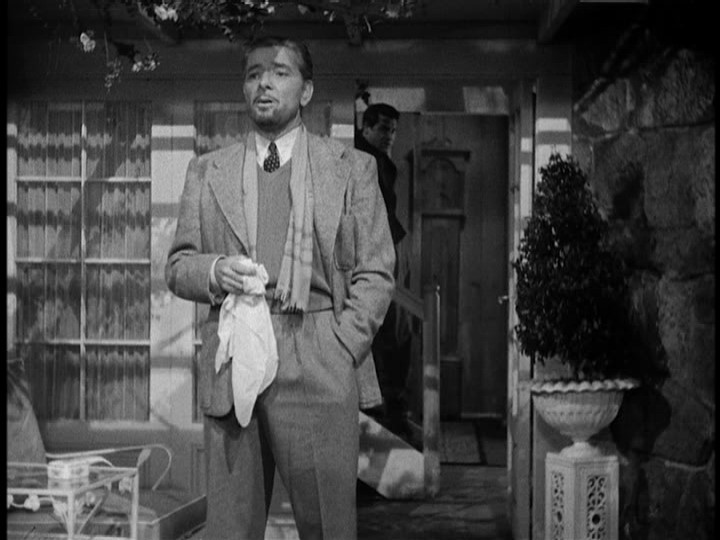
It's the least material aspect to the film in the first place. The plot involves the burning of a local mill and the framing of mill worker and "activist" (one assumes a unionist) Leopold Dilg (Cary Grant) for arson and the murder of the plant foreman.  Everything is stacked against Dilg from the mill owner calling for his blood in the sympathetic press, to the trial judge being in Holmes' hip-pocket. Dilg escapes from prison (in a dramatic opening sequence that's a bit out of sync with the rest of the movie) and hides out in "Sweetbrook," the rental house run by his high-school acquaintance Nora, who's trying to get the place in shape for the impending arrival of a temporary lodger, law dean Michael Lightcap (Ronald Colman) who's taking the Summer off to write a book.  This being a comedy, Lightcap arrives early—the night Dilg has stumbled his way in—and Nora has to hide the runaway in the attic, while the police comb the area looking for him.
"Hilarity ensues"
After a restless first night for all—nervous Nora has spent the night in another room and Dilg snores in his attic roost leading Lightcap to advise Nora she needs to do something about her adenoids—the complications begin: Dilg is too restless a spirit and cranky an agitator to to stay cooped in the attic; Lightcap needs a secretary and to keep Dilg under wraps and separated from Lightcap, Nora takes the job; and then, to raise the stakes, a local Senator stops by to tell Lightcap he's being nominated for the Supreme Court. So, politics being what they are (the same as always), if there's any hint of scandal, oh, like, say, harboring a wanted fugitive in your house, it could hurt the professor's chances of being one of the Supremes (depending on who's in The White House, of course).

Dilg being Dilg, he can't stay under wraps for long, and he's soon hiding in plain sight as "the gardener," and his views of the law leads to some sparring over the letter of the law and how it can conflict with the intent, especially when those intentions are not honorable to the spirit of the law, and Lightcap finds himself embroiled in a conflict of interest, where his cloistered view from his ivory tower looks pretty good in theory, but bares only a conversational similarity to its practical applications in the world of dog-eat-dog.
That's the meat of The Talk of the Town, but the screenwriters and Stevens must gild it with a "who gets the girl" story-line that will satisfy the jury of the audience. Stevens let the answer to the question be decided by a preview audience of peers—with nothing decided until the very last second. With Colman as a sophisticated book-smart professional with a lot of learning to do, and Grant as am earnest dreamer, it's hard to choose, but Arthur is, as always, a delight, finding ways to make the quick-witted Nora flustered, but with the best of intentions and the most charming of choices.  Like the movie, she's a bit of a mess, but an enjoyable one.