Hell (As It Is On Earth)
or
Yea, Even Though I Walk Through the Valley of the Shadow of Death, I Will Fear No Evil, For You Are With Me.
Psalm 23:4
You may love Mel Gibson. You may hate Mel Gibson. But, what cannot be denied is that the man knows how to make movies. He also has the temerity...and the just plain guts...to make them on his own dime. Such risk-taking inspires careful consideration of subject-matter before committing to making it. And, say this for Mel Gibson, he will rarely play it safe when he is behind the camera, frequently taking on subject matter that most studios would rather not touch (especially now that he is box-office persona non grata).
Hacksaw Ridge (although he did not finance it, but took it as a job) is a case in point.
Based on the true story of Army Medic Desmond T. Doss (played in the film by Andrew Garfield)—the most decorated conscientious objector during World War II—it plays like a modern, more brutal—much more brutal—version of Sergeant York, with the exception that Doss' feats of bravery do not need Hollywood glorification or invention; they are already too unbelievable to be true (and, in fact, had to be toned down a bit because, as was said "no one would believe it"). But, they are a matter of record, detailed by men who, until his days of reckoning, had no use for the man whatsoever.

Doss grew up in Virginia, the son of a WWI vet and carpenter, in a devout Seventh Day Adventist household. An incident when he was a boy—nearly clobbering his brother with a brick—and the "Thou Shalt Not Kill" portion of the Ten Commandments, very early on cemented his religious convictions, vowing to never take a life—any life—and became a practitioner of non-violence and strict vegetarianism. He attended an Adventist school until eighth grade and then left to work to help his family during the Depression. In 1942, he was working at a Virginia shipyard and could have gotten a deferment, but joined the military and, because of his religious beliefs, filed as a conscientious objector, vowing to never pick up a gun and refusing to take a human life. His plan was to be a medic in the service.

All well and good. But first, he had to survive basic training. His superiors (played by Vince Vaughn—he's great in this—and Sam Worthington) are suspicious of his motives; Doss won't even hold a gun, much less fire one, and doesn't do any work on Saturday's by Adventist edict. And those suspicions and attempts to break him down filter down to his fellow recruits, who don't like the extra attention his actions bring on the squad from their superiors, and who look on Doss with suspicion—how can they trust him in the field if he won't carry a gun or watch their back?

In the film, Doss is not allowed off-base to attend his own wedding (which is movie fabrication as Doss was already married before he joined). Nor did he face actual court-martial proceedings for his on-compliance—although he was threatened with it, but, as disciplinary measures, he was prevented from consideration of leave to see his family. Intervention by his veteran father (played by Hugo Weaving)—although not by the means depicted in the film—prevented him from being punished by denial of leaves. Doss still faced suspicion—and sometimes retribution—for his stance. It was a dynamic that lasted until his troop was put into active combat.
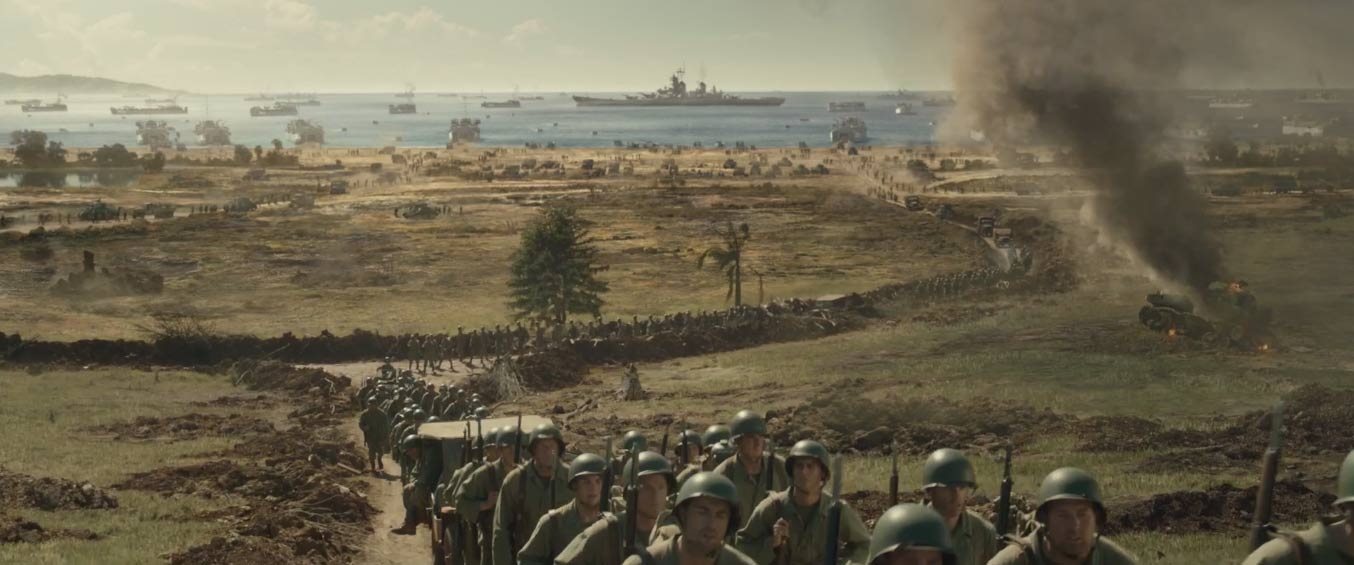
The film excludes Doss' service as a medic while in Leyte and Guam and cuts right to the chase of his service on Okinawa. Doss' unit was tasked with storming the Maeda Escarpment—dubbed "Hacksaw Ridge"—the high ground on the island, atop a 350 foot cliff, where Japanese troops had been dug in for years, tunneled in and waiting for attack.
First, the troop had to scale the sheer cliff and then, go to battle. The initial attack was a rout. Outnumbered and out-matched, Doss' troop was forced to fall back and go back over the cliff. But, Doss remained, tending to the wounded, and single-handedly lowering each man back to the ground, while also dodging machine gun fire.
For all the fabrications of the disciplining of Doss in basic training, the events on the hill are accurate as far as Doss' actions. He really did save between 50 and 100 men (His Medal of Honor compromised at 75, but even Doss' low-balling of 50 is an incredible accomplishment) on the hill by himself, alone on the ridge, finding and treating the wounded, hauling them under fire to the cliff's edge and lowering each wounded man by rope. Miraculously, he suffered shrapnel injuries that did not prevent him from tending the injured. And he kept going, man by man. And only until he had exhausted survivors, did he come down himself.

Gibson has always been over-the-top when it comes to violence, whether as an actor or director. And his battle scenes have a nasty visceral energy that seems to want to rub the audience's collective nose in the gore and brutality. It gets your respect inn its depiction of a savage hell-scape that would make any one want to run back and jump over that cliff. And Doss' bravery—unarmed—through the carnage and constant danger is only enhanced by Gibson's depiction of constant gunfire and fiery death.

But, he can push it to levels that approach the cartoonish. At one point, one of the soldiers finds the body of one of his comrades cut in half in the battle. He hefts the torso and uses it as a shield while firing a machine gun one-handed. This might be possible, if a soldier fueled by adrenaline, could lift the half-a-body and run with it while not having any recoil from the machine gun. But, given the evidence of the effect the bullets have on a body throughout the sequence, one would conclude such a grisly practice would not provide much shielding.
 |
| If this image upsets you, this is not the movie for you |
Case in point: in another moment, an advancing soldier takes a defensive position behind another soldier's fallen body on the ground. As he gets ready to take aim, the supposedly dead soldier sits bolt upright in front of him, screaming directly into the camera. He's immediately shot in the back of the head, his blood and brains splattering the the shocked first soldier in the reverse-angle. Then (because that wouldn't be enough, evidently, to show the brutality of war) both soldiers are cut apart by a following hail of gunfire. Horrific, it certainly is, but it's also entirely gratuitous, just piling on the carnage to further the point that war is a place that can get you killed. A lot. As if that wasn't known. It's a tendency that Gibson has, and a failing that he has to overstate the point, no matter how obvious it may be.

It does set up the constant threat that Doss faces by being the lone moving target in a kill-zone, and creates a tension throughout the rescue sequence as he darts from body to body searching for signs of life, then augmenting a stretcher to drag his comrades-in-arms at a run to the escarpment edge and using one of the ropes used to initially scale it to lower them to awaiting medics. Then, with a fervently whispered "Help me, Lord—just one more," he runs back into the fire to find the next soul to save, only descending himself once he has run out of survivors.
 |
| Home from the Hill—Doss showers—a baptism of water and blood |
Hacksaw Ridge compresses his initial rescue efforts to just one night. But, given the estimated 75 soldiers he saved, that would be 8 minutes spent per person, which feels impossible. Truth is, Doss was on Okinawa for three weeks. Three bloody weeks.
And when the final assault on the ridge took place, the troops would not go without Doss and the attack delayed to allow Doss to pray. A conversion—if you will—from his treatment in basic. That final mission is where Doss' actions—deemed "too impossible to believe" to include (after Doss is wounded from swatting and kicking enemy hand grenades away from his group, he gave up his stretcher to a more severely wounded soldier (he had 17 pieces of shrapnel in his leg), then, began treating other soldiers awaiting his turn, when his arm was shattered by rifle fire, and he crawled 300 hundred yards back to his position, so he could be evacuated.
It is an incredible story, made even more incredible in that it is, basically, true—such a man did exist, making a difference in an extreme and bloody war without firing a single shot. Saving lives. Not taking them.
 |
| Oh, yeah. Doss did this, too. |
I see a lot of previews for films with religious themes these days, backed by church money. But, this one, I'll bet, didn't get a single piece of silver from them. Too harrowing, too vicious, too bloody (and too Seventh Day Adventist, probably). Ironically, though, it is one of the great movie about faith and its inspiration to perform miracles on Earth, even in the midst of evil, inspired by it absence.
 |
| The real Desmond Doss-in situ |
 The Rookie (John Lee Hancock, 2002) With all the fuss being made over The Blind Side, attention must be paid to the director's previous sports-film that proved popular, like The Blind Side, also based on a actual story that's just this side of incredible and told with a clear-eyed lack of pretension.


 Grace? Sacrifice? Forgiveness? Where do you go to learn such traits? Such inspiration usually is found at the Cathedral, the Temple, or the Mosque, but in the sports-world the big stadium is the source of humility. Hancock stages Morris' first walk into the Texas Rangers stadium as if he was walking into the Vatican, the high-arched entryway with the sun streaming through that stretches to a vanishing point that evokes a long journey, but also the long history of a game that, more than any other sport, is a competition with the ghosts of the past as well as the Boys of that particular Summer. The arches reach to the sky to define the goal but also press down with the weight of tradition, dwarfing the new recruit, challenging him to fill the space. In the distance, his fellow rookie, half his age, looks on in amusement at the old duffer hanging back in awe, anxious to start his journey and not thinking he may be looking at a flash-forward to a future of regret. It is a poignant moment of film, that says volumes in a single image and no words.

 Jim Morris' baseball card