Showing posts with label Paul Thomas Anderson. Show all posts

Tuesday, August 9, 2022

The Master

Written at the time of the film's release. As a bit of context, the incident in the first paragraph referred to the 2012 attack on American facilities in Benghazi, Libya, which was initially blamed on Islamists fired up by a video trailer for a film called Innocence of Muslims, The attack was lately determined to be pre-meditated.

The Master: Scientologist-Baiter
or
"Tom and I Are Still Friends"


One wonders why, if a (laughable) movie trailer was so important to cause bloodshed in the Middle East, The Master isn't causing a ruckus in Los Angeles, the home of Scientology. Perhaps Scientologists have thicker skins (and more tolerance) than radical Islamists, who seem to find any excuse to cause harm at the drop of a Koran, or perhaps it would cause a worrisome spike in the members' auditing, or because—really—it has less to do with Scientology than other issues...like what would draw someone to a situation like Scientology—or any belief system—in the first place.

Paul Thomas Anderson's latest film has a similar theme to his previous films—the combustibility of individuals in a collective, and takes a similar tack—get the best individuals in their fields, wind them up and let them go, producing an oblique open-ended vessel into which audiences can pour their interpretations. It's not that Anderson doesn't have anything to say, so much as he'll be damned if he comes right out and says it, and sets up situations that suggest relevancy, waiting for the happy accident that will inform the whole. It's not that there isn't a directorial hand here—there's a reason there are so many close-up's—it's that there's isn't a sure directorial stance.
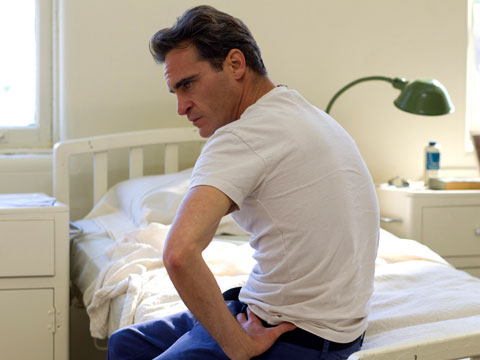
After useless psychoanalysis, Freddie turns the examination on others. 

So, you have a lot of surface, the brilliant spot-on "feel" of the production design by Jack Fisk and David Frank, the crisp cinematography of Mihai Malairemare Jr. , the individual performances of Philip Seymour Hoffman, Amy Adams, and (especially) Joaquin Phoenix on display, to an amorphous end that challenges, and often begs for, interpretation. Fortunately, the material is strong enough, and Anderson's contextual thesis is rich enough that one can throw all manner of thoughts into the stew, and make one's own meal out of it. 
We first encounter Freddie Quell (Phoenix) in the Navy during the battles in the South Pacific during World War II.
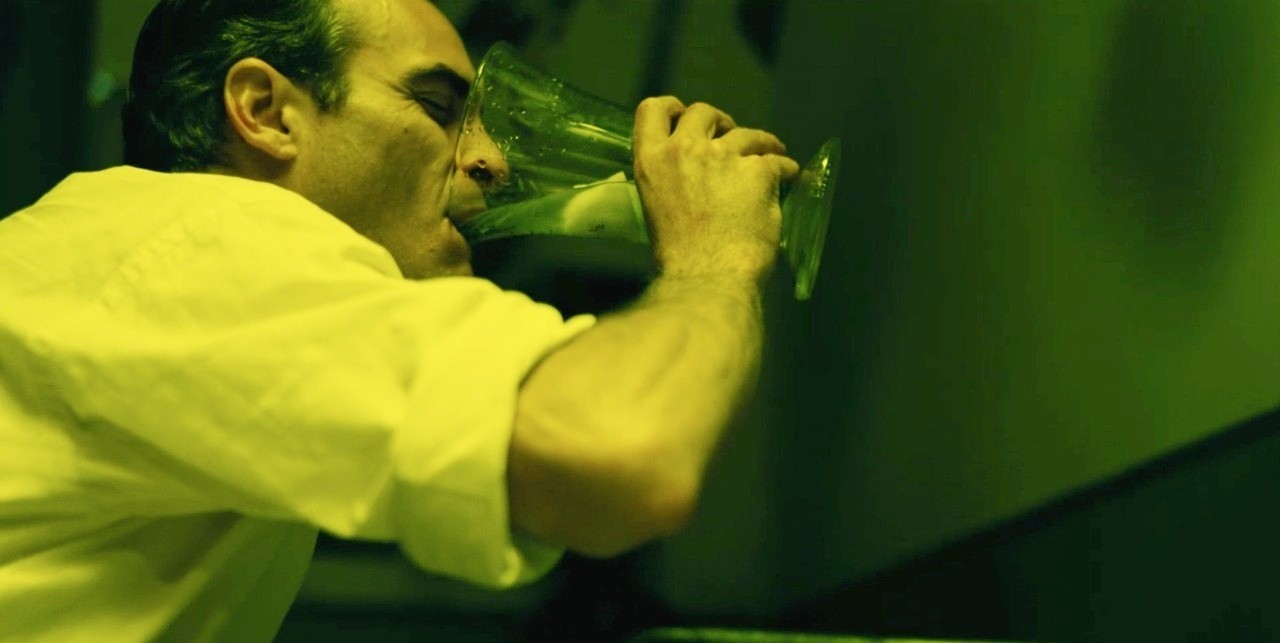
* Even there, in the midst of hundreds of young men in close quarters, he's an outsider, a loner connecting with no one except for his one discernible skill-mixing noxious brain-cell killing concoctions out of anything handy. He spends his time isolated, in some form of inebriation, the limits of behavior and humor blurred to indiscernibility, and when he's out of the service, he's immediately transferred to a psych division, where he is examined endlessly to no avail—the doctors are spending all their time trying to find the answer to what's wrong. 
It's all too obvious what's wrong—he's a barely functioning alcoholic obsessed with sex—but there's no cure for a complete lack of self-awareness or perspective, and Quell is released to the world, unchanged and unremorseful, just another problem that can't fixed and so is dispatched out of anyone's responsibility, to let Nature or Darwinism deal with him. He's a perpetual outcast on the edge of functionality, unstable and instinctually acting out. A job as a department store photographer ends up as an ironic choice—he spends his days looking in, trying to document normalcy, while on breaks, he uses his darkroom chemicals to create some bizarre cocktail to fry his brain and ease his isolation, while trying to make time with a store model. 
Phoenix is brilliant in this
, a raw nerve and not just mercurial, but mercurial at a high boil. The photography job ends with a violent incident of his own making, and he winds up as a migrant worker where, again, he moonlights with moonshine, and has to go on the lam where he stows away on a boat that has been commandeered for a wedding party.
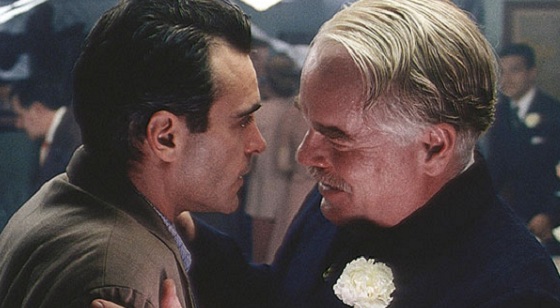
It's here that he meets Lancaster Dodd (Hoffman in a varied, extravagant performance that feels a bit like Orson Welles in Citizen Kane) self-described as "a writer, a doctor, a nuclear physicist and a theoretical philosopher. But above all, I am a man, a hopelessly inquisitive man, just like you."

 
"Just like you."
Yes and no. Dodd is the gypsy-evangelist of something called "The Cause," a nebulous philosophy for which he is the architect and messiah. The rules of The Cause change a bit according to need and the whims of Dodd (who erupts in petulant anger when challenged on it, by believers and non- alike) even though the origins of it supposedly date back "trillions of years" (later, his son will tell Quell "he's just making all this up as he goes along").
He's drawn to Quell for his potent concoctions, for his raw contrariness, which Dodd finds a challenge to his self-improvement methods (called "processing"), and because Quell's feral anti-social fury is a reflection of Dodd's free-thinking, but with the irresponsibility that he doesn't have the freedom to practice. Both men are self-medicating outliers, unable or unwilling to fit in—square pegs in the rounded holes of society.

For Quell, Dodd's processing is a tonic, though not as bracing as what he can make himself, a form of questioning self-examination that, instead of making one feel bad about oneself, makes one feel good. And for Quell, seeming to belong for the first time in his life, The Cause feels like home and family.

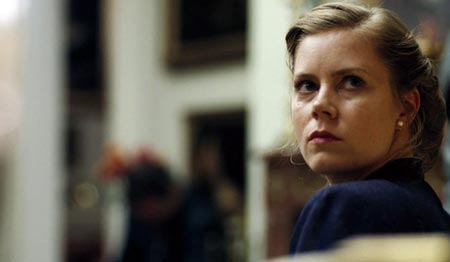
What color are her eyes?  You decide.

Not all the family is happy, though. Dodd's followers, including his Lady McBeth of a wife (Adams), fear Quell's aggressiveness and unpredictability, she especially questions whether Quell will ever improve and worries about the effect he will have on her husband and their cottage industry. Quell may be the best patient for the very therapy that they espouse, but the danger lies in how much damage he will prove to their house of cards in the process. It's a battle of co-dependents for The Cause, while the two men find the limits to their visions of paradise. There's a lot of room for mis-interpretation here, most especially in Dodd and Quell's scene in which the older man seeks to calm the emotions of both of them by singing, as if it was a lullaby, "(I'd Like to Get You on a) Slow Boat to China" which ends with the phrases "All to myself/Alone," emphasizing the isolation of both the Messiah and the acolyte, as they set themselves adrift.
So, in the end, once the credits have rolled up, what does it all mean? What's the point?** I'm honest enough with myself to say I don't have a flippin' clue, except what I've laid out here as themes and observations, but will admit that it is all up there on the screen, ready to be interpreted in as individual a manner as any audience member can provide, which is what makes Anderson (along with Terrence Malick, who is a bit more focused) one of our most enigmatic of filmmakers. Whether that makes him a visionary or a charlatan—like the filmmakers, captains of industry, and religious leaders he portrays, making it up as he goes along—depends on our interpretation, as well. And it is enough for me that he continues on the path he takes—not going for the easy superhero flick, or facile rom-com—without compromising anything...not even his intentions. It makes him brave, admirable...and always watchable. Challenging to be sure, but I like a challenge.
No, really. We're all together in this.

* One of the running motifs of the film is the time spent on ships of some sort, adrift.

** It's been amusing to read film critics struggling with this one, some finally merely knocking over their king to just call it a "character study."  It's a tough one, alright.  But, it is trying to say something about the human condition, even if only to say it has no easy answers, either, not even for those who espouse and specialize in easy answers.  I like that, but one wishes there was more provided by the film-maker, rather than just providing a rorschach test for us to throw our interpretations onto.

Tuesday, January 4, 2022

Licorice Pizza

What Makes Gary and Alana Run?
or 
Once Upon a Time in Paul Thomas Anderson's Encino
 
"I'm never gonna forget you. And you're never gonna forget me."
 
At some point, the current crop of filmmakers go back home. Lucas did American Graffiti, Linklatter did Dazed and Cofused, Tarantino made Once Upon a Time in Hollywood. They take stories and attitudes and landmarks and build a movie out of it. Nostalgia, certainly. But, also an homage to a better time of life (certainly for them), not dealing with critics and unions and divas, when the dreams were simpler and just within grasp. Aspirations went with ideas and not with box office, and the chance to tell stories the way you want to tell them is the biggest aspiration of all.
 
And so, makes Licorice Pizza about a time that can't be recaptured, merely recreated and certainly not eulogized. These things are supposed to be celebrations. The film takes place in 1973 (Anderson was born in 1970, but started making films when he was eight), so there is more than a hint of idealizing the period, as its young protagonists bumble through the California Dreaming and Ambition that typified the era in the post-Summer of Love/Manson-Psychosis.
Meet Gary Valentine (
Cooper Hoffman); he certainly wants to meet you. Gary is a child actor who's aging out of the industry, but has found a new outlet for his precociousness. At 15, he has a public relations firm in partnership with his mother, and he is always on the eye for "the next big thing" that will make his future. At his high school's picture-taking day, he is struck by a lightning bolt in the form of photographer's assistant Alana (Alana Haim), 25 years old, and both stand-offish and alluring. Gary loves a challenge and he asks her out for a date. As if! He's a high school student and a pimply one at that. But, Alana is still trying to find herself, and so, to her surprise, she takes him up on it, at a darkly upholstered watering-hole that Gary's company has done work for.
There's an agenda for the rendezvous; Gary has to fly to New York to do a promotional gig on "The Ed Sullivan Show" for this movie he did with Lucy Doolittle* (
Christine Ebersole). His mother has to stay behind to watch the business, and Gary, being underage, can't fly across country unsupervised. So, he asks Alana if she'll be his "chaperone". For him, it's a mere complication that needs to be dealt with, like re-scheduling a meeting; for her, it's just weird, she's an adult and she has to supervise this horny kid. But...it's a chance to fly across country. It's a chance to go to new York. It's a chance to be behind-the-scenes of show business.
It's a chance to be an adult.

Alana is from a strict Jewish family straight out of "Fiddler"—three daughters who are expected to "shelter in place." For her to be in charge on this trip, it's a thrill, no matter how odd it is to be with Gary, and it starts a series of adventures and misadventures that up-ends the traditional trope of "girls mature faster than boys." It's true to a point, Gary is incredibly immature emotionally, but has enough chutzpah and charm and manner that he's comfortable in any room he walks into. Alana is the more mature—to a point—but she's hindered by self-doubt and limited life-experience. Together, they're a power-house combination: where one is deficient, the other is strong (he can't drive; she can).

It's just the emotions get in the way. They're both smitten, but not in love. They're more partners, co-conspirators. So, Gary gets Alana an agent. Gary discovers there's this new thing called a "water-bed" and determines to be the most successful retailer in the L.A. area. When Alana starts working on the mayoral campaign of councilman Joel Wachs, she hires Gary to shoot some promotional pieces and Gary uses insider information overheard in the campaign headquarters to start a pinball arcade business.

But, with those adventures come friction. Alana's agent gets her a meeting with producer-star Jack Holden** (Sean Penn), who has dinner and drinks with the aging star, which is witnessed by Gary in a simmering jealousy. That's pay-back from Alana, who Gary hired to promote water-beds at his brick-and-mortar store only to ignore her for a class-mate at the opening. Alana is miffed that Gary has used the insider information to build his arcade business and goes for drinks with the attractive Wachs, only to discover that he's just using her as a "beard" to cover his break-up with a lover.
But, the most extended sequence (and the best) is Gary and Alana dealing with a water-bed delivery for one of their customers, Jon Peters*** (
Bradley Cooper going over the top because you can't under-play Jon Peters), which involves Peters' own "irrepressible" personality, the energy crisis, and driving a delivery truck through the Hollywood Hills all mixed into an "incredible mess" scenario that skirts the edges of the "comedy/panic" matrix.
For Anderson, who cast friends, relatives, sons and daughters of friends, and family in the film—and photographed it himself—it must have seemed like making a home movie when he was eight years old. That everyone is so good in it just shows that he's as good at making friends as he is at casting. The script, based on tall tales told by producer/child-star Gary Goetzman is rather shaggy at times (and a couple of times, downright cringey, as the scenes involving
John Michael Higgins' non-Japanese speaking restauraunteur), careening like a teenager's mood-swings, but ultimately, it's momentum leaves you with a smile on your face for one of the loosest movies Anderson has ever made, celebrating the sparking of adulthood's pilot-light before it becomes the smudged simmering of middle-age.
 
It's good to have fun making movies every once in awhile.

* The character is based on Lucille Ball. If you griped about Nicole Kidman's portrayal of her in Being the Ricardos, you will NOT be happy with what Anderson and Ebersole do with her.
 
** "Jack Holden" is based, it seems from dialogue spoken in the film, on William Holden, a movie star somewhat past his prime, but still considering roles where the leading lady is in her 20's ala Breezy.
 
*** Jon Peters is based on the real Jon Peters, who agreed to be portrayed in the movie only if they used his favorite pick-up line ("Hey, do you like peanut butter?") in the script because, after all, he is "from the streets."


Tuesday, January 23, 2018

Phantom Thread

Life, After a Fashion
or
"For the Hungry Boy"

Paul Thomas Anderson's Phantom Thread may be his emerging into his Max Ophuls stage, as it is so very well appointed, but where Ophuls usually had a complicated story tinged with irony, Anderson has managed to fashion a taut two hour film out of some thin material. 

Nothing wrong with that, Phantom Thread manages to be engrossing and curiously entertaining in how its short story progresses, rather than making something more dense that might have taken three hours to whittle down to a coherent story. And considering it's story-roots, it manages to boil the essence of it down to what really matters in the film from a character point-of-view without the intrusion of a plot device from third parties that would force a false solution to what really matters—the complicated relationships between men and women.

Meet Reynolds Woodcock (Daniel Day-Lewis) of The House of Woodcock, a fashion couture for the discriminating (hard to place the date but it would appear to be the late 1950's). Reynolds is fastidious and prim, he is a perfectionist when it comes to his creations and his taste—he will broker no argument that he might be mistaken or less than diligent if it comes from any source other than himself. He is a master of his craft, and he creates a world of comfort for his customers that nothing will be left to chance and any fears that they may have in their lives will be easily dismissed with the confidence that his frocks will instill in them. He is very good at his work, which is more of a craft than a profession, something he has done since the age of sixteen when he personally made his Mother her wedding dress for her second marriage. 
In a way, the women inside the dresses disappear once inside them—the dress becomes the focus of attention and they are mere passengers. The dresses are the art, meant to enhance the woman, who has been reduced to a series of measurements very quickly in the process—the time he spends with them is short, very deliberately; he sees them at the fittings and the final presentation, as everything else is about the dress, which is stable, has no moods, and has no questions.
Reynolds is in the final stages of his relationship with a model, who has made the unspeakable wrong of complaining about his coldness during morning breakfast when he is doing rough sketches for future concepts. He leaves it to his sister, Cyril (played very remotely by Lesley Manville) to discard her, while he, having taken care of a big job, goes to the remote family home to decompress. At breakfast, his waitress is Alma (Vicky Krieps) who immediately gets his attention by stumbling into the dining room, but smiling once she's recovered; she is able to take his order efficiently and perfectly, even after he requests to take her order pad away—she will remember, and, indeed, she does. Reynolds is so pleased that he asks her out.
The meal is dinner and a showing of his house and long silences as he stares, pleased, at her. He then asks her to follow him to the loft. But, rather than showing her his bedroom, the loft is his work-place, where he asks if he can make a dress for her. They are soon joined by Cyril, who dutifully jots down her measurements, meticulously, and he sets to work, measuring, cutting and producing for her a comely dress for their next date. This unnerves her, somewhat, but Cyril reassures her that it is alright—Reynolds is relaxed and this is what he does. This is what he loves.
Alma becomes a part of his life, moving into the posh townhouse that is The House of Woodcock, with her own separate bedroom, becoming a part of his work and his life, which are one and the same. But, it soon becomes clear to Alma that though she is a part of his life, she is part of his fiefdom, and she struggles to find a way to be essential to it, when it has such a narrow focus and his boundaries are exact and not to be crossed. How do you negotiate something so intractable?
Although Cyril is intimidating to Alma, she also professes to Reynolds that she is "quite fond of" Alma—a revelation that is a bit startling—when he becomes piqued with Alma's completely innocent indiscretions into his habits and moods.  And he has no compunction to withhold his dissatisfactions, whereas Cyril behaves like a complete cipher, unreadable even to her own brother. But, Alma does not want to be an adornment, a model, a help-mate; she wants to be essential, the fabric to his life that cannot be cut away when it proves to be extraneous. How do you become necessary and not just artifice?
If you're looking for clues about what it all means, look to the literature of the 19th century—Alma is a modern "Jane Eyre", or if you want to go to the previous century's equivalent, "Rebecca". She is a simple, humble woman thrust into a fairy-tale land that is both a dream and a nightmare. The environment is rife with ways in which she can be materially happy, but can wound her soul and her self-worth. She has it better than her predecessors—there are no forbidden wings or unmentionable scandals—but, those are merely plot-devices that obfuscate the real issue—is she deserving of this life that she has been hand-held into? Is she a part of it, or another adornment? Will she fall out of taste or fashion? How can she be equal to the man who controls things, when he does not accept an equal and has become absolutely calcified to his life and his ways of doing things.
Phantom Thread cuts right to the chase and the icy heart of the problem—the man is just unwieldy and his authority is unquestioned, and any woman who trespasses must realize that it is "his way or the highway." That is apparent enough with his clients, but she is not a client. But, what she cannot quite figure out is...what is she? And what must she become to survive in his world? How does she get to this man's heart?
That's where revealing anything must stop, because that's where Phantom Thread leaves the road paved by Bronte and DuMaurier and goes its own way, but not going too far astray from the sensibility of Rebecca's director, Hitchcock, who would chortle at Anderson's solution, even while mopping his own brow in worried identification. It might be a bit base, given the trappings of civility that Reynolds overrules, but it gets the job done, and, in a lovely bit of perverse thinking, makes the two lovers co-conspirators. All's fair...
I can't say I've ever been too terribly fond of Anderson's work. Oh, he works hard at it and you can certainly admire the effort of what he's done before. One is often left wondering what the point of it all is, though. But, Phantom Thread is my favorite of everything he's done in that he is so scrupulous, so refined, and so focused on what is important. It's amazing, and fits in very nicely with the surge of feminist-tinged movies that have hit theaters at just the right time. This one is both lovely to look at, and lovely to consider.


Saturday, January 17, 2015

Inherent Vice

Marijuana Jones and the Curse of the Golden Fang
or
"What's Up, Doc?" 

I've never smoked dope. Never been tempted and probably never will be (despite living in one of the—first—two states to legalize its recreational use). When asked why (usually by someone who has and is saying more about themselves than actually caring about the reason) my standard answer is: "The world doesn't need me any more paranoid."

It's a nice laugh line, but it's also true—the world doesn't necessarily need me any more paranoid, but I certainly don't need myself to be. I'm paranoid enough as it is.*

Which brings us to the central conceit of Inherent Vice—a film noir about a stoner detective.**  The thing about film noir (the term—meaning "black film"—coined by French film critics for the pulpy paranoid ambiguously moral post-war films that had a cynical edge to them) is that they're set in a Universe—ours, unfortunately—where unseen forces are in control of things to the detriment of the people too busy with their ordinary lives to notice something wrong.  The best description I've read of film noir is it depicts a world where "the streets are dark with something more than night."***
Precisely. There are things more black than night...especially when it comes to the motivations and the souls of men, the stuff of those "detective" stories with long shadows running through them that hide evil from detection and provide a cloak for those wanting to remain anonymous and invisible.

So, we have a stoner detective, already a little paranoid in how the world works under the influence, operating in the film noir world promoting paranoia on the not-so-grand scale. Seems a natural. ****  And Thomas Pynchon used it for "...Vice," his most accessible novel to date. Paul Thomas Anderson has made a film of it.
I'm not the biggest fan of Paul Thomas Anderson. He's a critical darling (like Quentin Tarantino, but at least P.T. isn't such a snorter of other people's material) which makes me suspicious of him. I rarely find him consistently entertaining, but his films are always interesting...well, filled with interesting ideas, bridged by some meandering sections and extended diversions that test the patience of the viewer. He is, however, never afraid to take on a challenge, even if the reach exceeds his grasp, which is always worth supporting. The works of Thomas Pynchon have never been filmed before...because they are nothing if not a challenge...and his novel of "Inherent Vice" is as close to being movie material as he has come.
It tells the story of LA P.I. Larry "Doc" Sportello (Joaquin Phoenix) who is tasked by ex-girlfriend Shasta Fay Hepworth (Katherine Waterston) with the finding of her current lover Michael Wolfmann (Eric Roberts) who has gone missing. Shasta suspects foul play—not hard to figure out since Wolfmann's wife (Serena Scott Thomas) and her current lover have asked for her cooperation with the enticement of reward, and she's laying low—staying untraceable, just in case.
Doc is not exactly a high roller (although he could easily fit one of those terms separately), having his office in an L.A. free-clinic. Almost immediately, clues start coming in about Wolfmann and his disappearance, and Doc find life getting complicated. His first recce/sortie is to a future Wolfmann development site, which is currently the site for a double-wide "massage parlor" where Doc is knocked unconscious and awakens next to the dead body of Wolfmann's body-guard (or we should say former bodyguard), surrounded by squad cars and the loaded guns of their occupants, led by the humorless presence of Lt. Det. Christian F. "Bigfoot" Bjornsen (Josh Brolin), who, along with being a part-time actor, has a checkered history with Doc.
Doc is questioned as a key-witness to the murder, before his lawyer Sauncho Silax, Esq (Benicio Del Toro) shows up to advise (despite specializing in maritime law) and spring him. Doc drifts from person of interest to person of interest—a crack Mom (Jena Malone), her "disappeared" husband (played by Owen Wilson, so obviously he's not disappeared), former clients, white supremacist groups, black activists, a drug cartel called "The Golden Fang," and a society of dentists. Clearly, there's safety in numbers and it's tough out there for a lone wolf like Doc. With all the covert operations and secret societies, professional or otherwise, it only lends to the paranoia associated with the noir world, obscured in shadow and fog, but also by Doc's personal purple haze.
Another aspect of the noir that Pynchon has hit on is the unresolved loose threads of post-war versions. Ever since Chandler and Howard Hawks' presentation of The Big Sleep***** has been the apparent lack of attention to details. Mystery aficionados and fans of Dame Agatha do not appreciate the victims who fall through the cracks, and it can be frustrating for regular audiences, too ("Wait a minute...what happened to....?"). Few questions are answered in Inherent Vice to a consistent degree. This may mar any entertainment value for the casual viewer—you'll also find the tone of the thing different from the comedy tone of the trailer; it's more of a peculiarity than a comedy.
These guys should do a movie together...maybe with music.
Still, I took pleasure in the final shot where Doc is driving through the night, the headlights of the cars behind him illuminating the suspicious squint in his eyes—as fine a visual representation of the mood of noir as I've seen.
Inherent Vice is also the first movie that genuinely gave me the munchies.

* The oldest joke I remember on the subject is "It's a wonder I'm NOT paranoid, what with the whole world against me and everything..."

** Nope.  Don't bring up comparisons to The Big Lebowski, even though its plot resembles that of the Dean of detective novels, Raymond Chandler. Jeff Bridges' "Dude" is not a detective, so much as a righteous man seeking revenge.

*** Raymond Chandler, again, from 1950's "The Simple Art of Murder."

**** I've always wanted to see a production of "Harvey" updated so that Dowd, "Elwood P," doesn't see puca's because of booze, but because of hallucinogens.  I've always imagined Jack Nicholson as Dowd.

***** There is the story where Humphrey Bogart asked Hawks who killed the chauffeur and Hawks couldn't tell him, nor could the screenwriters.  They wired Chandler who claimed it was one character and Hawks remembered that character was someplace else.  "I don't know," said Chandler.