Dracula (Tod Browning, 1931) Filmed version of the stage-play* featuring its matinee-idol, Bela Lugosi. As with "Frankenstein," there had been other versions of Count Dracula's British Invasion, including one (Nosferatu by F.W. Murnau) that got around copyright issues by calling its "vampyre" "Count Orlok."** As with Universal Picture's earlier productions of The Phantom of the Opera, The Hunchback of Notre Dame and The Man Who Laughs, the film is heavy on theatrics, but, this time, is a bit lean in the make-up department, although Lugosi did wear painful silvered contact lenses to enhance his seductive glare. Lugosi's elegant monster, with his slash of a mouth, and eyes wide open while balefully squinting with a laser-like intensity manages to still evoke "the creeps" to this day.
Tod Browning's direction is full of subtle touches--the sudden appearance of the Count's "brides," for example--and not-so-subtle--a shot of Jonathan Harker on Dracula's staircase is shot through a spider web, and Dwight Frye's performance as Renfield is babblingly over-the-top, as is required of so many actors in the horror genre.

As we wrote of the primal homosexual aspects of Frankenstein, Dracula is the straighter blood-brother--the heterosexual aspect of humanity gone hysterical. Dracula's attacks start as seductions, but his acts are akin to rape--animalistic and savage--and linked to sexuality--penetrative, taking blood and passing on the disease of vampirism to his victims. sapping life-strength and energy. And it's all under the guise of civility and position, of manners and societal restraint. But underneath throbs the bestial urges--hidden by day, and only alive at night. Sure, it's nice to bask in the glow of celebrity, but make sure the smile isn't hiding fangs.
Count Dracula, then, is one big hard-on, that by light of day, crumbles to dust. That his bane are religious icons and his own lack of reflection (self-knowledge) only reinforces the metaphor. He's never gone out of style, no matter how straight-laced or free-loving the times. Dracula is one popular "playa."
With the times, the incarnations of "Dracula" have become increasingly sexual over the years, *** only making more obvious what Bram Stoker and Tod Browning buried in the sub-text. "Dracula" is, and always has been, the personification of serial criminal sexuality--which can only be curbed by the light of day. Dracula is The Forbidden, and carries the risk of damnation for seeking it. Besides the purifying rays of the sun, the surest way to kill a vampire is a blessed stake...through the heart.
Frankenstein-homosexuality. Dracula-heterosexuality. Of course, these haunts were conjured during the repressed Victorian era. But what horrified them, still carried a tingle, just as their stories intrigue us and our children, thrill us, and haunt our dreams. No wonder the Religious Right condemn them, or any aspect of the occult.
Hollywood makes a vain attempt (or stab) at killing them, but these monsters of the Id keep coming back, rising from the grave (or the ashes) to stalk another day...er...night. How do you handle these monsters/urges?
The answer next Friday
*Adapted from Bram Stoker's 1897 novel by Hamilton Deane and John L. Baderston. A Spanish-language version was filmed simultaneously (the English version during the day and the Spanish at night) using the same sets, directed by George Melford and starring Carlos Villarias, Lupito Tovar, and Eduardo Arozamena. BOTH versions are in the National Film Registry.
** "Dracula" did not go into the public domain until April, 1962.
*** A guided tour of coffin-dwellers (PLEASE, no flash pictures!): Christopher Lee's athletic, animal Dracula in the heaving Hammer films, Frank Langella oozing Byronesque charm in the 70's stage version and 80's film version, Barnabas Collins, cutting a swath through the ladies of daytime soap-opera on "Dark Shadows," Anne Rice's tortured, damned rock-star vampires, and right on up to current day with the throbbing vampiric (though chaste) teen romances of the "Twilight" series.
I've spent quite a few October's on this blog presenting all sorts of reviews of horror films (and the tradition continues this year), but I've never published reviews of the "Big Two" horror films—Frankenstein and Dracula. Well, it's never too late. Time to unearth them from another archive.
Frankenstein (James Whale, 1931)
"We are about to unfold the story of Frankenstein, a man of science who sought to create a man after his own image without reckoning upon God. It is one of the strangest tales ever told. It deals with the two great mysteries of creation – life and death. I think it will thrill you. It may shock you. It might even – horrify you. So if any of you feel that you do not care to subject your nerves to such a strain, now's your chance to – uh, well, we warned you."
Every young boy's horror touchstone—and if we're to believe Víctor Erice's El Espíritu de la colmena every little girl's, too. One of Carl Laemmle Jr.'s ghoul gallery of public domain necromancy movies that spawned dozens of sequels and dozens of imitators, all inferior to the craft of these primitive films, made at the fog-shrouded dawn of the Sound era.
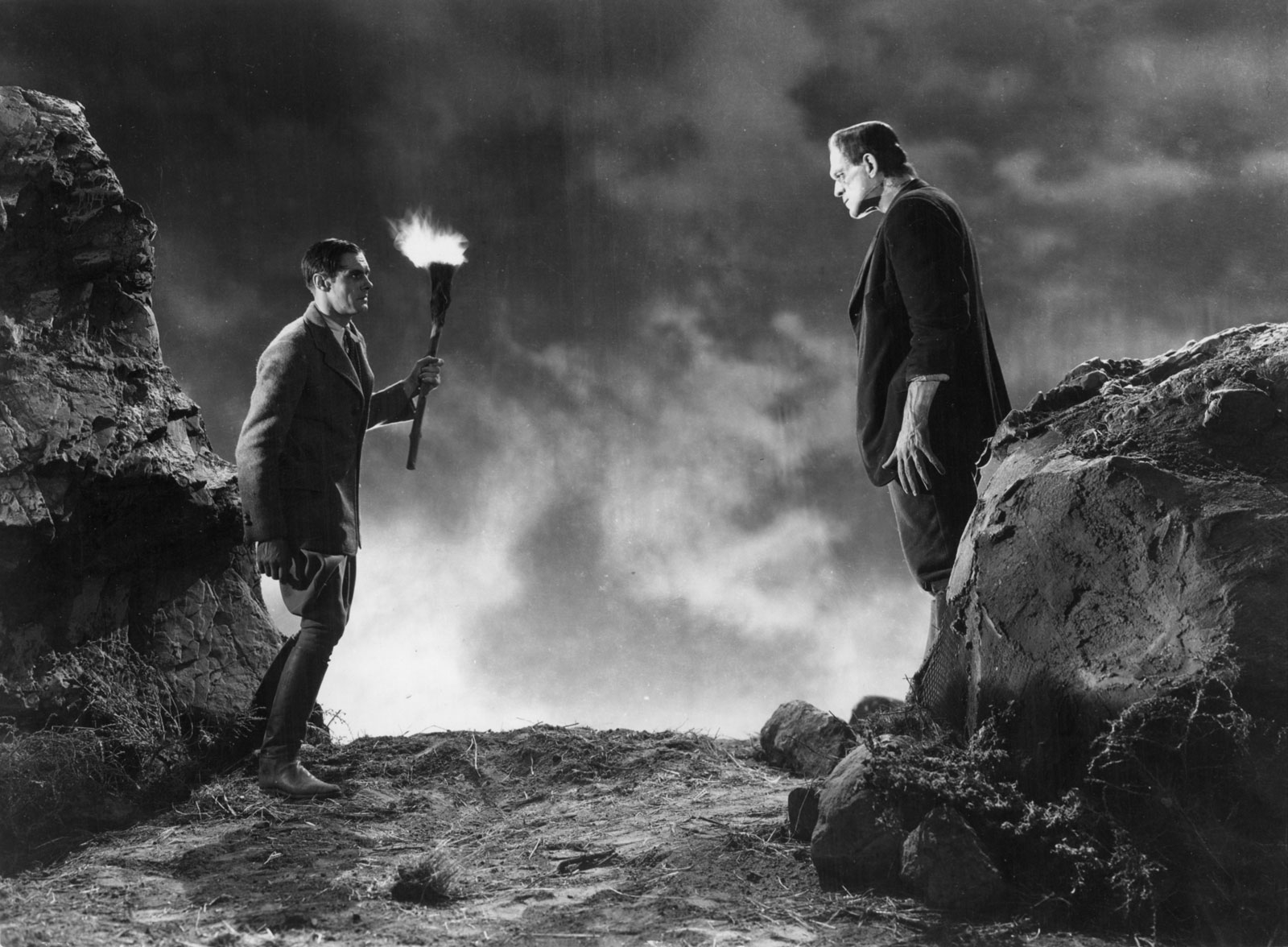
But towering above them all in the pounding hearts, toad-squirming minds, and knocking knees of horror fan-dom is the story of "The Modern Prometheus" and the Monster to whom the public bequeathed his name. Frankenstein boasts odd beginnings. Written by Percy Bysshe Shelley's frail flower of a wife, aged 18 when she conceived it, during a Gothic night's creativity, "Frankenstein's" story and it's several graves-deep inner meanings had been a classic for decades. It had been filmed before (even by Thomas Edison), but Laemmle's production, directed by James Whale has emerged as the one with the biggest boots to fill.
It might be because of its introduction (reproduced above). Edward Van Sloan walks out onto the filmed stage and warns us of the subject matter to come and the blasphemous implications of a man not "reckoning upon God." It's a good tactic—a carnival barker's come-on—for rather than warn us away, it whets the audience's appetite for the terrors to come.
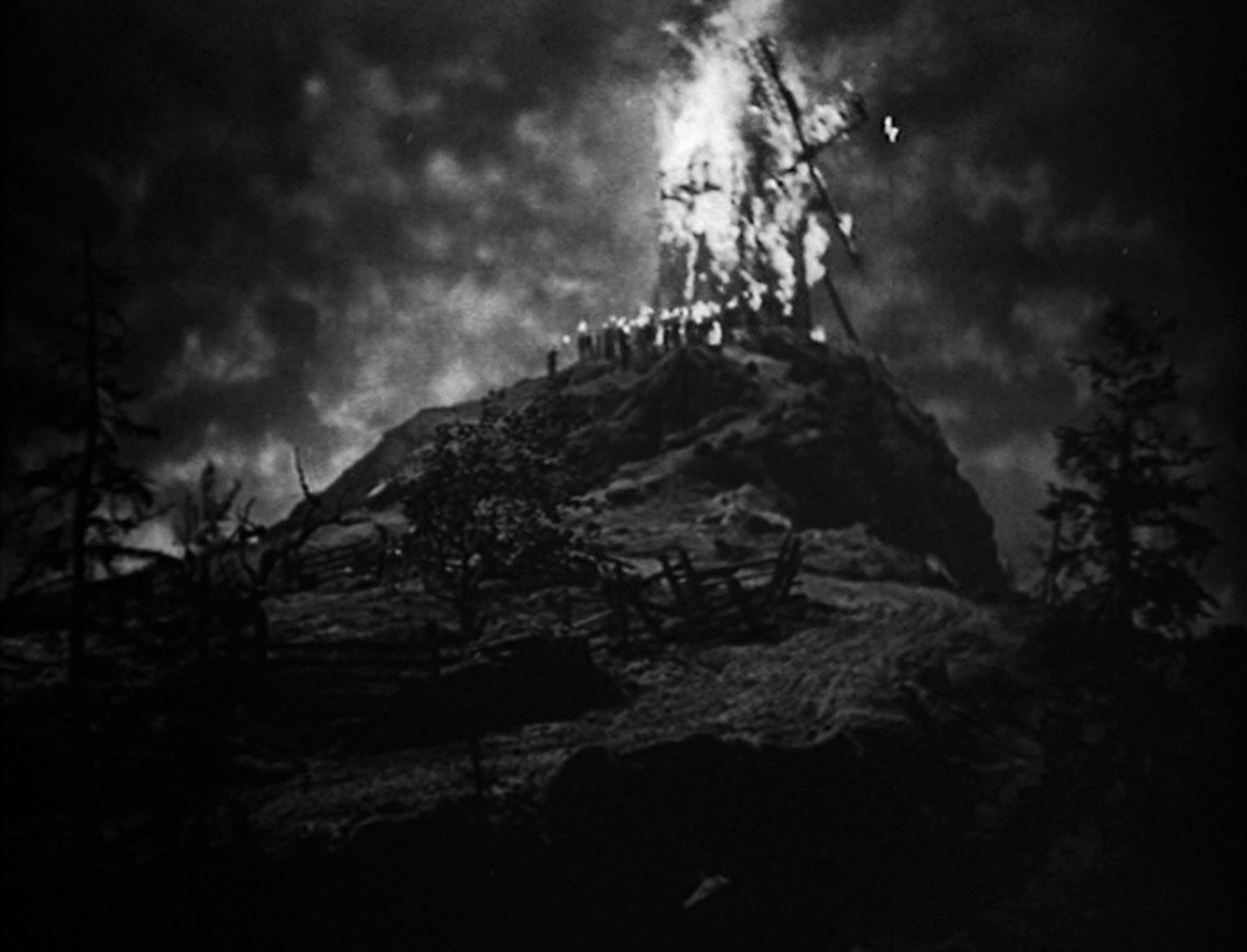
 And James Whale doesn't disappoint. Whale's life has merged with Legend (the movie Gods and Monsters), but his German-expressionism-influenced eye and sense of the absurd (which would come to full flower in the follow-up, The Bride of Frankenstein) created a sinister world of vast-shadowed hallways, spitting whirling laboratories, and castle chambers that resembled gargantuan funeral homes.
Before going on to the actors, homage must be paid to the craftsmen: Art Director Charles D. Hall, whose bizarre designs for the film give it its scale and majestic decay; and, of course, make-up artist Jack Pierce, who transformed a slight British actor named Karloff into a 7-foot, barrel-chested, electrode-studded,* flat-skulled (and copyrighted) hulk. There have been many subsequent designs for Frankenstein's piece-meal monster, but none have been so iconic as the Whale-Pierce-Karloff version.
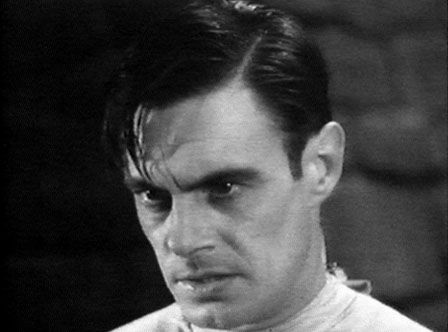
Karloff's contribution cannot be slighted—including his removal of an upper dental plate to give the Monster a dented, off-kilter face. But mention should be made of Colin Clive's hyper-bi-polar doctor (he was a wayward medical student in Shelley's tale), prone to manic exultation or fainting dead away in emotional extremis. The good doctor's a bad drama queen. As his house-keeper would say in the sequel, he's a queer fellow.

There's another reason to celebrate the longtime classic-ness of James Whale's Frankenstein. It and it's sequel The Bride of Frankenstein may be two of the greatest gay-themed movies to come out of straight, Hayes Code mainstream Hollywood. I had a film professor who was studying Bride and told of his curiosity about the air of exoticism in the first two "Frankenstein" films, when that "queer" line came out, it was the lightning-bolt that was the key. What is Frankenstein and The Bride of Frankenstein except the story of a man (or two men in Bride, with Frankenstein and Professor Pretorius collaborating) trying to by-pass God (and women) to give birth.**

The melancholy cruelty of Nature and mob-hysteria towards the different permeates both of Whale's "Frankenstein" films,*** and turns Monster into mirror, a figure of identity rather than horror, and occurs whether the audience is gay or straight. There's a reason the shunned figure of Frankenstein's Monster resonates: he's an outcast, yearning but misunderstood, tortured, but sympathetic. And though kept prisoner in a castle dungeon rather than a closet, he would emerge sequel after sequel, never vanquished—indomitable—his super-human will-to-live allowing him to see another day. As they say in Jurassic Park, "Life will find a way."
Frankenstein is one gifted director's roaring protest against the Nature of Things ... and man's intolerance.
* One of the basic copy-rights of the Universal design are the electrodes sticking out of the Monster's neck. Though "Frankenstein," the story, is in the public domain--one of the main reasons Francis Ford Coppola produced a version years ago--and anyone can do a re-make, those electrodes, and the rest of the make-up design, are the commodity of Universal Pictures. When Mel Brooks made his Young Frankenstein in the 70's, he by-passed the neck-studs...with zippers.
**When he presented his theory in class, one of the students remarked "That's kind of mind-blowing..." to which he replied, "I'm glad you said 'mind...'"
*** Christopher Isherwood also used Frankenstein and Pretorius (dubbed "Polidori") to create a more homo-erotic version of the story...for NBC television...when he wrote the teleplay for "Frankenstein: The True Story"
 Dracula (Tod Browning, 1931) Filmed version of the stage-play* featuring its matinee-idol, Bela Lugosi. As with "Frankenstein," there had been other versions of Count Dracula's British Invasion, including one (Nosferatu by F.W. Murnau) that got around copyright issues by calling its "vampyre" "Count Orlok."** As with Universal Picture's earlier productions of The Phantom of the Opera, The Hunchback of Notre Dame and The Man Who Laughs, the film is heavy on theatrics, but, this time, is a bit lean in the make-up department, although Lugosi did wear painful silvered contact lenses to enhance his seductive glare. Lugosi's elegant monster, with his slash of a mouth, and eyes wide open while balefully squinting with a laser-like intensity manages to still evoke "the creeps" to this day.